


I arrived in Morondava on a late afternoon flight from Antananarivo, expecting a sleepy coastal town that existed mainly as a launchpad for the Avenue of the Baobabs and the Tsingy de Bemaraha. I had booked four nights, a local driver with a 4x4 for two of those days, and a hotel on the beach in Nosikely that looked perfect in photos. What I did not expect was how much time would disappear into dirt roads, how the town’s own rhythm would get under my skin, and how a few simple planning mistakes would shape my experience of Madagascar’s western gateway far more than any Instagram shot of a baobab.
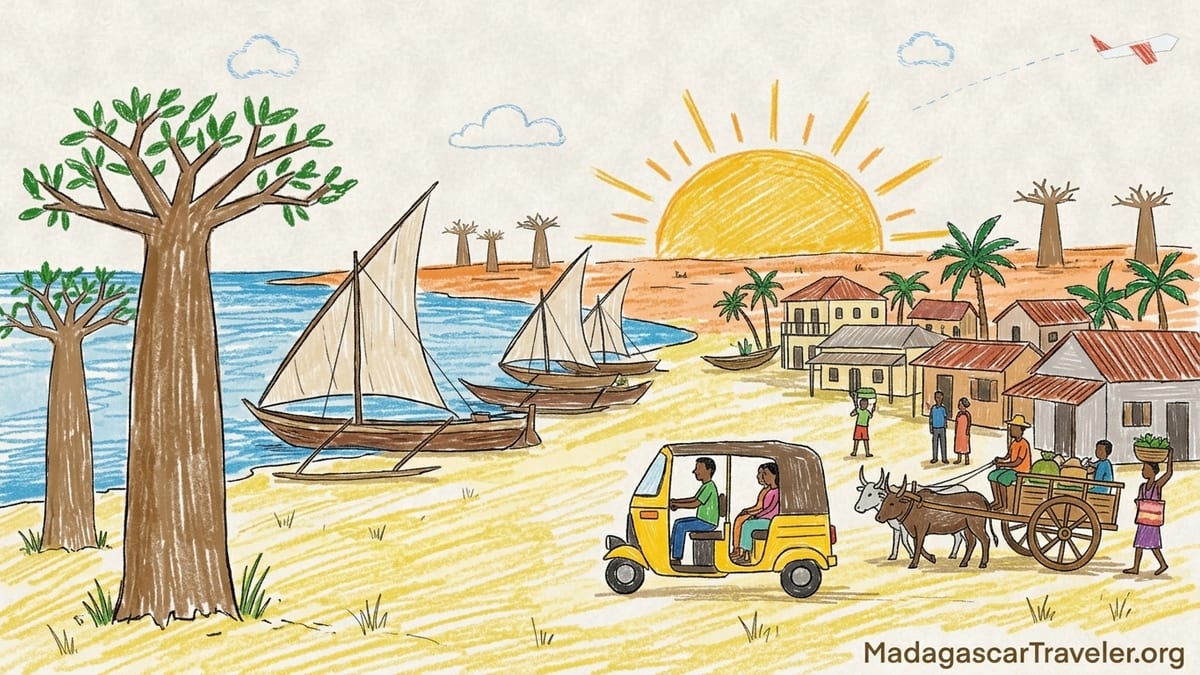
Arriving in Morondava: First Impressions of the Western Gateway
The first hint that Morondava was different came before we even landed. From the plane window, the coastline unfolded as a strip of sandy beach framed by palm trees, with the town spread low and wide behind it. There were no high rises, only tin roofs and a scattering of larger hotels near the water. As we descended, the pilot traced the line of the coast, and the famous baobab silhouettes appeared inland like scattered matchsticks on a dusty canvas. It was a clear reminder that in western Madagascar, distance on the map is never the full story; terrain, dust and a lack of paved roads all do their best to slow you down.
Morondava’s small airport is efficient but refreshingly informal. We walked off the plane onto the tarmac and into a simple terminal where luggage is delivered by hand. Outside, a row of local taxis waited, along with a handful of drivers holding signs for guests heading directly toward the baobabs or north to Kirindy Forest. Taxi fares from the airport into town are usually discussed on the spot and are commonly in the range that independent travelers report as a few U.S. dollars equivalent, depending on distance and bargaining. I had prearranged a pick-up through my hotel, which removed the negotiation but, as I later learned, cost a little more than flagging a car on arrival.
The drive from the airport into central Morondava is short, typically around 15 to 20 minutes. It passes small roadside stalls, children playing football in sandy patches, and the occasional baobab standing lonely against the sky. The first thing I noticed was the light: a soft, almost golden tone that becomes more intense toward sunset. The second was the dust. Even in dry season, Morondava’s streets carry a fine layer of reddish powder that rises when cars pass, settles on shop awnings, and gives everything a slightly hazy look by late afternoon.
I had chosen to base myself in Nosikely, the peninsula-like strip just south of the town center where many of the long-standing hotels and restaurants hug the beach. It seemed ideal on paper: sunsets over the Mozambique Channel, seafood grills within walking distance and quick access to the main road heading north. In reality, this choice shaped my days more than I expected, for better and for worse. Nosikely’s beachside calm was wonderful, but being a little removed from some everyday services and transport options added extra steps to already full days of exploring.
Understanding the City: Streets, Markets and Coastal Life
Morondava quickly revealed itself as more than a mere staging post. The central streets form a modest but busy grid, with the main market acting as a noisy, colorful anchor. Mornings begin early. By 6:30 a.m., vendors are already stacking tomatoes and onions, selling baskets of small fish and arranging pyramids of rice. The market alleys are narrow, with tarps stretched overhead for shade, and the air is a mix of charcoal smoke, dried shrimp and ripe fruit. I wandered through before my first excursion and realized that I could easily have spent a few hours here, just watching daily life and snacking on fried bananas.
Further toward the coast, Morondava’s character softens. In Nosikely, sandy lanes lead to low-key hotels, beach bars and simple restaurants with plastic chairs spilling towards the shore. The beach itself is wide and gently shelving, used more by locals than by tourists during the heat of the day. Fishing pirogues pulled up on the sand, children splashing in the shallows and groups of teenagers practicing dance routines near the waterline gave the area a relaxed, communal feel. By mid-afternoon, when the sun slows most activity, it is one of the few places where catching a sea breeze makes the heat bearable.
Heat in Morondava is not a subtle thing. In the dry season, daytime temperatures often sit somewhere in the high twenties to low thirties Celsius, with very strong sun. Away from the waterfront, the town can feel oven-like by early afternoon, especially on the main roads where shade is limited and the dust reflects the light upward. Most locals adapt with a long midday pause. Shops stay open, but the pace of life noticeably slows. For visitors, this makes a strong case for planning active exploration early in the morning and late in the afternoon and surrendering the mid-day hours to rest or a slow lunch.
Evenings in Morondava are surprisingly gentle. I had expected more bustle, more music and more street life, but found a quiet rhythm instead. A handful of restaurants in Nosikely and around the Baobab Café area in town do steady trade, serving grilled zebu, fish of the day and rice-based dishes, often in the equivalent of 5 to 15 U.S. dollars range for a main course in 2025 and 2026. Beyond that, the streets grow calm by 9 or 10 p.m. There are a few bars with live music on weekends, but Morondava is not a party town. Walking back along the beach after dinner, with only the sound of waves and the occasional motorcycle on the road, I understood why many travelers leave saying they wish they had added at least one full day just to absorb the atmosphere.
Getting Around Town: Local Transport, Heat and Hotel Logistics
Navigating Morondava means embracing small, simple forms of transport. Regular taxis are present but not in endless supply, especially later in the evening. During the day, three-wheeled tuk-tuk style vehicles known locally as bajaj buzz along the main routes, along with bicycle rickshaws and a steady stream of motorcycles. For short hops between the market, bus station and central hotels, these are the easiest and most affordable way to move, with many travelers reporting single-ride prices that equate to one or two U.S. dollars after a brief negotiation.
I made my first mistake by assuming I could always find a ride instantly from Nosikely into town and back. During daylight that was mostly true. In the evening, however, I sometimes had to wait or walk a while along the main road before finding a tuk-tuk willing to run me back to the beachside area. If you are staying further south along the peninsula, in one of the more secluded bungalow hotels, this extra distance is very pleasant by day but can make returning from dinner venues in town a bit more complicated than it looks on a map.
Choosing a hotel in Morondava is as much about logistics as it is about scenery. The cluster of long-established options in Nosikely places you directly on the beach and within walking distance of a few good restaurants and simple shops. Staying closer to the market and main taxi-brousse station, on the other hand, makes early-morning departures noticeably easier. When I planned my trip, I treated these areas as essentially the same, separated by what looked like a compact stretch of town. In practice, the combination of heat, dust, and the need to hail transport turned what I thought would be a casual stroll into something I mostly avoided during peak sun.
Another factor is electricity and water reliability, which can fluctuate, particularly in high season when demand spikes. Most mid-range and better hotels in Morondava are prepared for this with generators or backup systems, but it is worth asking in advance how they handle outages and whether fans or air-conditioning will still function at night. After a day on dusty roads, a working shower and a cool room become more than just comforts; they are what keep you willing to get up at dawn and do it all again.
Morondava as a Base: Time, Distances and Classic Excursions
The biggest lesson from my time in Morondava was that the city really is both an interesting place in its own right and a practical base for western adventures, but only if you respect the distances and road conditions. On a map, the Avenue of the Baobabs is roughly 20 kilometers from town. Kirindy Forest sits perhaps 50 to 60 kilometers north along the same general route. The ferry crossing to Belo-sur-Tsiribihina, on the way to Tsingy de Bemaraha, lies further again. None of these numbers sound intimidating. On the ground, those kilometers pass in a slow choreography of potholes, sandy patches and occasional delays.
For the Avenue of the Baobabs itself, the road from Morondava is mostly straightforward during the dry season. Local taxi-brousse vehicles and private taxis make the run daily, and current local accounts indicate shared bush taxis from Morondava to the baobab area typically cost somewhere between the local currency equivalent of a few to several U.S. dollars per person each way, with journey times of around 30 to 45 minutes, depending on conditions. Many visitors, including me, choose to hire a taxi or 4x4 privately, combining the avenue with a wider loop or timing it for sunrise or sunset. This offers flexibility but comes at a higher cost, especially if used over multiple days.
Kirindy Forest, by contrast, demands more commitment. The reserve is commonly described by Malagasy tour operators as sitting around two hours from Morondava by 4x4 during the dry months, despite being only some dozens of kilometers away. The road transitions from tarmac to dirt, with corrugations and soft patches that slow even experienced drivers. Most itineraries treat Kirindy as a full-day or overnight excursion: an early morning departure from Morondava, daytime wildlife viewing, nocturnal walks after dark and either a late return or a night in one of the modest lodges near the forest. Trying to squeeze Kirindy into a half-day from Morondava will usually leave you chasing the clock and missing the best wildlife moments.
Further afield, the legendary Tsingy de Bemaraha and the Tsiribihina River define the outer reach of Morondava’s sphere. Official and operator information converges on the same reality: reaching Bekopaka, the gateway village for the Tsingy, takes two full days by 4x4 from Morondava with at least one ferry crossing and rough tracks that can become impassable in the wet season. Real-world quotes from travelers in 2025 and 2026 show that hiring a vehicle and driver for this multi-day loop often runs into many hundreds of euros equivalent when fuel, driver, park fees and lodging are all considered. Morondava sits at the start of this journey, but it is not a place from which you casually pop up to the Tsingy and back in a day or two.
Lessons from the Road: Mistakes, Surprises and What I Would Change
My biggest mistake was treating Morondava primarily as a one-night gateway, at least on paper. Before arrival, I penciled in just enough time for a sunset at the baobabs and a quick overnight in town before heading north. Airline schedules and the reality of travel nudged me into four nights, and that accident turned out to be my saving grace. Having a buffer meant that delays on the road, slow lunches and long dusk drives back from Kirindy did not destroy my plan. It also allowed for one slow day enjoying Morondava itself, which became one of the most memorable parts of the trip.
I also misjudged the impact of road time. On my first day trip, I tried to combine a morning in town, a late afternoon at Avenue of the Baobabs and exploratory planning with my driver for the Tsingy route. By early afternoon I realized that just reaching the baobab avenue, walking among the trees, waiting for the light to soften and then returning to town would easily occupy half a day, even with a private vehicle. The compound effect of dusty roads, slow-moving local traffic and short photo stops added up, and we pulled back into Nosikely well after dark.
Another lesson came from my choice of hotel location. Staying on the beach was wonderful for sunsets and sea breezes, but it added a layer of logistics to every early start. On the day we headed toward Kirindy, we needed to be on the northbound road at first light to maximize wildlife viewing and reduce driving in the hottest hours. That meant arranging a very early breakfast, loading the vehicle while the beach was still quiet and factoring in the time to navigate from the peninsula through town to the main road. Friends who stayed nearer the market had an easier time with these pre-dawn departures.
Finally, I underestimated how much Morondava deserved time of its own. My initial plan was to see the market in passing and focus most of my energy on the iconic attractions beyond town. In practice, an unscheduled afternoon spent wandering the back streets, watching pirogues come and go, and talking with a Sakalava carpenter repairing a fishing boat did more to connect me with western Madagascar than any single viewpoint. The city rewards slow observation: the rhythm of schoolchildren walking home in uniform, the call to prayer carried faintly on the wind and the way shopkeepers pull wooden shutters closed at dusk all linger in memory long after the perfect baobab photo fades.
Beyond the Baobabs: Kirindy, Belo-sur-Mer and Longer Western Circuits
Morondava’s role as the principal departure point for Avenue of the Baobabs is well known, but its reach extends south and north along the coast and inland river systems. My own excursions focused on the baobab avenue and Kirindy Forest, with the longer Tsingy loop only partially explored due to time and budget. Still, conversations with guides and other travelers in town filled in a fuller picture of what is realistically possible from this base.
Kirindy Forest is perhaps the most accessible taste of western Madagascar’s dry deciduous ecosystem from Morondava. Visitors commonly see several species of lemurs, including the dancing Verreaux’s sifaka, along with reptiles and the elusive fossa if luck cooperates. Overnight stays in basic lodges near the forest allow for both daytime and nocturnal walks, which significantly increase wildlife sightings. Most travelers I met either arranged this through a Morondava-based operator or negotiated directly with drivers waiting near central hotels, with day-trip prices for a 4x4 and driver, excluding park fees and lodging, often running into the equivalent of a substantial but manageable portion of a daily budget for a couple or small group.
To the south, Belo-sur-Mer offers an entirely different experience: a remote-feeling Vezo fishing village, mangroves, shallow turquoise water and traditional wooden boatbuilding. Access, however, is highly dependent on tides, boat availability and seasonal weather. In the dry season, small motorized boats and occasionally 4x4 vehicles run between Morondava and Belo-sur-Mer, with travel times often quoted as a few hours in favorable conditions. The community offers several simple guesthouses and small hotels, but services remain basic compared with Morondava or Tana. If this extension appeals, it is wise to build in flexibility and confirm locally, a day or two in advance, whether boats are running and at what times.
The longer classic circuits from Morondava tie these elements together with the Tsingy de Bemaraha and sometimes a Tsiribihina River descent. These trips usually stretch over a week or more, starting with Morondava as the coastal gateway, then moving north along rough tracks, crossing the Tsiribihina River on wooden ferries, spending nights in Belo-sur-Tsiribihina and Bekopaka, exploring the small and big Tsingy formations and looping back via the baobabs at sunrise or sunset. Group tours and private arrangements vary in comfort and cost, but every guide I spoke with repeated the same advice: do not underestimate how tiring the travel days can be.
Unlike some destinations where you can push hard for a few days and then rest, western Madagascar asks you to factor in fatigue as part of planning. The combination of heat, dust, limited shade during roadside stops and the constant vibration of 4x4 travel means that most travelers appreciate at least one more relaxed night back in Morondava at the end of a Tsingy loop. My own decision to keep Morondava as a base at both the start and end of my time in the west allowed a gentler landing after long days on the tracks.
Practical Planning: When to Come, How Long to Stay and Budget Realities
Looking back, I would treat Morondava as a multi-night destination rather than a technical layover. A good starting framework is at least three nights if you hope to see Avenue of the Baobabs well and make a meaningful excursion, and four to five nights if you are also attempting Kirindy or a short Belo-sur-Mer extension. This allows for arrival day logistics, one dedicated baobab visit in good light, a full day or overnight at Kirindy, and at least half a day to simply exist in Morondava itself without rushing.
Seasonality matters. Most operators and official sources describe the western region as best visited between roughly April and November, when the tracks are drier, river levels are more predictable, and the risk of heavy rains closing the road to the Tsingy is lower. I visited in the heart of the dry season and still found some sections rough enough that our driver slowed to a crawl. In the wet months, the same stretches can become extremely challenging or impossible. For travelers with fixed dates that fall at the edges of the dry season, building in extra spare days becomes even more important.
Budget expectations can catch first-time visitors off guard. On-the-ground reports and recent cost breakdowns suggest that a basic backpacker-style day in Morondava, staying in a simple guesthouse, eating at local eateries and using shared transport, can sometimes be managed in the equivalent of a few dozen euros or dollars. Comfortable beach hotels, restaurant meals in the mid-range, and occasional private taxi or 4x4 hire raise that significantly. Once you add multi-day 4x4 trips to Kirindy and especially the Tsingy, daily costs climb further, mainly due to fuel prices, vehicle maintenance and the remoteness of services along the route.
For my own stay, I spent relatively modestly in Morondava itself but allocated a substantial part of my budget to a two-day 4x4 arrangement that included Kirindy and multiple baobab stops. That choice limited what I could do afterward, but it also guaranteed flexibility and safety in areas where public transport is sporadic and slow. Speaking with other travelers, I noticed a pattern: those who tried to stitch everything together purely with taxi-brousse and ad-hoc rides often saved money but paid with uncertainty and lost time. Those who invested in at least one multi-day arrangement with a driver generally saw more and worried less, even if it meant trimming their overall itinerary.
The Takeaway
Morondava is more than the gateway its reputation suggests. It is an easygoing coastal town with its own daily rhythm, a market that hums from dawn, and a sandy peninsula where sunsets linger long after the sky has faded. It is also the logistical hinge on which many western Madagascar itineraries turn, from quick baobab visits to ambitious loops into the Tsingy and beyond. Treating it as a one-night technical stop underestimates both its charm and its importance in making the rest of the region work.
The lessons from my stay are simple but powerful. Give yourself time, both in Morondava itself and in the days you allocate for excursions. Respect the roads and the heat. Choose your base with early starts and evening returns in mind, not just with beach views in sight. Accept that hiring a 4x4 and driver, at least for the more demanding stretches, is not a luxury but often a necessity. And, perhaps most importantly, leave space for unplanned hours in town: a slow walk along the market streets, a coffee in the shade watching bajaj roll past, or a quiet sunset on the beach while pirogues drift home.
When I finally left Morondava, flying back east across the highlands to the bustle of Antananarivo, I realized that what stayed with me most was not the postcard-perfect alignment of baobabs at sunset, but the softer details: the warm, dry air when I stepped off the plane; the taste of freshly grilled fish with my feet in the sand; and the patient patience of drivers who know that in Madagascar’s west, no journey is as quick as it looks on a map. Plan carefully, expect things to take longer than you think, and Morondava will reward you with one of the most quietly compelling corners of the island.
FAQ
Q1: How many nights should I spend in Morondava?
Most travelers are happiest with at least three nights in Morondava, which allows for a dedicated baobab visit, one main excursion such as Kirindy, and some time to enjoy the town itself without rushing.
Q2: Is it possible to visit Avenue of the Baobabs without a tour?
Yes. You can hire a local taxi, arrange a private driver through your hotel, or take a shared taxi-brousse heading toward the north and get off near the baobab area, then walk or arrange a short secondary ride for the final stretch.
Q3: Do I need a 4x4 vehicle for the baobab avenue?
In the dry season, a 4x4 is usually not essential just to reach Avenue of the Baobabs. However, if you plan to continue to Kirindy or further north on dirt tracks, a 4x4 with an experienced driver becomes important.
Q4: What is the best time of day to visit the baobabs?
Sunrise and sunset are the most atmospheric times, with soft light and long shadows. Sunset is more popular and therefore busier, while sunrise is quieter but requires a very early start from Morondava.
Q5: Can I use Morondava as a base for Tsingy de Bemaraha?
Morondava is the main coastal gateway for trips to Tsingy de Bemaraha, but the park is not a day trip. Reaching Bekopaka, the access village, typically takes two full days by 4x4 each way, so plan on a multi-day loop.
Q6: Is Morondava safe to walk around at night?
Morondava generally feels calm after dark, especially in Nosikely and the central areas, though streets become quiet. As in any town, it is sensible to walk on main roads, avoid carrying obvious valuables and use taxis for longer distances after dinner.
Q7: What kind of budget should I expect in Morondava?
Costs vary widely. Simple guesthouses and local eateries can keep daily spending relatively low, while beach hotels, restaurant meals and private transport raise the budget. Multi-day 4x4 trips to Kirindy or the Tsingy are usually the largest single expense.
Q8: Are there ATMs and mobile coverage in Morondava?
Morondava has ATMs connected to major Malagasy banks, though it is wise to withdraw when you can as machines occasionally run out of cash or experience outages. Mobile coverage in town is generally good, but it weakens quickly on remote tracks.
Q9: Is it worth spending a full day in Morondava itself?
Yes. A full day gives you time to explore the central market, wander the sandy streets, enjoy the beach at Nosikely, watch fishing boats come and go, and soak up the gentle pace that you miss when you are always rushing to excursions.
Q10: How far in advance should I book drivers and hotels in Morondava?
In the main dry season months, it is wise to book your preferred hotel and any multi-day 4x4 arrangements at least several weeks ahead, especially if your dates are fixed. Day trips and short taxi hires can often be arranged locally a day or two in advance.