


I arrived in Morondava in late dry season specifically to see Kirindy Forest, the CNFEREF research and tourism area that has become Madagascar’s most famous place to look for fossa. I had read so many accounts that blurred it with Kirindy Mitea National Park, or treated it simply as a box to tick on a long western loop, that I wanted to experience the forest on its own terms. What follows is a precise account of how I actually traveled from Morondava to Kirindy Forest inside the Menabe Antimena protected landscape, what the road and trails were like, what the heat and insects felt like hour by hour, and which species I really did and did not see on both day and night visits.
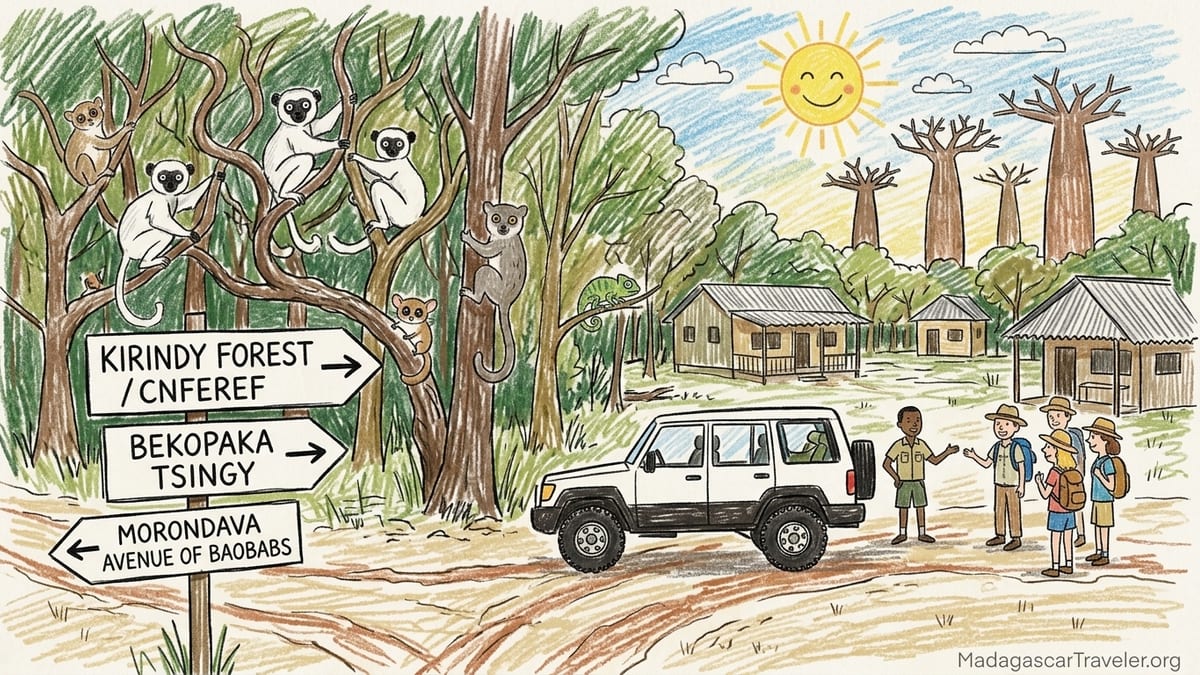
Kirindy Forest / CNFEREF, Not Kirindy Mitea
Before describing the journey, it is important to be clear about where I went. Kirindy Forest, often written as Kirindy / CNFEREF, is a dry deciduous forest about 60 kilometers north of Morondava. It sits inside the Menabe Antimena protected landscape and is managed as a forestry and research concession by CNFEREF, the National Centre for Training, Studies and Research in Environment and Forestry. It is reached via Route Nationale 35 out of Morondava and then the sand and laterite track of RN8, the same road that continues on toward Bekopaka and the Tsingy de Bemaraha.
This is not Kirindy Mitea National Park. Kirindy Mitea lies to the south, near Belo sur Mer, and protects a mosaic of coastal forest, dunes, mangroves and reefs reached by a different road and sometimes by boat. Tour itineraries and online posts very often mix the two, but on the ground they are separate destinations requiring separate logistics. When local guides in Morondava talk about fossa, night walks, and a forest stop combined with Avenue of the Baobabs, they mean Kirindy Forest / CNFEREF to the north, not Kirindy Mitea.
Within Menabe Antimena, Kirindy Forest forms one of the most intensively studied fragments. Research stations, long-term primate projects and monitoring programs operate here, which is why you see references to sifaka studies “at Kirindy / CNFEREF” in academic reports. For the traveler, that scientific presence translates into marked trails, regular guiding, basic but practical accommodation and relatively reliable access compared with more remote western sites.
Because of this confusion in names, many travelers think they have “done Kirindy” when they only skirted the southern national park coastline or, conversely, assume that a short forest visit means they have seen the marine habitats of Kirindy Mitea. In Morondava I quickly learned to specify “Kirindy Forest north, on the way to Tsingy” every time I spoke with drivers or hotel staff.
The Logistics: Departure Time, Vehicle and Road Conditions
I left Morondava for Kirindy Forest at 1:30 in the afternoon in a hired 4x4 with driver, arranged through my beachfront guesthouse the evening before. Prices in 2024 and 2025 for a private vehicle with driver on this route cluster around 100 to 150 euros for a full day including Avenue of the Baobabs stops, fuel and the driver’s time, and the quote I received sat roughly in the middle of that range. Cheaper per-person rates are possible if you join others, but every option still depends on a high-clearance four-wheel-drive vehicle. Even at the driest time of year the northern part of RN8 is sandy, deeply rutted and occasionally corrugated enough that a low car would struggle.
From Morondava we first followed RN35 for about 11 kilometers through low houses and rice paddies. After roughly twenty minutes we turned north onto RN8 at the signed junction for Bekopaka and Menabe Antimena. This is still the start of the same road that most Tsingy trips use. The surface changed immediately from asphalt to wide, beige laterite and sand. During the first dry-season months the top layer becomes a fine dust that the breeze lifts into a pale haze whenever a truck passes.
The total road time from my Morondava hotel to Kirindy Forest reception was just under two and a half hours, including one brief photo stop at Avenue of the Baobabs on the way out. Without stopping, many drivers report somewhere between 90 minutes and three hours depending on recent rain and how heavily the vehicle is loaded. My driver kept to a steady but not aggressive pace, slowing for clusters of zebu carts, schoolchildren and the deeper sand patches where the track braids into several parallel ruts.
By midafternoon the sun was still high and the light brutally bright. Even with the air flowing through the open windows the cabin grew hot enough that I was glad for a hat and water. There are a couple of small kiosks along RN8 that sell warm soft drinks and biscuits, but during my drive we passed them rather than stopping. If you are sensitive to heat or dust it is worth carrying a light scarf or buff to cover your face when other vehicles overtake and throw up a cloud of fine powder.
Arriving at Kirindy and Arranging Guides
Kirindy Forest’s tourism hub is a compact clearing with a reception hut, a handful of simple bungalows, a dormitory building and a restaurant that doubles as a meeting point for guides and researchers. We arrived a little before 4:00 in the afternoon. The air felt immediately heavier and hotter than in breezier Morondava. In the shade of the big trees near reception, my driver parked under a scattering of leaves while I checked in.
Guide arrangements here are straightforward. All visitors must enter the forest with an accredited local guide, and those guides are based at the site rather than traveling in with you. At reception I paid the entry fee and hired a guide for one late-afternoon walk starting at about 4:15 and a night walk after dinner beginning around 7:15. The rates posted on site and quoted consistently in recent trip reports put a single daytime or night walk at the equivalent of a few tens of euros for a small group, with separate conservation and access fees per person. Payment is in Ariary. My driver, like others I saw that day, stayed in the vehicle area while the resident guides handled all the forest interpretation.
There is no need to pre-book a specific guide for standard walks if you are staying overnight, but in high season groups arriving from Tsingy or Morondava can create short bottlenecks, especially at dusk when everyone wants a night walk. When a mid-sized tour group arrived as I was finishing my check-in, reception allocated different guides and staggered start times, so in the forest I never felt crowded.
What struck me immediately was that everything was designed for very simple, short loops. Unlike some of Madagascar’s steeper parks, Kirindy Forest around the lodge area is almost entirely flat, and the network of trails radiates out like spokes through dry, open understorey. That makes the site accessible to a wide range of fitness levels, but it also means that the quality of your visit depends heavily on the sharp eyes and local knowledge of your guide rather than on reaching some remote viewpoint.
Daytime Walk: Sifakas, Heat and Quiet Forest
My daytime visit began around 4:15 in the afternoon, chosen deliberately so that the worst of the mid-day heat had passed but there were still several hours of light. Temperatures earlier in the day had pushed into the low thirties Celsius in the clearing, high enough that even slow movement under the direct sun felt draining. By late afternoon, however, the low canopy cast broad pools of shade across the path and the forest felt dry and warm but manageable.
Trail conditions were easy. Underfoot the ground was firm, baked laterite and leaf litter with the occasional root. I wore light trail shoes but many visitors managed in normal trainers or sturdy sandals. There were no serious inclines or river crossings on the loops closest to the lodge. Insects during this daytime walk were noticeable but not aggressive. A few flies hovered around any sweat-damp clothing, and there were occasional mosquitoes in still pockets of shade, but repellent and long sleeves kept them from becoming more than a background irritation.
Wildlife activity in the first half hour was subtle. We heard distant bird calls and the dry crackle of leaves but saw only a pair of Coua birds and a Madagascar magpie robin flitting ahead on the path. Then, near a slightly more open patch of forest, my guide paused and scanned the canopy. A small group of Verreaux’s sifakas moved slowly through the mid-level branches, their white fur and dark faces unmistakable against the rust-colored bark. One adult and a half-grown youngster crossed a low gap directly above the trail, pausing long enough that we could watch them groom and stretch. The guide positioned us carefully to avoid blocking their path, and for ten minutes the only sound was their quiet rustle as they climbed.
That was the only sifaka encounter of the afternoon, but it felt intimate and unhurried. We did not see any red-fronted brown lemurs during this daylight walk, nor any diurnal sportive lemurs, which some visitors report asleep in tree cavities if a guide knows their resting sites. I preferred that my guide focused on animals we could actually observe rather than reciting a list of potential species. By 5:45 the light began to soften, shafts of orange filtering through crooked branches, and we walked back to camp as large chameleons and nocturnal geckos started to stir but were not yet active enough to see clearly.
Night Walk: Mouse Lemurs, Sportive Lemurs and Insects
After an early dinner in the open-sided restaurant, where a single dim bulb attracted a drifting halo of insects, I met the same guide at 7:15 for the night walk. The air remained warm, close to the high twenties, and without the daytime breeze the forest felt more humid. I wore a light long-sleeved shirt and trousers to manage mosquitoes, plus a headlamp with a red filter that the guide requested to reduce disturbance when we were close to animals.
The night trail followed a different loop from the daytime route but used the same style of flat, sandy paths. Immediately the forest felt transformed. The beam of the guide’s lamp picked out the reflective eye-shine of small creatures in every thicket. Only a few minutes from the lodge he stopped and angled his lamp to reveal a greyish-brown sportive lemur clinging vertically to a trunk. The lemur watched us with wide, orange eyes, its body tense but not bolting. We observed it for perhaps two minutes as it shifted slightly higher up the tree, then the guide dimmed the light and we moved on, leaving it still in place.
Further along the path the guide located the first mouse lemur of the evening. These are tiny animals, little more than a handful of fur and a tail, and without an experienced eye you would walk past them. This individual sat lower, in a shrub at about chest height, licking sap or insect secretions from the surface of a leaf. Its movements were quick and nervous, darting around the twigs in a blur. We saw at least two more distinct mouse lemurs during the hour and a half walk, though it was hard to be certain they were different animals rather than the same one circling us in the undergrowth.
Reptiles were present but more discreet. On a narrow side path the guide located a small sleeping chameleon, pale against the branch where it had curled for the night. Its sides moved rhythmically with its breath and it barely reacted as we approached. We did not find any snakes or the locally noted giant jumping rat during this specific walk, though other guests in camp who had gone out slightly later that same night reported a jumping rat crossing the vehicle track. The absence of those species on my walk underlined how variable any single visit can be.
Insects at night felt more intense than by day. Moths threw themselves repeatedly at our headlamps, and small beetles landed on bare skin whenever we stopped. Mosquitoes became noticeable in the more enclosed sections of trail, especially where stagnant puddles from earlier rains lingered. With repellent and light clothing the annoyance remained manageable, but I would not have enjoyed the walk in shorts. By about 8:45 we were back at the lodge, where the generator hummed and a few geckos hunted around the restaurant lights.
Fossa: What I Did and Did Not See
One of the central questions for many visitors to Kirindy Forest is whether they will see a fossa. This medium-sized, cat-like predator has become a symbol of the site, and several tour operators and guides mention Kirindy as the “best place in Madagascar to see fossa,” particularly in the late dry season when animals often pass through the lodge area. I arrived in that same general window, but I want to be precise: on my own walks I did not see a fossa in daylight or on the night trail inside the forest.
The closest I came to a fossa encounter was on the return from the night walk, when another guide returning slightly behind us called quietly and pointed toward the vehicle track near the kitchen outbuilding. By the time we turned, the animal they had glimpsed had already disappeared into the dark beyond the clearing. The next morning several people at breakfast described waking early to find clear fossa footprints in the sand near the chicken enclosure and said that on the previous week’s visits one animal had trotted through the open space at dawn. Those were their reports, not my direct observation.
Because I did not personally see a fossa, I will not describe its behavior or appearance beyond what is visible in any field guide or documentary. Kirindy Forest’s reputation for fossa is real and is supported by long-term research and field data, but even in the right season a one-night visit can miss the animal entirely. That is important for readers planning around a single, tightly scheduled day trip from Morondava. You might see a fossa in one lucky afternoon, but it is far from guaranteed.
What this meant in practice was that my wildlife experience focused more on lemurs, birds and the general atmosphere of the dry forest than on any dramatic predator sighting. I left Kirindy with a strong sense of the habitat and a memorable sifaka encounter, but without the headline species that many associate with the site. Travelers who absolutely prioritize seeing a fossa in the wild will likely want to build in at least two nights at or near Kirindy to increase their chances, accepting that even then nature does not work to order.
Heat, Comfort and the Case for an Overnight Stay
Spending the night at Kirindy, rather than attempting a full Morondava round-trip in a single day, changed the rhythm of my visit completely. Heat was a major factor. Midday in the dry season felt punishing both in the open clearings and under the somewhat sparse canopy. Had I tried to drive out from Morondava at 7:00 in the morning, walk in the forest from late morning through early afternoon, and then drive back for a sunset baobab stop, I would have spent nearly all the most uncomfortable hours of the day in motion under strong sun.
By staying overnight I could time my activities to the more pleasant windows. My first walk began in the late afternoon as the heat slowly bled from the air, and my night walk took advantage of the relative coolness after dark, even if the humidity still felt present. The following morning, I had the option of a short early walk before breakfast when light is gentle and animals are often most active. Many current local itineraries use that pattern: leave Morondava in the afternoon, stop briefly at Avenue of the Baobabs for photos, sleep at Kirindy, then take a morning walk and return to Morondava via another stop at the baobabs.
Comfort at the lodge was simple but adequate. My bungalow had a concrete floor, mosquito net over the bed and a fan that ran while the generator operated in the evening. Showers were cold and refreshing after hot, dusty walks. There were gaps in the wall planking and roof that allowed insects inside, but under the net I slept well. Electricity shut off later in the night, leaving the site in deep darkness punctuated by stars and the occasional call of distant owls.
From a value perspective, doing both daytime and nocturnal visits did justify the overnight in my case. The day and night forests felt like two different places, and I would have missed that contrast in a rushed day trip. The flexible timing also provided more overall wildlife viewing hours without compressing them into the hottest and most crowded parts of the day. I returned to Morondava the next day at a relaxed pace, stopping again at Avenue of the Baobabs in soft late-afternoon light instead of trying to chase a single perfect sunset at the end of an exhausting round-trip.
Comparing Day Trips with Overnight Tours from Morondava
Current tour products in Morondava present visitors with a very specific commercial choice. On one hand are full-day excursions that leave town early, drive straight to Kirindy Forest, include one guided walk, then return to Morondava with photo stops at Avenue of the Baobabs, usually timing either the outward or return leg for golden hour. On the other are two-day programs that look similar on a map but build in a night at Kirindy, sometimes with an additional night further north toward Tsingy.
The day trips appeal because they fold several headline experiences into a single calendar day. You wake up in a hotel room by the sea, travel in a 4x4 along RN35 and RN8, walk in a famous forest, and still stand among the baobabs at sunset before returning to town. The costs per person fall once the price of the vehicle and driver is split among three or four travelers. These are the tours many visitors book on arrival in Morondava when they only have a narrow window in their itinerary.
Yet, after completing an overnight version, I found it hard to imagine compressing the experience into one long day. The two and a half hours of road time each way, combined with the necessary rest and meal breaks, would have left perhaps three or four hours for actual forest time. In the heat of the dry season that window could easily straddle the quietest hours of animal activity. A single walk would probably be daytime only, with no chance for night wildlife unless you accepted a very late and tiring arrival back in Morondava along a dark, dusty RN8.
By contrast, the overnight gave me one late-afternoon walk, one night walk, and the option of one early-morning walk, spreading my effort and increasing the range of species and behaviors I could observe. Even without a fossa sighting, that combination felt much more satisfying. For travelers with only a few days in the western region, I would still recommend allocating at least one night at Kirindy if budgets and schedules allow, even if that means sacrificing a second night in Morondava itself.
The Takeaway
My trip from Morondava to Kirindy Forest / CNFEREF was defined as much by logistics and conditions as by wildlife. I left town in mid-afternoon in a hired 4x4, spent around two and a half hours on a dusty combination of RN35 and RN8, checked in at a simple forest lodge and arranged separate resident guides for late-afternoon and night walks. Trail conditions were flat and easy, the heat was real and at times draining, insects were present but manageable with basic precautions, and the animals I actually saw were modest in number but memorable in character.
In concrete terms I watched a small group of Verreaux’s sifakas move calmly through the canopy at close range in the late-afternoon light, observed a sportive lemur clinging to a trunk at night, followed several tiny mouse lemurs in the undergrowth, and admired a sleeping chameleon’s pale outline on a twig. I did not see a fossa myself, despite visiting in a season and at a site where they are genuinely present. That absence shaped how I think about recommendations. Kirindy Forest is not a guaranteed fossa show, but a textured dry-forest experience whose value lies in its atmosphere, its research presence and the contrast between day and night in a fragile, threatened habitat.
Most importantly, staying overnight rather than returning to Morondava the same day let me distribute my limited energy across the cooler, more wildlife-rich hours. It allowed for both diurnal and nocturnal visits without compressing everything into one overheated sprint. When I watched the dust hanging golden between baobab trunks on the way back to town, I felt I had engaged with Kirindy Forest more deeply than if I had simply passed through on the way to somewhere else. For travelers weighing that same decision, this is the trade-off in real terms: a longer but richer experience in the forest, with honest expectations about what you may and may not see.
FAQ
Q1. Is Kirindy Forest the same place as Kirindy Mitea National Park?
Kirindy Forest / CNFEREF north of Morondava is a dry deciduous forest and research concession inside the Menabe Antimena landscape. Kirindy Mitea National Park lies to the south near Belo sur Mer and includes coastal forest, dunes and marine areas. They are separate sites reached by different roads.
Q2. How long does the drive from Morondava to Kirindy Forest actually take?
The distance is about 60 kilometers, and in dry conditions the drive in a 4x4 takes roughly two to three hours each way, depending on recent rain, vehicle condition and how often you stop for photographs or villages along RN8.
Q3. Do I really need a 4x4 to reach Kirindy Forest?
Yes, in practice almost all visitors use a high-clearance four-wheel-drive vehicle. The northern section of RN8 is sandy and rutted, and while it may be passable for a sturdy truck in the driest months, a standard low car is likely to struggle, especially after rain.
Q4. Is an overnight stay at Kirindy worth it compared with a day trip?
For many travelers it is. An overnight allows a late-afternoon walk, a guided night walk and an early-morning walk, spreading your effort into cooler hours and increasing your wildlife viewing time. A day trip from Morondava can work if you are short on time but offers fewer chances to see nocturnal species.
Q5. Will I definitely see a fossa at Kirindy Forest?
No, there is no guarantee. Kirindy has some of the best odds in Madagascar for fossa, especially in the late dry season around the lodge area, but even in good periods a one-night visit can miss them entirely, as mine did.
Q6. What kind of wildlife did you personally see on your visit?
On my daytime and night walks I saw Verreaux’s sifakas, at least one sportive lemur, several mouse lemurs, a sleeping chameleon and a range of forest birds. I did not see red-fronted brown lemurs, giant jumping rat, snakes or fossa during my specific walks.
Q7. How bad are the insects at Kirindy, and what should I bring?
Insects were noticeable but manageable. There were flies and some mosquitoes in the day, and more mosquitoes, moths and beetles at night. Long sleeves, trousers and an effective repellent were enough to stay reasonably comfortable on the trails and around the lodge lights.
Q8. Are the trails at Kirindy difficult or steep?
The main visitor trails around the lodge are flat, sandy or packed earth paths with only small roots and leaf litter underfoot. There are no sustained climbs near the accommodation area, so most people with average fitness can complete the standard loops at a relaxed pace.
Q9. How do you arrange guides for walks in Kirindy Forest?
Guides are based at the site itself. On arrival you pay entry and guiding fees at reception, and they assign a local guide for each daytime or night walk. You do not bring a guide from Morondava, and you cannot enter the forest without one of the resident guiding team.
Q10. Can I combine Kirindy Forest with Avenue of the Baobabs in one itinerary?
Yes. The access road RN8 to Kirindy passes directly through Avenue of the Baobabs, and most trips either stop on the way out from Morondava, on the way back, or both. Many overnight Kirindy itineraries use a sunset or sunrise stop at the baobabs to frame the forest visit.