


Reaching Morondava from Antananarivo is more than a simple transfer. It is a strategic decision that shapes your whole Madagascar itinerary, from how rested you feel at the Avenue of the Baobabs to how much risk you accept with domestic flights. On my last trip, I flew one way between Antananarivo and Morondava, then dug into the overland alternatives. Here is what I actually experienced door to door, and how it compares with the long road west.
Why Getting to Morondava Is a Bigger Decision Than It Looks
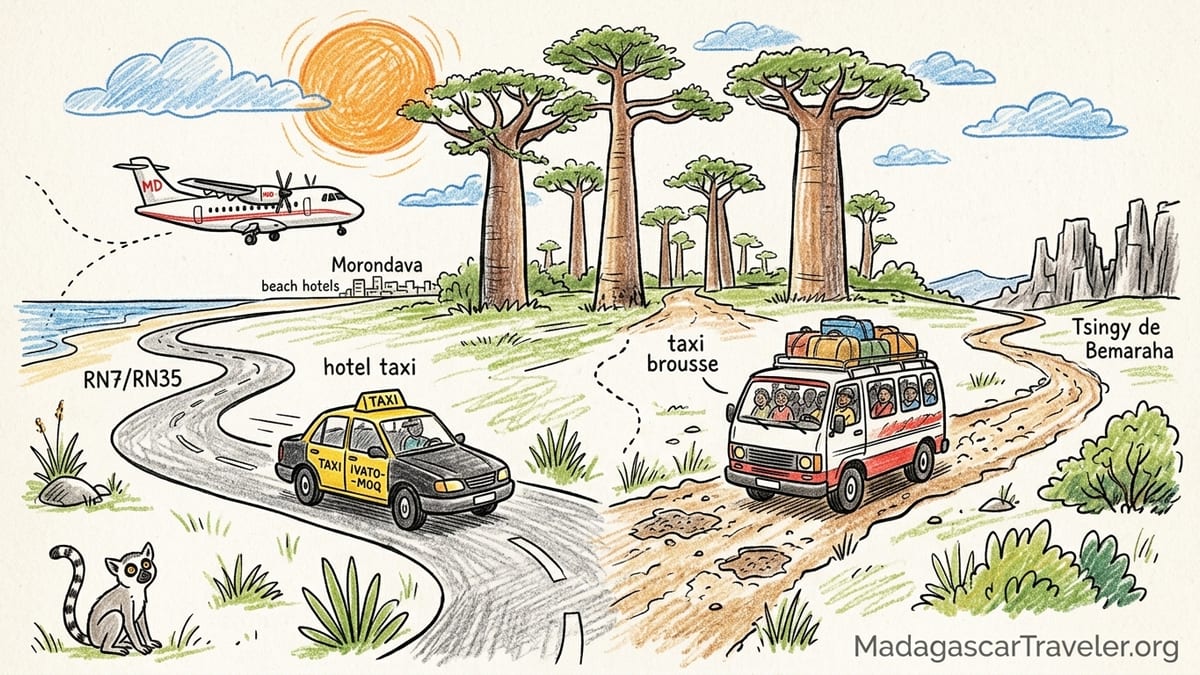
Morondava is the coastal gateway to some of Madagascar’s most photographed landscapes, especially the Avenue of the Baobabs and the road north to the Tsingy de Bemaraha. On a map it sits roughly 450 to 700 kilometers west of Antananarivo, depending on how you measure the route, connected by a patchwork of Route Nationale 7 and Route Nationale 35. In practice, that distance can feel very different depending on whether you take the air bridge or commit to a long road journey.
Domestic transport in Madagascar is improving but still fragile. Madagascar Airlines has been rebuilding its network and currently lists Morondava (airport code MOQ) in its domestic schedule from Antananarivo Ivato. A published timetable in April 2026 showed the Antananarivo to Morondava sector at about 1 hour 5 minutes in the air, which sounds wonderfully short compared with a full day on the road. However, in September 2026 the airline also warned of temporary fleet constraints that could force schedule adjustments, so reliability is part of the equation.
On the ground, the classic alternative is the taxi brousse system that fans out from Antananarivo’s western bus station toward Morondava and the west coast. Official and semi official information suggests a driving time that ranges widely, from about 12 hours on a good day to 16 hours or more if traffic, roadworks or breakdowns intervene, and some travelers report even longer when something blocks a key bridge or section. Choosing between these options is less about a simple price comparison and more about how much buffer you have in your trip.
I chose to fly from Antananarivo to Morondava and then explored what the road journey would have required. That combination gave me a realistic sense of total door to door timing, the true hassle of domestic flight changes, and the trade offs for travelers who might be on tighter budgets or building longer overland itineraries in the south and west.
My Door to Door Experience Flying Antananarivo to Morondava
For my flight, I booked Madagascar Airlines from Antananarivo Ivato to Morondava on a morning departure in the 06:30 time slot that has appeared in recent schedules. One official timetable from late 2025, for example, shows flight MD702 scheduled from 06:30 to 07:40 on some days, and the spring 2026 schedule that travelers shared with me quoted a block time around 1 hour 5 minutes. My flight followed a similar pattern and used a turboprop aircraft with a single economy cabin.
The real day, however, starts long before takeoff. I was staying in the Isoraka district of central Antananarivo, about 45 to 60 minutes from Ivato Airport in light morning traffic. I ordered a hotel arranged taxi for a 04:00 pickup. We reached the terminal at 04:50 after the usual crawl through the final approach to Ivato, and I was standing in the domestic departures hall by 04:55. From my hotel door to the first security check had already taken almost an hour.
Check in for domestic flights typically opens about two hours before departure. When I arrived, Madagascar Airlines had a staffed counter for Morondava and two other coastal destinations. Economy passengers queued in a single line. It took about 20 minutes to reach the desk. My checked bag weighed 17 kilograms, within the usual 20 kilogram economy allowance for domestic sectors; hand luggage limits were being enforced informally, more focused on size than on exact weight. By 05:20 my bag was tagged to Morondava and I had a printed boarding pass with an unassigned seat number that would later be allocated at the gate.
Security and departure formalities were straightforward but not quick. The domestic terminal is small, and with several morning flights clustered around the same time, the single security lane backed up. It took about 15 minutes to clear. After that I had roughly 45 minutes in the gate area. Boarding started about 25 minutes before the scheduled time and proceeded via buses out to the aircraft. The plane door closed about 10 minutes late, but we spent a further 10 minutes in a ground hold, so we were airborne roughly 20 minutes after the timetable indicated.
In The Air: A Short Hop With Outsized Consequences
Once we were in the air, the flight itself felt blissfully short. Flight time was just around one hour from wheels up to touchdown, consistent with the April 2026 published block time of approximately 1 hour 5 minutes. The cabin crew offered a simple drink service and a small snack, and the aircraft cruised low enough that views of the central highlands and the westward plains were clear on a sunny morning.
The real advantage of flying is how dramatically it compresses the experience of crossing Madagascar’s interior. One moment you are over the patchwork rice paddies outside Antananarivo, and an hour later you descend over sandy tracks and mangroves near Morondava. Looking down, the sinuous line of Route Nationale 35 is visible in places, reminding you that this same distance can represent a long, stop start day for those traveling by road.
On arrival in Morondava, the small terminal handled our turboprop efficiently. We parked on the apron and walked across to the building on foot. Despite the earlier late departure from Antananarivo, we touched down only about 10 to 15 minutes behind the schedule. I was in the baggage claim area within 5 minutes of leaving the aircraft, and my checked bag appeared on the single belt less than 10 minutes later. The entire arrival process felt quick and informal compared with larger airports.
From aircraft door to airport exit took no more than 20 minutes. Outside, a small cluster of taxis waited for arrivals. I negotiated a fixed price to my beachfront hotel in central Morondava, which took about 15 minutes along the town’s main road. By the time I dropped my bag in my room it was roughly 09:00. Counting from my 04:00 hotel pickup in Antananarivo, the door to door journey had taken about five hours, including check in, security, boarding, the flight, baggage reclaim and the short transfer into town.
Flight Costs, Schedule Changes and Real World Risk
Airfare is often the first question travelers ask. Exact fares vary by season and booking channel, and I will not quote a specific number that could become outdated quickly. Broadly, one way tickets on Madagascar Airlines for the Antananarivo to Morondava route in 2025 and 2026 have tended to sit in the range that many visitors would consider moderate for a domestic flight, especially compared with long haul tickets, but definitely significant compared with taxi brousse costs that are typically quoted in euros or tens of thousands of ariary rather than hundreds.
The bigger issue is schedule reliability. Madagascar Airlines has improved compared with some earlier years, but its own communications in September 2026 acknowledged temporary fleet constraints that might lead to schedule adjustments. That mirrors what many travelers report. Some describe smooth experiences from booking through to on time flights. Others recount last minute departure time changes or day of week shifts, including emails sent the day before travel advising that a flight had been cancelled and moved to another day, which then forced them to rearrange hotel bookings or accept shorter time in Morondava.
On my trip, I experienced a minor time shift rather than a major disruption. About one month before departure, the airline moved my original mid morning flight approximately two hours earlier. This required changing my hotel check out and booking an even earlier airport transfer. For me, that was an inconvenience rather than a disaster. However, if I had been trying to connect the Morondava flight directly with an international arrival or departure at Antananarivo, the risk profile would have been different.
This is why most experienced visitors treat the Morondava flight as an internal element of their itinerary, not a same day connection to or from their international flights. Online discussions in late 2024 and 2025 include several examples of travelers whose domestic sectors were retimed, leaving them with very tight connections. Others deliberately build a full buffer day in Antananarivo before their flight home, in case a domestic leg such as Morondava to Antananarivo is delayed or pushed to the next day. That buffer is part of the hidden cost of relying on flights.
The Overland Road: Taxi Brousse and Private Car From Antananarivo
To understand the alternative, I spent time at Antananarivo’s Gare de l’Ouest, the main departure point for taxi brousse services to Morondava and other western routes. Here, minibuses and larger vans line up under destination signs, and touts call out cities such as Morondava, Miandrivazo and Mahajanga. Several Malagasy language and French resources confirm that this is the standard hub for Morondava bound services and note the route via the national roads that peel away from Antananarivo toward the southwest.
A number of operators provide the Antananarivo to Morondava route by taxi brousse. Some specialize in basic seats, with little legroom and maximum occupancy, while others market themselves as VIP or more comfortable options, sometimes with fewer passengers and slightly newer vans. One Madagascar based information site that compiles taxi brousse routes describes the Antananarivo to Morondava journey as taking about 14 to 16 hours for VIP services, which aligns with many on the ground reports. Road condition, weather, police checkpoints, and delays loading or unloading luggage all influence the final timing.
Prices also vary by operator and by season, and fuel costs in Madagascar have risen in recent years, resulting in fare increases across several long distance routes. Recent travel blogs and local tour operators mention approximate fares for Antananarivo to Morondava in the ballpark of low double digit euros, or the equivalent in tens of thousands of ariary, for standard services. Some travelers on forums mention specific companies where a seat in a smaller van cost a little more, but bought a more controlled passenger count and shorter waiting time at departure. Even taking into account fare increases, the road option generally comes in significantly cheaper than a domestic flight.
The downside is time and fatigue. I spoke with one independent traveler who had taken the route in 2024 and reported that the scheduled 14 hour ride became closer to 19 hours sitting in a taxi brousse, plus an extra 10 hours delayed on the road due to a truck breakdown blocking a bridge. Official planning documents for Madagascar’s transport network highlight that the condition of national roads, including sections used to reach Morondava, has a major effect on travel times, which can swing widely from averages on paper to real life journeys when heavy vehicles and weather are factored in.
What Overland Travel Really Feels Like: Roads, Stops and Fatigue
On paper, part of the route to Morondava looks reassuring. Route Nationale 7, which runs south from Antananarivo toward Antsirabe and beyond, is widely considered one of Madagascar’s better maintained highways, with a fully paved surface across long stretches and a critical role in connecting the capital with the southern regions. Official descriptions classify RN7 as paved and generally in good condition. However, even good roads in Madagascar can be slow due to villages, markets and mixed traffic.
The more challenging portion is Route Nationale 35, which links from the highlands down to Morondava. RN35 is described as a primary highway that runs from the junction near Ambositra down through Ambatofinandrahana and Malaimbandy before reaching the coast at Morondava. Parts of this road have been resurfaced, but other stretches remain in poorer condition. Some sections between Malaimbandy and Mandrosonoro are unpaved or only partially paved and can be difficult even for four wheel drive vehicles when the weather is bad. Recent accounts from overland tour operators describe potholes, broken surfaces and long sections that demand slow speeds and careful driving.
Most Antananarivo to Morondava taxi brousse itineraries involve traveling overnight or through the very early hours to arrive in Morondava the following day. There may be stops in larger towns for food, fuel and bathroom breaks, but these are functional pauses rather than comfortable rest breaks. Sleep is difficult for many travelers due to cramped seating and loud Malagasy music videos playing on screens. Roadside security is another factor. While most journeys pass without serious incident, standard travel advisories still recommend avoiding unnecessary night road travel in rural areas where feasible.
A private car with driver is the upgrade many visitors consider. Travel agencies in Antananarivo can arrange 4x4 vehicles with experienced drivers for multi day itineraries that include Morondava. This allows more flexibility in pacing, with an overnight stop for example around Miandrivazo or Antsirabe, reducing the longest single driving day. It also makes it easier to stop for photographs and meals. However, the total driving hours remain similar, spread across one and a half or two days instead of one extreme push, and the cost rises significantly compared with taxi brousse, often into the hundreds of euros for a multi day package including driver, fuel and accommodation.
From a fatigue perspective, the difference between walking off a one hour flight and stepping out of a vehicle after 14 to 19 hours of mixed road conditions is stark. On arrival by air in Morondava I was able to drop my bag and head directly out for a late morning wander along the beach. In contrast, every overland traveler I spoke with described arriving primarily in search of a shower and several hours of sleep before they could enjoy the town or head out to the baobabs for sunset.
Door to Door Time and Money: How Flying and Road Travel Compare
When you compare options, it is important to think in terms of door to door time, not just the scheduled flight duration or the stated driving hours. In my case, the flight option looked like this: around 1 hour from hotel to airport, about 1 hour and 30 minutes of check in and security before boarding, roughly 1 hour in the air, 20 minutes to deplane and collect baggage, and 15 minutes by taxi into central Morondava. That added up to about 5 hours from central Antananarivo to my Morondava hotel.
The taxi brousse scenario, based on real schedules and traveler reports, would likely involve taking a taxi from my hotel to Gare de l’Ouest, arriving one or two hours before departure to secure a seat and wait for the vehicle to fill. Once on the road, a realistic door to door window might be 14 to 18 hours, depending on traffic, road conditions and delays. Even with a best case direct VIP service, the total journey would be at least three times as long as my flight based experience, and potentially much longer in case of disruptions.
Financially, flying is more expensive as a single line item, but the gap narrows when you factor in what your time is worth and how many nights you are paying for hotels in Madagascar. A reasonably priced domestic ticket from Antananarivo to Morondava might easily cost several times more than a taxi brousse seat, but it frees an extra travel day that you can spend in a national park or on the coast instead of in transit. For travelers on short itineraries of two to three weeks, that time dividend can be substantial.
On the other hand, for backpackers and slow travelers on longer trips, the price difference can justify the discomfort of the road. Some travelers deliberately choose at least one long taxi brousse journey as part of the Madagascar experience, accepting the cramped conditions in exchange for closer contact with local life and significant savings. Others compromise by traveling one way by road and flying the other way, using the flight where it solves the biggest logistical problem in their wider circuit.
Which Option Fits Different Types of Itineraries
Whether flying is worth it depends heavily on how Morondava fits into your wider Madagascar route. For itineraries that focus on the west coast, Tsingy de Bemaraha, and perhaps loop back through the highlands and south via RN7, an overland leg can integrate naturally. For example, one common pattern is to drive from Antananarivo to Morondava over one or two days, continue north to Bekopaka for Tsingy using 4x4 vehicles and river ferries, then return to Morondava and continue by road toward Antsirabe and onward to the south. In that kind of trip, you already budget several full days in vehicles.
By contrast, if your Madagascar itinerary connects several distant regions, such as combining Morondava with Nosy Be in the north and perhaps the east coast around Andasibe, internal flights become more appealing. Trying to link all of these areas purely by road within a two or three week trip quickly becomes exhausting. Several travelers in 2024 and 2025 discussions arrived at a hybrid strategy: use flights for the longest legs, such as Morondava to Antananarivo or Nosy Be to the capital, and reserve road travel for segments where the scenery and stops justify the time.
Another factor is your tolerance for uncertainty. If you have an international departure that cannot be missed, it is safer not to schedule a same day domestic sector from Morondava. Flying two days before your long haul flight gives you one buffer day in Antananarivo in case Madagascar Airlines retimes or delays your leg. If that feels unacceptably risky or inefficient, you might prefer to end your itinerary by road in the capital, traveling overland from Morondava toward Antsirabe and back to Antananarivo over a couple of days.
From my perspective, flying into Morondava at the start of the west coast portion of my trip was worth the extra cost. It maximized my time among the baobabs and on the coast while I was still fresh from my international arrival. If I had been planning to continue south by road through Toliara and back toward the capital, I might have considered saving the flight for a different segment, or even skipping it entirely in favor of a carefully paced overland loop.
The Takeaway
After experiencing the Antananarivo to Morondava journey by air, and examining the overland alternatives in detail, I came to see the choice less as a simple comfort upgrade and more as a strategic piece of itinerary design. The flight is not perfect. It costs more, it depends on an airline that has openly acknowledged temporary fleet constraints, and it requires you to build buffer into your schedule so that a last minute change does not cascade into missed connections. Yet when it works, it transforms what could be a draining, 14 to 18 hour overland slog into a manageable half day of travel.
The road, by contrast, is cheaper and can be folded into longer exploratory routes that thread through Madagascar’s highlands and western interior. A taxi brousse seat out of Gare de l’Ouest or a private car and driver lets you see the gradual shift from rice terraces to dry savanna, and it can make sense if you have the time, patience and budget for at least one overnight stop en route. However, it demands resilience. Real world accounts highlight not only long hours but the possibility of extended delays if a truck blocks a bridge, if rain damages an unpaved section, or if your vehicle suffers mechanical problems far from major towns.
If your priority is to see Morondava, the Avenue of the Baobabs and perhaps Tsingy de Bemaraha within a limited holiday window, flying is usually worth the cost and the manageable level of schedule risk, provided you do not connect it directly with long haul flights and you monitor your booking closely in the weeks before travel. If you are on a longer trip with flexible dates, or you want to immerse yourself more deeply in day to day Malagasy travel, an overland leg can make sense either one way or in combination with flights elsewhere in your route.
In the end, my own decision for a future return would be a hybrid. I would again fly from Antananarivo into Morondava to hit the ground running on the coast, then consider returning by road as part of a broader loop through Antsirabe and the southern highlands, where additional stops can break up the drive. Framed that way, the question is not simply whether flying is worth it, but how you want to balance money, time and energy across one of the most logistically complex destinations in the Indian Ocean.
FAQ
Q1. How long does it really take to fly from Antananarivo to Morondava door to door?
For my trip, it took about five hours door to door: around one hour from central Antananarivo to Ivato Airport, roughly 90 minutes for check in and security, about one hour in the air, then around 35 minutes for deplaning, baggage claim and a taxi to my hotel in Morondava.
Q2. How many hours should I expect if I travel overland by taxi brousse?
Most recent information and traveler reports suggest a range of roughly 14 to 16 hours in a best case scenario, with some journeys stretching to 18 or 19 hours or more if there are breakdowns, blocked bridges or bad weather along Route Nationale 35.
Q3. Is Madagascar Airlines reliable on the Antananarivo to Morondava route?
Experiences are mixed. Many flights operate close to schedule, and the airline has added Morondava frequencies since mid 2026, but Madagascar Airlines has also warned of temporary fleet constraints that can cause timetable changes. Some travelers report last minute retimings or day changes, so it is wise to check your booking regularly and avoid tight connections.
Q4. How much cheaper is the taxi brousse compared with flying?
Taxi brousse fares from Antananarivo to Morondava are generally quoted in low double digit euros or the equivalent in tens of thousands of ariary, while flights are usually several times more expensive. Exact prices change with fuel costs and season, so you should confirm locally, but the road option remains significantly cheaper in cash terms.
Q5. Is the road between Antananarivo and Morondava safe to drive?
The main route uses RN7 and RN35. RN7 is paved and generally in good condition, while RN35 includes sections that are rough or partially unpaved and can be challenging in heavy rain. Most trips are completed safely, but it is advisable to use an experienced local driver, avoid unnecessary night driving, and allow extra time in case of delays.
Q6. Should I book a private car and driver instead of taxi brousse?
A private car with driver offers more comfort, flexibility and safety than a taxi brousse, with the option of overnight stops to break up the journey. It is, however, much more expensive and still involves long hours on the road. It makes the most sense if you are combining Morondava with a longer overland route and want control over your schedule.
Q7. Can I connect a Morondava flight with my international flight on the same day?
It is not recommended. Because domestic schedules can change and delays are possible, most travelers and tour operators advise keeping at least one full buffer day in Antananarivo between a Morondava domestic leg and any long haul international departure or arrival.
Q8. When is flying the better choice for visiting Morondava?
Flying is usually the better choice if you have a limited holiday of two or three weeks, want to prioritize time at the Avenue of the Baobabs or Tsingy de Bemaraha, and are willing to pay more to avoid a very long and tiring road journey. It is especially valuable at the start of a west coast section, when you want to arrive rested.
Q9. When does overland travel make more sense than flying?
Overland travel makes more sense if you are on a longer, flexible itinerary, traveling on a tighter budget, or planning a broader loop that already includes several days by road through the highlands and the south. In those cases, adding a road leg to or from Morondava can fit naturally into your route.
Q10. Is a hybrid approach, flying one way and driving the other, a good idea?
Yes. Many experienced travelers recommend flying one way between Antananarivo and Morondava, usually at the start of the west coast section, and returning by road as part of a wider itinerary. This approach balances comfort and time savings with the chance to experience Madagascar’s landscapes and towns more slowly overland.