


When I planned my trip to Morondava in western Madagascar, every guide repeated the same vague line about the “dry season being better.” That sounded helpful on paper, but it did not tell me how it would actually feel to stand under the baobabs at sunset, how rough the dust would be on my lungs, or whether a run to Kirindy Forest would be a pleasant morning drive or a bone-rattling grind. After traveling to Morondava in the cool, dry months of June and July, I learned the difference between theory and the real road. This is what the dry season, heat and rain really changed for my trip, followed by carefully marked guidance for months I have not personally experienced.
When I Went: Grounded in a Cool, Dry-Season Trip
My time in Morondava was in June and July, right in the heart of the long dry season that usually runs from about April to October along this part of Madagascar’s west coast. Meteorological data for Morondava show that June and July are among the driest and coolest months of the year, with average daytime highs close to 28 degrees Celsius and virtually no rainfall recorded. Humidity drops compared with the wet months, which makes the heat much more manageable than on paper. I could feel that in a very practical way: I was comfortable walking around town all afternoon with just a hat, sunscreen and a refillable water bottle, never feeling drenched in sweat.
The first big surprise was how mild the mornings felt. Instead of waking up to heavy tropical humidity, I needed a light layer when stepping out around 6:00 or 6:30 a.m. for coffee near the beach. The air was dry enough that laundry left on a guesthouse balcony dried within a few hours. Locals told me that in January they often sleep under a fan all night, but in June and July a fan was mostly about air circulation instead of fighting oppressive heat.
Another reality check came from the sky. During my stay, the days were almost uniformly sunny with high, pale-blue skies. Historical climate records back this up, showing around ten hours of sunshine per day in mid-year and almost no cloud cover. For travel planning, this matters less as an abstract statistic and more as a guarantee that activities like the Avenue of the Baobabs at sunset or a full-day visit to Kirindy Forest are rarely rained out in these months.
Finally, June and July felt like a natural fit with Morondava’s rhythm. Many small hotels were open, and there were enough visitors that I could easily share transport costs to Kirindy, but not so many that the baobab viewpoints felt crowded. Talking with drivers and lodge owners, several confirmed that they see their most reliable road conditions between May and September, which matched exactly what I saw on the ground.
Heat, Dust and Light: How June–July Felt on the Avenue of the Baobabs
In June and July, the Avenue of the Baobabs felt surprisingly gentle in terms of temperature but very intense in terms of light and dust. Midday in the open sun still felt hot, but not brutal. The air temperature hovered somewhere in the high twenties Celsius, but the very strong, almost white sunlight made it feel hotter on exposed skin. I found that a long-sleeved, light-colored shirt and a wide-brimmed hat were more important than the actual air temperature numbers suggested.
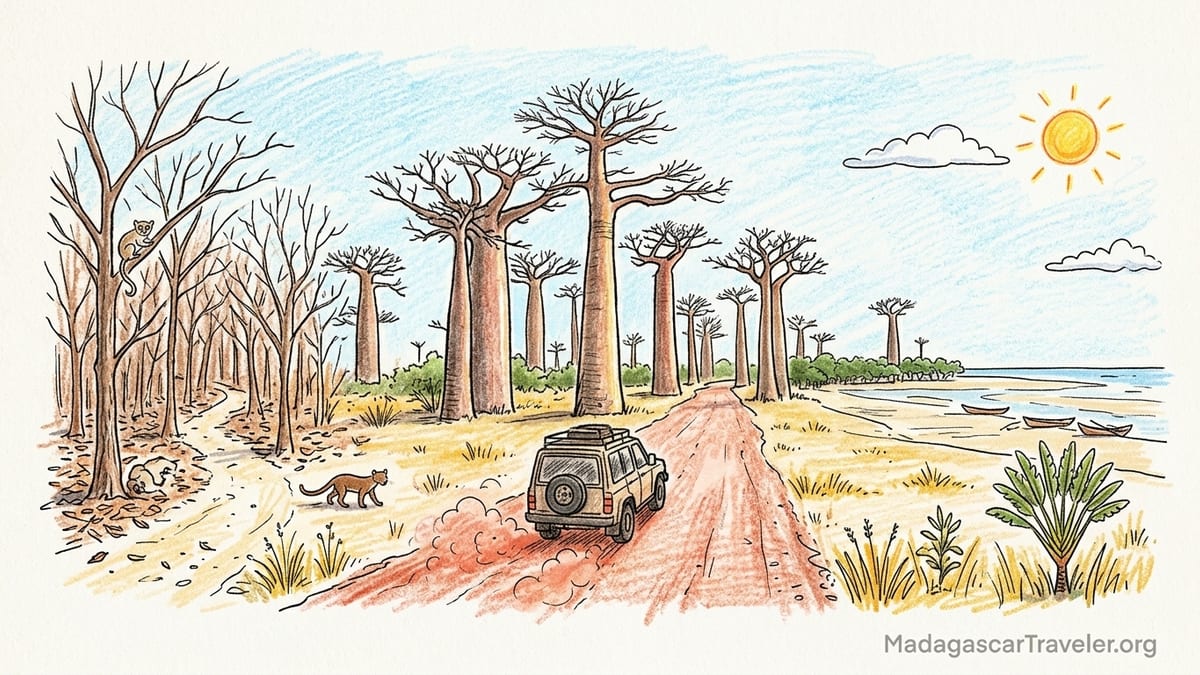
Dust, not mud, defined the landscape. The red laterite track that connects the main road to the Avenue had been baked rock-hard, and each passing 4x4 lifted a powdery cloud that hung in the air. When a convoy of vehicles arrived close together before sunset, a fine film settled on my camera, daypack and even my teeth. I wished I had brought a simple dust mask or buff for the drive. This is the practical trade-off of the dry season: easy passage and firm surfaces, but plenty of airborne grit.
The vegetation around the baobabs reflected this dryness. Grasses were mostly yellow or straw-colored, and many smaller shrubs looked tired and dusty. The baobabs themselves, which store water in their thick trunks, stood out even more dramatically against this muted backdrop. From a photographic standpoint, the golden-brown ground and clear skies created a sharp, high-contrast scene. Around sunset, a low haze of dust in the air softened the light just enough to give the silhouettes a warm glow, particularly on evenings when a light breeze blew the dust sideways across the sun.
Sunset visibility was excellent almost every night I went. Without afternoon thunderstorms to build high clouds, the sky usually shifted from pale blue to orange and then a soft purple after the sun dropped. On one evening, thin high clouds caught the last light and turned pink behind the baobabs, while the horizon remained clean and clear. Other nights were more minimalistic, with the sun setting into a simple, cloud-free sky. The key benefit of the dry season was predictability: I felt confident planning more than one evening at the Avenue, knowing that weather was very unlikely to ruin the light show.
Road Conditions and Speed: What Dry-Season Reliability Meant Day to Day
The most important regional issue for western Madagascar is road reliability, and here the dry season made a tangible difference. On my June and July visit, the roads from Morondava to both the Avenue of the Baobabs and Kirindy Forest were entirely dry and mostly firm. The main route north starts on the sealed RN35 out of town before transitioning to laterite and dirt. In the dry season, this unpaved section becomes a rigid, corrugated surface. I could feel every ripple through the vehicle, but at least the wheels stayed firmly on the track.
My driver, using a standard Toyota 4x4, estimated the Morondava to Kirindy Forest journey at about two hours each way in these conditions, driving around 40 to 60 kilometers per hour on the paved stretches and slowing to around 20 to 30 kilometers per hour on the dustier, corrugated parts. He explained that in the heart of the rainy season the same route can take much longer, partly because potholes expand and partly because some low-lying sections turn to sticky mud. Seasonal guidance for Menabe Antimena and Kirindy Forest notes that access deteriorates significantly between about December and April, and his stories of vehicles bogged down after heavy downpours made that guidance feel very real.
Dust was the single biggest drawback of those “good” roads. On dry, windy days, the vehicle in front of us vanished into a red cloud, forcing our driver to hang back and lose time. Villages along the road had a faint orange film on houses and trees, and I saw locals wrap scarves across their faces as trucks rolled by. Inside the car, my camera bag quickly turned into a dust trap, and I started sealing lenses in simple zip pouches whenever we moved. None of this made the route impassable, but it did make eye drops and a microfiber cloth as essential as sunscreen.
At the same time, the dry conditions made detours and small stops feasible. On the way back from Kirindy, we spontaneously pulled off on a side track to visit a small baobab cluster and a rice field. In the rainy season this would likely have been a risk, since any side road could hide a mud hole. In June and July, the worst that happened was a bit more corrugation and dust. For a traveler who wants to explore, photograph and accept a few jolts, the dry season opens up these small freedoms that would be far more complicated on soaked, partially flooded tracks.
Wildlife, Vegetation and Insects: How the Dry Months Looked and Sounded
Kirindy Forest in June and July felt both alive and strangely quiet at the same time. This part of the Menabe Antimena protected area is a dry deciduous forest, and during the long dry season many trees lose their leaves to conserve water. As a result, large sections of woodland looked bare, with a carpet of dry leaves underfoot and leafless branches above. That might sound bleak, but it actually improved wildlife viewing. With less foliage, it was easier for our guide to spot sifakas leaping between trunks, sleeping sportive lemurs curled in tree hollows, and a fossa snoozing in the shade near a sandy track.
From a heat and humidity perspective, the forest was much more comfortable than I had expected for a tropical destination. Walks in the late afternoon felt warm but not stifling, and sweating was moderate. Night walks, which are popular to search for mouse lemurs and other nocturnal species, were pleasantly cool. I wore a light long-sleeved shirt and never felt sticky. Climate records show that humidity in Morondava drops notably from April onward, and it felt that way under the trees. The air was still, but not heavy.
Insects were present but manageable. Mosquitoes existed around stagnant water and near some lodges, especially around dusk, but they were not in the dense swarms you might associate with wet-season jungle. A single application of repellent before sunset and long sleeves were enough for me. On the other hand, there was a noticeable increase in dust-loving bugs and small flies along the tracks, especially where vehicles stirred up fine particles. My impression, supported by conservation briefings I read later, is that the wet season from December to March brings more intense mosquito activity along with the rain.
The trade-off is that certain wildlife behaves differently between seasons. Some small mammals in Kirindy, like the Malagasy giant jumping rat, are more active after rains, and guides mentioned that the forest “wakes up” in a different way when the first downpours arrive. During my June and July visit, the forest felt drier, a little crunchy underfoot, but still rich with lemurs, birds and reptiles. For practical tourists, the key advantages of the dry season are good trail conditions, limited mud, relatively low insect pressure and more reliable access by road, while the main sacrifices are greener scenery and possibly some seasonal behaviors that align more closely with the rains.
Kirindy Mitea and the Coast: What I Saw and What I Learned Secondhand
Kirindy Mitea National Park sits further south along the coast from Morondava and combines dry forest, mangroves, dunes and fringing reefs. During my June and July trip, I did not personally reach the core of the park, but I did travel part of the coastal route and talked with drivers and lodge owners about how the season shapes access. Official guidance for Kirindy Mitea states that its preferred visit period runs from roughly May to December, with land access by 4x4 limited to about May through November. The key constraint is the track known locally as RIP 110, which links Morondava through Bemanonga to Belo sur Mer and beyond. In the dry season, that track can be rough and sandy but is generally usable. Once the heavy rains start, certain sections flood or turn to deep mud, and travel slows dramatically.
On the stretches I did travel in early dry-season conditions, the pattern felt familiar: compacted sandy sections, some corrugation and plenty of dust in the air. The landscape shifted from open baobab country to a mix of low coastal scrub, salt pans and mangroves in estuaries. Villages along the way had small pirogues pulled up on the sand, and the sky remained almost perfectly clear. Drivers described the main seasonal difference in terms of speed and reliability. From May to November, a 4x4 could realistically cover the distance from Morondava to Belo sur Mer in half a day, allowing travelers to continue further if needed. From December onward, they warned, unexpected pools, slushy stretches and even temporary river crossings can slow the journey or force last-minute route changes.
Here it was helpful to connect their anecdotes with official statements. Park information for Kirindy Mitea emphasizes that land access is only advised in the roughly May to November window, and even then, high-clearance 4x4 is strongly recommended. Outside that period, some visitors choose to reach the area by boat instead, taking advantage of calmer sea periods when wind and swell allow. My personal dry-season experience along the coast aligned closely with this picture of stable, if dusty, conditions that enable multi-stop itineraries without constant fear of being stranded by a roadside mud trap.
The coastline itself in June and July felt pleasantly breezy. Heat in the middle of the day was strong but moderated by the sea wind, and humidity was more noticeable than inland but still comfortable. Standing on the beach near Morondava at low tide, I saw wide sand flats and a soft salt haze in the distance. Locals mentioned that later in the year, toward October and November, the heat picks up and some afternoons feel more oppressive. By contrast, in the heart of the rainy season, attention shifts to whether tracks are passable and whether storms disrupt small-boat transfers, especially to remote fishing villages or simple coastal ecolodges.
Firsthand Experience vs Researched Guidance for Other Months
Everything described so far is rooted in my own trip in June and July: the dry, dusty tracks to Kirindy, the mild but bright heat at the Avenue of the Baobabs, the mostly leafless forest with clear wildlife viewing and the relatively low insect pressure. What follows in this section moves beyond my own experience and into researched guidance from climate data, conservation authorities and current regional advice. I did not personally visit Morondava between November and April, so treat these insights as informed planning tools rather than direct testimony.
Climate records for Morondava show a sharp wet season from roughly December to March, with January typically the wettest month by far and rainfall totals more than fifty times higher than in mid-year. Humidity climbs during this time, and temperatures stay warm, with average highs around 30 to 33 degrees Celsius. Locally, this is when tropical downpours can fall on multiple days each week and when regional organizations warn that western roads, including those serving Menabe Antimena and Kirindy Forest, are prone to rapid deterioration. The official note that access to Kirindy deteriorates significantly from about December to April is not just theoretical; when heavy rain falls on the same laterite and sand I drove across in June, it can turn to deep ruts, puddles and slippery mud.
For Kirindy Mitea, official guidance indicates that land access by 4x4 is realistically limited to May through November. That implies that in the wet months, some tracks either disappear under standing water or turn into boggy surfaces that even high-clearance vehicles struggle with. Drivers and local operators quoted in recent discussions stress that during the wettest weeks, travel times between Morondava, Belo sur Mer and further coastal villages may double or require waiting periods for water levels to drop. In practice, travelers who insist on going in that season often arrange boat transport and build in extra days to absorb delays.
There are also ecological advantages to the rainy months that I did not personally see. With the arrival of the first consistent rains, dry forests in Menabe Antimena reportedly flush green, and many trees leaf out. Insects surge, amphibians call from temporary pools and some mammals and reptiles become more active, particularly at night. Temperatures can feel hotter due to the combination of heat and humidity, and insects, especially mosquitoes, become much more persistent. This is the opposite of my crunchy-leaf, open-canopy walks in June and July and will appeal to visitors who prioritize lush vegetation and breeding activity over easy road travel.
The shoulder months of April, May, October and November sit between these two extremes. From what local data and recent operator feedback suggest, April often marks the transition out of the rains, with showers becoming less frequent and roads gradually improving. By May, rainfall has usually dropped to very low levels, and temperatures begin to cool, which matches the official opening of the main 4x4 access period to Kirindy Mitea. October and November, on the other side of the dry season, stay mostly dry but grow progressively hotter. Clouds build more frequently in the afternoons, and short showers can start appearing in November. For travelers, this means longer daylight, more heat and the first hints of greener vegetation but still largely reliable road conditions before the hardest wet period sets in.
How Season Changed What Was Possible on My Trip
Looking back, almost every aspect of my trip was shaped by the fact that I visited in the cool, dry season. My schedule was ambitious: multiple sunsets at the Avenue of the Baobabs, a full day and night at Kirindy Forest, side stops in villages and exploratory drives down side tracks. The dry conditions made this efficient and realistic. Distances that might require a full day in the rainy season were comfortable half-day journeys in June and July. I could plan a morning departure to Kirindy, spend the midday and afternoon on the trails, join a night walk and still feel confident about the next day’s return.
Excursion feasibility also changed with the seasons. Night walks in Kirindy felt safe from a footing perspective; trails were dry and leaf-littered rather than wet and slippery. This allowed me to focus on spotlighting tiny mouse lemurs and chameleons instead of watching every step for hidden mud holes. Similarly, approaching the Avenue of the Baobabs an hour or two before sunset was simple. We did not have to worry about a storm rolling in to darken the sky, and the track out to the trees stayed firm even as vehicles came and went. It was easy to stay until the last afterglow before driving back to Morondava, headlights carving through dust instead of mist.
At the same time, the dry months imposed their own character on the landscape. Baobab country felt austere, in shades of beige, gray and faint green rather than lush emerald. Some visitors might find this stark beauty exactly what they want. Others might miss the intense greens and fresh leaves that come with the first rains. I found that for photography, the muted palette and clear air helped create powerful silhouettes and long shadows, especially in the late afternoon, but it also meant that wider landscape shots sometimes looked harsher.
Perhaps the most tangible seasonal benefit was the psychological ease of travel. In the dry season, I did not lose sleep wondering whether an overnight storm might wash out a bridge or cut the track to the airport. Conversations with drivers confirmed that in February or March, by contrast, every morning can begin with a round of phone calls and updates about which sections of road are still passable. For travelers with tight schedules, that risk can be stressful. My dry-season trip was not risk free, but the underlying infrastructure of laterite roads and rural bridges felt as reliable as it ever gets in this part of Madagascar.
The Takeaway: When I Would Personally Return and Why
If I had to choose one period to return to Morondava based on my experience and subsequent research, I would again target the dry months between May and September, with a small shift depending on my priorities. For baobab photography, I would aim for late June to early August. The light is clear, the air is dry, and sunsets are consistently visible, with only a thin layer of dust adding warmth to the horizon. The Avenue of the Baobabs in this period feels accessible and predictable, which is ideal if you want to set up tripods, experiment with silhouettes and perhaps capture a series of evenings rather than gamble on a single night.
For wildlife in Kirindy Forest and the wider Menabe Antimena area, June and July worked very well, and I would not hesitate to recommend them again. Cooler temperatures make daytime walks and night excursions comfortable, the forest remains open enough for good visibility, and road access is highly reliable. If I wanted slightly greener surroundings without drifting into the peak rains, I might consider a return in May, when showers have mostly faded but some vegetation still holds more moisture and color.
For road trips and multi-stop itineraries that include coastal extensions toward Belo sur Mer or deeper into Kirindy Mitea territory, my choice would lean toward the broader window from May to September. In this band, official guidance and local experience align: roads are at their firmest, land access to Kirindy Mitea by 4x4 is possible, and you have the best chance of completing ambitious loops without losing days to washed-out sections. If I specifically wanted warmer beach days and did not mind higher heat, October might be appealing, but I would watch forecasts closely for the onset of early rains.
The only period I would personally avoid for this region, unless I had a very specific ecological goal, would be the peak rainy months from late December through March. While there can be rewards in terms of lush vegetation and certain wildlife behaviors, the trade-offs in mud, humidity, insect density and road reliability are substantial. Having felt how transformative the dry season was for my own journey, from the speed of the drives to the crispness of baobab sunsets, I would rather stack the odds in favor of smooth logistics and clear skies, even at the cost of a little green in the landscape.
FAQ
Q1. What months did you personally visit Morondava and Kirindy?
My firsthand experience is from June and July, in the cool, dry season. All detailed observations on heat, dust, road conditions, vegetation, wildlife behavior and insects are based on that specific period.
Q2. How hot did it actually feel in June and July?
Daytime temperatures felt warm but manageable, roughly high twenties Celsius, with strong sun but relatively low humidity. I could walk around in a light shirt and hat without feeling constantly drenched in sweat, though direct midday sun was intense.
Q3. Were the unpaved roads to the Avenue of the Baobabs and Kirindy difficult in the dry season?
The unpaved sections were firm and fully passable but very dusty and corrugated. A normal 4x4 handled them without trouble, and travel times were predictable, though the ride was bumpy and fine dust seeped into the vehicle and gear.
Q4. Did you encounter many insects and mosquitoes during your dry-season trip?
There were mosquitoes around dusk and near stagnant water, but they were not overwhelming. A single application of repellent and long sleeves were usually enough. Dust-loving flies appeared along some tracks, but insect pressure was moderate compared with many wet tropical regions.
Q5. How was wildlife viewing in Kirindy Forest in June and July?
Wildlife viewing was very good. With many trees partly leafless, lemurs, fossas and birds were easier to spot in the open canopy. Night walks produced mouse lemurs and chameleons, and trails were dry, which made walking easier.
Q6. What changes should travelers expect in the rainy season from December to March?
Based on regional data and local guidance, the rainy season brings heavy downpours, higher humidity, muddier roads and more insects. Access to Kirindy Forest and western tracks becomes less reliable, and travel times can increase significantly as some sections flood or turn to deep mud.
Q7. Is Kirindy Mitea National Park realistically visitable all year?
Official guidance and local feedback indicate that land access by 4x4 to Kirindy Mitea is usually possible from about May to November. Outside that window, some tracks can become difficult or impassable, and travelers often need to switch to boat transfers or adjust their plans.
Q8. When would you personally return for the best baobab photography?
I would return between late June and early August. The combination of clear skies, predictable sunsets, dry air and golden dust in the atmosphere creates reliable conditions for dramatic baobab silhouettes and warm, soft evening light.
Q9. Which months would you choose for a road-focused trip with coastal extensions?
For a trip combining Morondava, Kirindy Forest and coastal stops like Belo sur Mer or Kirindy Mitea, I would aim for May to September, when roads are usually at their firmest and most reliable and official guidance supports 4x4 land access to the park.
Q10. Should I completely avoid Morondava in the rainy season?
Not necessarily, but you should be prepared for slower travel, possible route changes, higher humidity and more insects. If your priority is smooth logistics, reliable road access and clear baobab sunsets, the dry months from about May to September are a safer and more comfortable choice.