


At the northern tip of Madagascar, Antsiranana, still widely known by its colonial name Diego Suarez, is one of the country’s most rewarding bases for adventure. Within an hour or two of the city you can hike limestone ridges, stroll a lively port, cross wind‑sculpted bays, snorkel in the Emerald Sea and disappear into a cool montane rainforest in Amber Mountain National Park. This guide focuses on how to do it in practice, separating outings you can realistically manage on your own from those that need a boat, a 4x4 or a local guide.
Understanding Antsiranana as a Base
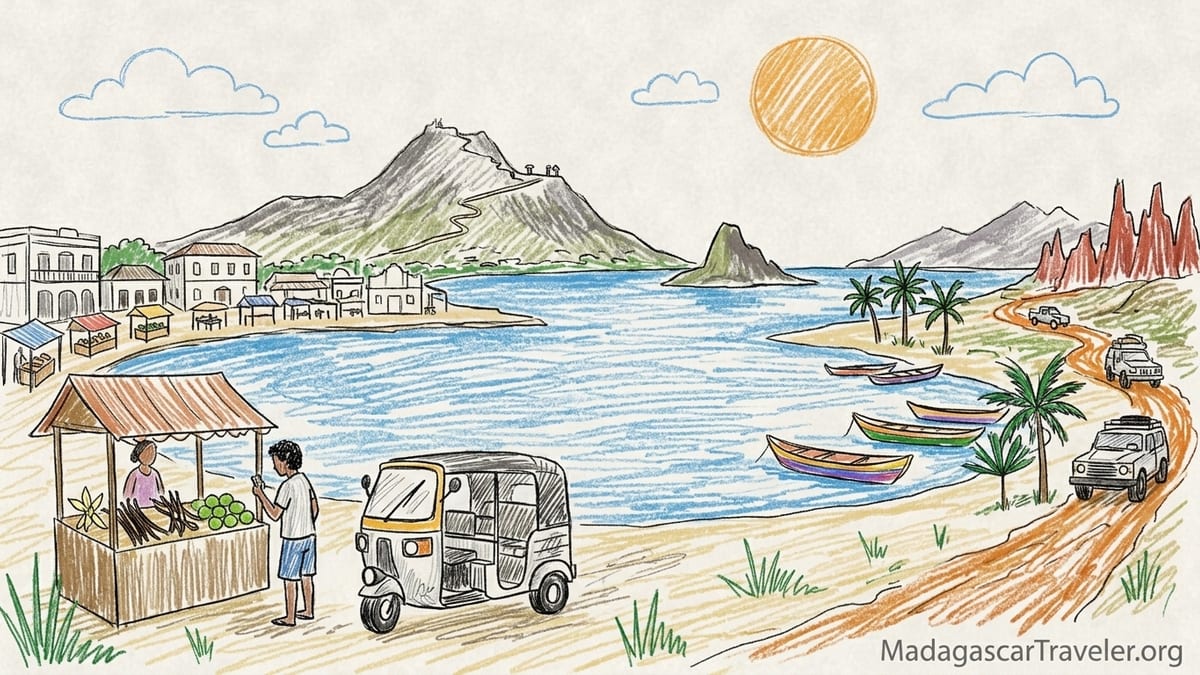
Antsiranana sits on one of the world’s great natural harbours, a wide bay fringed by colonial-era buildings, markets and a working port. The city itself is compact, with most hotels, restaurants and agencies clustered around the centre and the waterfront. For most visitors, Diego Suarez is not just a stop in the far north: it is the hub for day trips to Ramena Beach, the Three Bays, the Emerald Sea, Amber Mountain and the Red Tsingy, all within roughly 30 to 90 kilometres.
Distances are short, but road conditions and heat make planning important. Ramena Beach is about 18 to 20 kilometres east of town, usually a 30 to 40 minute drive by taxi or hotel transfer. The trailhead for Montagne des Français lies along the same road, while the Three Bays track branches further along toward Sakalava, Pigeon and Dune bays. South of the city, Amber Mountain National Park is approached via Joffreville, around 30 kilometres away, and the Red Tsingy formations lie roughly 60 kilometres further south again on rougher tracks.
Because tourism infrastructure is still relatively low key, many experiences remain pleasantly undeveloped. For example, you can walk the Three Bays route with almost no built-up facilities, or sit on Ramena’s sand watching fishing pirogues rather than jet skis. On the other hand, that lack of infrastructure means you need to think ahead about water, sun protection, transport back to town and whether you want a local guide to smooth the logistics.
In broad terms, independent travellers can comfortably explore the city centre and market, Montagne des Français, Ramena, the Three Bays and Sakalava Bay without signing up for a packaged tour, provided they arrange a reliable taxi or hotel car. Excursions to the Emerald Sea, Amber Mountain and the Red Tsingy are almost always easier and safer with a guide, boat crew or 4x4 driver who knows the tides, tracks and park procedures.
Exploring the City Centre and Market Independently
The centre of Antsiranana is flat and walkable, and most visitors start by getting their bearings here. From many guesthouses it is an easy stroll to the main market district, where stalls overflow with vanilla, cloves, lychees in season and pyramids of tiny green limes. Early morning is ideal, both for cooler temperatures and for watching the city wake up. You can walk this entire area independently, and with normal big-city awareness it feels reasonably relaxed compared with the capital Antananarivo.
Concrete examples help when planning: a short ride in a local tuk-tuk, called a bajaj, within the city will usually cost a fraction of what you might pay in larger capitals, often just a few local notes if you negotiate in advance. Many travellers budget for a simple local breakfast near the market, perhaps coffee with a fresh baguette or mofo gasy rice cakes, before they move on to organize their excursions at an agency or hotel desk nearby. Negotiating in French helps, but more and more operators are used to English-speaking visitors.
Independent exploration of the waterfront gives a different angle on the city. The port is close to the centre, and you can walk along the bayfront to watch cargo ships, fishing boats and the outline of Nosy Lonjo, the distinctive sugar-loaf islet at the bay’s mouth. Late afternoon is especially atmospheric, when the light softens and locals gather around food stalls selling sambos and skewers. This is also the time to confirm pick-up times and costs with any drivers you have arranged for the next day, to avoid early-morning confusion.
For practical purposes, use your time in town to stock up. Heat and exposure on the coastal hikes and at the bays can be intense, so buying several litres of bottled water, snacks such as peanuts and bananas, and basic sun gear in Antsiranana will save you paying higher prices at the beach. Cash is also easier to manage here; while there are ATMs in the city, you should not rely on finding one in Ramena or along the Three Bays track.
Montagne des Français and the Three Bays: Independent Adventures
Montagne des Français, also known by its Malagasy name Ambohitr’Antsingy, rises just east of Antsiranana on the road to Ramena. The trailhead is around 10 to 12 kilometres from the city, and many travellers negotiate a one-way taxi or bajaj drop-off early in the morning. The hike to the summit typically takes around two hours at a relaxed pace, with viewpoints over the bay and remnants of old French military installations along the way. You can do this walk independently if you are used to hot-weather hiking, carrying at least two litres of water and starting no later than mid-morning to avoid the worst heat.
The path is fairly clear but can be rocky and steep in sections, particularly near the top, where the reward is a panoramic view over Antsiranana’s vast bay, Ramena peninsula and the offshore sugar-loaf islet. Many visitors simply ask their taxi driver to wait at the base for three to four hours, paying a bit extra for the waiting time, or arrange for a fixed pick-up time in advance. This is a realistic do-it-yourself outing, as long as you are comfortable navigating an unshaded hill path and descending over loose limestone.
The Three Bays route is another independent classic. It links Sakalava Bay, Pigeon Bay and Dune Bay on a track that runs along the peninsula and eventually comes out near Orangea and Ramena. Many travellers organize a morning drop at either Sakalava or Dune Bay, then walk the coastline for several hours before relaxing at Ramena and taking a taxi back to Antsiranana in the late afternoon. The walk itself is mostly straightforward along sandy paths and shoreline, but it can be windy and there is almost no shade, so long sleeves, a hat and good sunscreen are essential.
In real terms, you might pay a local driver in Antsiranana for a full-day arrangement: drop-off at Sakalava in the morning, then a late-afternoon pick-up at Ramena after you have finished the walk and perhaps a swim and early dinner. Travellers who do this independently often report that the scenery is rewarding, with views over turquoise water and white sand, but that it is wise to carry far more water than you think you will need and to keep an eye on your timing so that you are not still walking in the midday sun.
Ramena Beach and Sakalava Bay: Relaxed Days Without a Guide
Ramena is a small fishing village with a long arc of sand, around 30 to 40 minutes’ drive from Antsiranana. Shared taxis and hotel transfers run this route routinely, and many visitors base themselves in Ramena for a few nights to be closer to the sea. This is an easy independent outing: once your transport is organized, you can simply wander the beach, watch colourful wooden pirogues head out to fish and choose a simple restaurant for grilled fish or prawns. Prices for a plate of seafood with rice are generally low by international standards, although exact numbers fluctuate with fuel and catch.
A typical independent day might look like this: leave Antsiranana after breakfast, arrive in Ramena in time for a mid-morning swim, have a seafood lunch in a beachfront eatery and walk the length of the beach as the afternoon breeze picks up. Ramena is also a good place to arrange the next day’s boat trip to the Emerald Sea, since local boatmen and small agencies often base themselves here. Locals will frequently approach you with offers for pirogue trips, snorkelling or combined Three Bays and Emerald Sea days; take your time to compare what is included, especially meals, snorkelling gear and park or community fees.
Further along the coast, Sakalava Bay has become one of the region’s most renowned kitesurfing spots. The bay is shallow, with steady winds in season and a relaxed, low-rise set of small lodges and kite schools behind the beach. Independent travellers can come for the day from Antsiranana or stay in one of the bayside lodges and rent equipment or book lessons on the spot. In practice, this means you do not need to plan far ahead if you just want to try a beginner lesson: you can walk up to a kite school, discuss wind conditions, and arrange a half-day session including board, kite and harness.
Even if kitesurfing is not of interest, Sakalava is worth including as the northern gateway to the Three Bays walk. Combined with a finishing point at Ramena or Orangea, this gives you a full coastal day without any formal guiding. The main expense is transport: you will either pay a driver from Antsiranana for a return journey plus waiting time or combine several shorter legs by hitching lifts with other travellers staying at the bay’s small lodges.
Emerald Sea, Amber Mountain and Red Tsingy: Excursions Requiring Boats, 4x4s and Guides
Certain highlights around Antsiranana are significantly more complex to tackle alone, and in practice most visitors join a tour or hire a dedicated driver and guide. The Emerald Sea, or Mer d’Émeraude, is the most obvious example. Reached by boat from near Ramena, this wide, shallow lagoon is known for its unreal shades of green and turquoise, coral sandbanks and islands. To get there safely you need a pirogue or motorboat, a crew that understands local currents and tides, and fuel and food for a full day. As a result, travellers usually book with a local agency or arrange directly with a boat owner, paying per person or for the entire boat.
A typical Emerald Sea excursion involves a road transfer from Antsiranana to Ramena in the morning, then a crossing to the lagoon, snorkelling stops, a grilled fish lunch on an island and a return by mid- to late afternoon. Exact prices vary with season, group size and whether you negotiate directly with a boat crew, but it is realistic to expect a full-day package to cost more than local beach outings, reflecting fuel costs and time on the water. It is technically possible to charter a boat privately if you speak French and are comfortable negotiating details such as departure time, safety gear and who provides lunch, but for most visitors an organized excursion is the most practical and reliable option.
Amber Mountain National Park, or Montagne d’Ambre, sits around 30 kilometres south of Antsiranana and requires a road transfer to the small town of Joffreville, followed by entry into the park and hiking on its trail network. The road from Antsiranana to Joffreville is paved, but arranging a return car for the day, plus park entry and guiding, is easier through an agency or your accommodation. Many visitors book a car and driver for a day that includes pick-up in Antsiranana, transport to Joffreville, several hours of guided hiking to waterfalls and crater lakes and a late-afternoon return.
Officially, some trails in Amber Mountain are simple enough to walk without a guide, but in practice a local guide is strongly recommended. Guides help spot the park’s famous wildlife, from leaf-tailed geckos and tiny chameleons to crowned lemurs, and can adjust the route according to weather and fitness. Costs are usually structured so that your group pays a park entry fee per person and a separate guiding fee, which may cover up to four or more people. Booking via an agency in Antsiranana or directly in Joffreville will add the cost of transport, often using a 4x4 or high-clearance vehicle, since heavy rain can create potholes and muddy sections on side tracks.
Reaching the Red Tsingy formations, a surreal landscape of eroded red sandstone pinnacles, almost always requires a proper 4x4. The site lies roughly 60 kilometres south of Antsiranana along the main road toward Ankarana, followed by rougher laterite tracks that can become sticky or rutted after rain. For this reason, many itineraries combine Amber Mountain and Red Tsingy into a long day trip with a driver, starting early from Antsiranana, spending several hours in the cool forest of Amber Mountain and then visiting the Red Tsingy on the way back or while continuing south.
Trying to reach the Red Tsingy independently with a standard taxi or rental car is generally discouraged, as recovery from a breakdown or getting stuck in the mud can be difficult and expensive. Instead, treat it as a classic guided 4x4 excursion, shared with a few other travellers if you wish to keep costs down. Your driver will navigate the side tracks, manage time at viewpoints and liaise with local gatekeepers or communities responsible for site maintenance. Even if you are an experienced off-road driver at home, local knowledge of seasonal conditions is a major safety advantage.
Choosing Between Independent Exploration and Organized Tours
Planning a stay in Antsiranana usually means deciding when to go alone and when to pay for structure and support. A practical rule of thumb is to go independently when the route is linear, close to services and easy to navigate on foot or by simple taxi, and to go with a guide or agency when boats, national park rules, long unpaved tracks or changing weather conditions are involved. The city centre, market, Ramena, Sakalava and the Three Bays fit comfortably into the first category, while the Emerald Sea, Amber Mountain and the Red Tsingy belong in the second.
In real-world terms, that could look like alternating days. One day, you hike Montagne des Français and return to Antsiranana for a sunset drink on the waterfront. The next, you have booked a full-day Emerald Sea trip, with hotel pick-up in the morning and drop-off at sunset. Another day, you walk the Three Bays from Sakalava to Ramena independently, then follow it with a guided day in Amber Mountain and a 4x4 detour to the Red Tsingy. Spreading guided and unguided days like this keeps overall costs manageable while still giving you access to the region’s more remote experiences.
When booking tours, the practical questions matter. Ask what is included in the price: park fees, guide fees, lunch, snorkelling equipment, drinking water and transport. For example, a cheaper quote for an Emerald Sea excursion might not include lunch on the island or gear, which could make the apparent saving less significant. Likewise, an Amber Mountain day trip that advertises a low headline price may not factor in park entry for each participant, which you will then pay on arrival.
For independent outings, confirm return transport carefully. If you are being dropped at Sakalava for the Three Bays walk and picked up at Ramena, agree a specific time, exchange phone numbers and have a backup plan, such as knowing the approximate cost of a local taxi back to Antsiranana if your original driver is delayed. Carrying some extra cash in small denominations helps in such situations, as does patience; this is a part of Madagascar where schedules are flexible and the heat of the afternoon can slow everything down.
The Takeaway
Antsiranana’s appeal lies in how much variety lies within a short radius of the city. In a few days you can trade the bustle of the market for empty dune-backed bays, the glare of the Emerald Sea for the cool mist of Amber Mountain and the soft sand of Ramena for the sculpted ridges of the Red Tsingy. With thoughtful planning, many of the coastal highlights are within reach for independent travellers, especially the city centre, Montagne des Français, the Three Bays route, Ramena Beach and Sakalava Bay.
At the same time, some of the region’s finest experiences benefit from a guiding hand. The Emerald Sea rewards those who trust a local boat crew with the tides and sandbanks, while Amber Mountain and the Red Tsingy are safer and richer with a driver and guide who know the tracks, wildlife and weather rhythms. Mixing self-guided days with well-chosen excursions lets you keep flexibility and local contact without sacrificing safety or spending precious daylight solving transport problems.
However you structure your stay, Antsiranana works best when you give it enough time. Three to four full days is a reasonable minimum to balance city, sea and forest, but a week allows for weather hiccups and slower days on the beach. With realistic expectations about roads, heat and timing, northern Madagascar’s unofficial adventure capital can be one of the most memorable stops on the island.
FAQ
Q1. How many days should I spend in Antsiranana to see the main sights?
Most travellers need at least three full days to cover the city, Three Bays, Ramena and one major excursion such as the Emerald Sea or Amber Mountain. Four to six days allows for a more relaxed pace and time for the Red Tsingy.
Q2. Can I visit the Three Bays and Montagne des Français without a guide?
Yes, both are realistic independent outings for fit travellers. Arrange a reliable taxi or hotel car, start early to avoid heat, carry plenty of water and confirm your return pick-up time in advance.
Q3. Do I need to book an Emerald Sea excursion before arriving in Diego Suarez?
It is possible to book after you arrive, either in Antsiranana or Ramena, especially outside peak holiday periods. That said, if you are visiting in local school holidays or only have one specific day available, reserving through your accommodation a few days ahead is sensible.
Q4. Is Amber Mountain National Park suitable for children or older travellers?
Yes, many of the main trails are relatively short and can be tailored to different fitness levels. A local guide can propose gentler circuits to waterfalls and viewpoints, and your driver can wait at the park entrance while you walk.
Q5. Do I need a 4x4 to visit the Red Tsingy?
In practice, yes. The access tracks to the Red Tsingy are rough and can become difficult after rain, so most visitors go with an organized 4x4 excursion or a private driver in a high-clearance vehicle familiar with the route.
Q6. Can I swim safely at Ramena and along the Three Bays route?
Ramena’s main beach is popular for swimming, especially closer to the village where the bay is more sheltered. Along the Three Bays route, conditions vary with wind, waves and tides, so it is best to ask locals and avoid isolated swims if there is a strong swell.
Q7. Are there ATMs and card facilities in Ramena and Sakalava Bay?
ATMs are concentrated in Antsiranana city. Some hotels and lodges in Ramena and Sakalava accept cards, but reliability varies, so carrying enough cash from the city for meals, small purchases and tips is advisable.
Q8. When is the best time of year to visit Antsiranana and the Emerald Sea?
The cooler, drier months roughly from May to October usually offer more pleasant temperatures and more reliable sea and road conditions. The cyclone season and heavy rains, typically in the first months of the year, can disrupt both boat trips and access to sites like the Red Tsingy.
Q9. Can I combine Amber Mountain and the Red Tsingy in a single day trip?
Yes, many operators offer long day trips that start early from Antsiranana, visit Amber Mountain in the morning and continue to the Red Tsingy in the afternoon before returning or continuing south. It makes for a long day, but it is a common, efficient option.
Q10. Is it necessary to speak French or Malagasy to organize excursions?
French is widely spoken and makes negotiations easier, but many agencies, hotels and some guides now work regularly with English-speaking visitors. Learning a few basic Malagasy phrases is appreciated, but with patience and clear questions you can arrange most trips in simple English.