


Northern Madagascar’s Amber Mountain National Park and the Red Tsingy formations south of Antsiranana deliver two very different kinds of adventure: cool rainforest slopes alive with lemurs and chameleons, and a semi-arid canyon of red pinnacles reached by rough tracks. Travelers arriving in Diego Suarez, whether by air, road or cruise ship, quickly face the same question: visit Amber Mountain as a short forest escape, commit to a full-day Red Tsingy 4x4 adventure, or join a combined northern tour that links both highlights and other regional attractions. Understanding road conditions, park rules, guide requirements and realistic timing is essential to making the most of limited days in the far north.
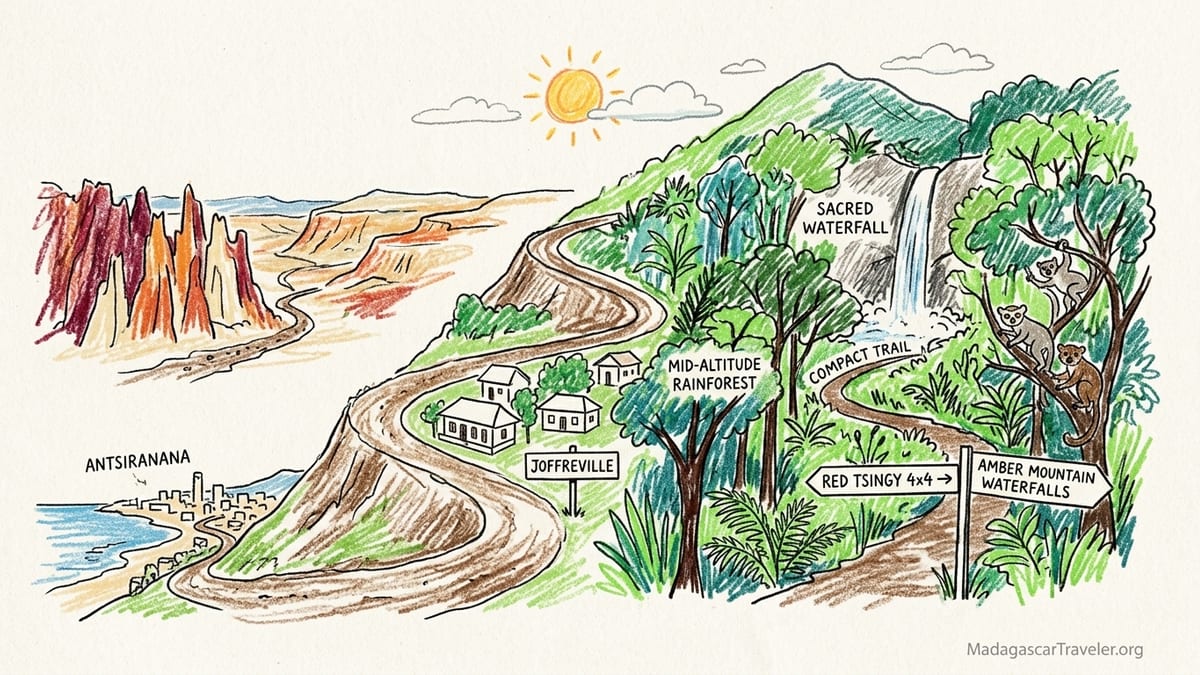
Amber Mountain from Antsiranana: What to Expect
Amber Mountain National Park, or Montagne d’Ambre, rises just inland from Antsiranana, sheltering one of Madagascar’s lushest mid-altitude rainforests. Created in the late 1950s around an extinct volcanic massif, it now protects dense evergreen forest, crater lakes and cool waterfalls that feel worlds away from the dry plains surrounding Diego. For most visitors, the experience begins with a transfer from Antsiranana up to the small hill town of Joffreville, the traditional gateway on the park’s northern edge.
From Diego’s center, the drive to Joffreville usually takes about 45 minutes to one hour in a 4x4 or sturdy minivan, depending on traffic and the latest state of the access road. Many operators, such as local agencies based along Rue Colbert, package this transfer with a half-day guided walk that fits neatly into a cruise ship call or a short stopover in town. Even on a brief 4.5 hour shore excursion, there is enough time to reach the park gate, complete a compact waterfall circuit and return to the harbor tenders.
Inside the park, paths are well established and, compared with some other Malagasy reserves, relatively gentle. Circuits range from short two to three hour loops to longer day hikes that reach viewpoints and higher waterfalls. On a typical half-day visit, most guides focus on the easier circuits to Sacred Waterfall or Antomboka Waterfall, which combine manageable walking with good chances of spotting lemurs and reptiles. Because temperatures at altitude are cooler than in Diego, visitors often appreciate the forest’s fresh air after days along the coast.
Visitors who can spare a full day in Amber Mountain gain access to a broader network of trails leading to additional cascades and crater lakes. Local tour companies frequently suggest a morning departure from Diego, picnic lunch in the forest and a later afternoon return to town. This schedule allows slower-paced wildlife viewing, photography stops and periods simply listening to the forest, which can be difficult on compressed cruise itineraries.
Joffreville, Waterfalls and Wildlife: The Amber Mountain Experience
Joffreville itself, sometimes still called Ambohitra by locals, is a sleepy highland town with old colonial villas, basic guesthouses and a couple of small lodges that cater to travelers who want to sleep near the park. Staying here rather than in Diego allows visitors to enter the forest early, when many animals are most active and the mountain is often wrapped in mist. A practical example is a one-night stop at a Joffreville lodge, where guests might arrive from Diego in the afternoon, take a short sunset stroll with views of the Mozambique Channel, then start their park walk immediately after breakfast the next day.
Once inside the forest, guides usually choose routes that strike a balance between waterfalls and wildlife. The Sacred Waterfall trail, for instance, combines a shaded path through tree ferns and pandanus with a final descent to a narrow cascade surrounded by mossy rock. Another common route links several smaller falls and natural pools along a loop of forest tracks. Surfaces are often damp and can be muddy after rain, so even on short circuits visitors are advised to bring closed footwear with good grip and a light rain jacket.
Wildlife is a major draw. Amber Mountain is known for several lemur species, including crowned lemurs and Sanford’s brown lemurs that often cross the paths in family groups. With luck and a patient guide, visitors may also spot the tiny Amber Mountain leaf chameleon clinging to low branches, or the eye-catching panther chameleon in roadside shrubs. Birders appreciate the park for its forest species such as Madagascar paradise flycatchers and various vangas, though sightings require quiet walking and a bit more time than a rushed outing allows.
For many visitors, the coolest aspect is how quickly the climate changes. Temperatures can drop noticeably as vehicles climb from sea level to over 1,000 meters. On some days, those coming straight from the hot streets of Diego are surprised to need a light fleece or windbreaker during their waterfall stops. This climatic contrast is one reason some travelers choose to overnight in Joffreville and enjoy a second walk, rather than treating Amber Mountain purely as a half-day detour.
Red Tsingy: Landscape, Access Roads and 4x4 Reality
The Red Tsingy, or Tsingy Rouge, lies south of Antsiranana on the RN6 before the road bends inland toward Ambilobe and Ankarana. Instead of dense forest, visitors arrive to a semi-arid canyon carved by the Irodo River, where iron-rich laterite has eroded into thousands of red and cream pinnacles. The formations change shape and color after each rainy season, so photographs taken one year can look subtly different from those a season later. The contrast with the cool greens of Amber Mountain could hardly be greater.
From Diego, drivers follow the RN6 for roughly 60 to 70 kilometers before turning off onto a rough track toward the canyon. Under late dry-season conditions, this track can take about 45 minutes to one hour each way, combining rocky sections, shallow fords and dusty red dirt. In practice, agencies in Diego schedule at least three hours of driving time for a standard Red Tsingy excursion, not counting time spent walking among the formations. The last section of road is the reason local tourism offices and guide associations consistently recommend a high-clearance 4x4, even during the dry months.
For example, many travelers book a full-day 4x4 trip that leaves Diego at around 7:00 or 7:30 in the morning. After a coffee stop at a roadside village near Sadjoavato, the driver tackles the track to the Red Tsingy parking area. Visitors typically spend 1.5 to 2 hours on foot, following pathways along the canyon rim and down to viewpoints over the pinnacles. There are simple wooden railings and signboards in some sections, but the terrain remains uneven, dusty and exposed to the sun, so hats, water and sunscreen become more important here than sturdy rain gear.
Road conditions are very sensitive to weather. Heavy showers late in the rainy season can create deep ruts or muddy hollows that make the approach slow even for experienced local drivers. Agencies based in Antsiranana frequently adjust or even cancel Red Tsingy excursions in January and February if flooding cuts the track, and they usually warn cruise passengers that this is not a realistic half-day option from the port. Travelers who try to economize by hiring a basic sedan instead of a 4x4 routinely report scraping the underbody, getting stuck in soft sections or having to walk longer distances from where the car is forced to stop.
Guides, Park Fees and What Tours Actually Include
Both Amber Mountain and the Red Tsingy fall under Malagasy regulations that strongly encourage, and in practice require, visitors to be accompanied by certified local guides inside protected areas. At Amber Mountain, guides are booked either directly at the park entrance near Joffreville or through agencies in Diego, with fees charged per group and per circuit. Separate park entry fees are payable per person per day. These have risen steadily in recent years, and international tourists in 2026 can expect entry for major northern parks to cost the equivalent of tens of US dollars per person, with guide services as an additional line item.
In real terms, a couple booking a half-day Amber Mountain excursion through a Diego-based operator might see a quote that includes round-trip transport, park entry for two, mandatory local guide, and a simple picnic or snack. Prices vary by operator, but sample packages advertised locally show per-person costs that roughly align with other national parks in Madagascar, once transport and guiding are factored in. For Red Tsingy, the structure is similar, though there is often a separate local community fee for access to the formation sites, again usually bundled into agency pricing rather than paid in small cash amounts on arrival.
Travelers should pay close attention to what is and is not included in package descriptions. Some lower headline prices cover only the vehicle and driver, leaving clients to pay park entry and guide fees in cash at the gate. Others include everything except lunch, which might be arranged at a roadside restaurant between Diego and the RN6 turnoff, with simple plates of rice and zebu or fish. Asking operators to provide a clear written breakdown, even if informally via email or messaging apps, helps avoid uncomfortable surprises on the day of the excursion.
Most agencies in Antsiranana supply driver-guides who speak at least French and often some English, but park-based guides at Amber Mountain may have more limited language skills. Guests who prioritize detailed natural history interpretation, rather than simply route-finding, should mention this when booking so that agencies can request particular guides known for stronger English or for expertise in birds, reptiles or botany. Tipping is not mandatory but widely appreciated, particularly when guides help locate sought-after species such as leaf-tailed geckos or the smaller nocturnal lemurs during late-afternoon visits.
Shore Excursions vs Multi-day Northern Circuits
Travelers reaching Antsiranana by cruise liner often have a single day in port, with tender operations and all-aboard times compressing their real time ashore to six or seven hours. In response, local agencies and cruise lines have shaped Amber Mountain half-day shore excursions that run around 4.5 hours from pickup to drop-off. These typically include the scenic road up past Joffreville, a compact forest walk of 1.5 to 2 hours, and a brief stop at a viewpoint before descending. For passengers who want an easy taste of Malagasy rainforest and a few lemur sightings without long drives, this format works well.
Red Tsingy, by contrast, rarely fits into cruise ship time frames. The return journey alone can take five or more hours once current road conditions and port logistics are factored in, leaving very little margin for delays. Some itineraries marketed in international cruise brochures mention the Red Tsingy as an optional long excursion, but fine print often clarifies that its operation is weather dependent and may require an early departure and late return with less flexibility than Amber Mountain tours. Cruise guests considering independent Red Tsingy trips are usually advised to be back at the port at least four hours before final tender time, which in practice rules out most same-day visits.
Independent travelers with several days based in Diego have far more options. Many agencies offer two to four day northern circuits that combine Amber Mountain, Red Tsingy and Ankarana Reserve, sometimes with side trips to the Three Bays, Ramena Beach or the Emerald Sea lagoon. A common pattern is to spend the first day hiking in Amber Mountain from Joffreville, the second day driving to Red Tsingy and continuing to a lodge near Ankarana, and the third day exploring Ankarana’s limestone tsingy and caves before returning toward Ambilobe or Nosy Be. These packages simplify logistics by bundling all 4x4 transport, guides, park fees and accommodation.
Travelers on tight overland schedules sometimes try to squeeze both Amber Mountain and Red Tsingy into a single very long day from Diego. In theory this is possible in the longer dry-season daylight, but it often means abbreviated walks and a late return on fatigued roads. Fatigue, fading light and the risk of livestock or pedestrians on unlit stretches of the RN6 make such marathon days less appealing in practice. For most visitors, splitting the experiences across two days or embedding them in a northbound circuit yields a more relaxed and safer journey.
Choosing Between Amber Mountain, Red Tsingy or a Combination
Deciding whether to prioritize Amber Mountain, the Red Tsingy or a combined itinerary depends on time, interests and tolerance for bumpy roads. Wildlife enthusiasts, especially those eager to see lemurs, chameleons and forest birds, will gain more from a full day or an overnight stay oriented around Amber Mountain. The park’s maintained trail network and shorter walking distances make it accessible to a wide range of fitness levels, and the cooler temperatures are a relief for families with children or older travelers who struggle in heat.
Landscape photographers and travelers who have already visited rainforest parks elsewhere in Madagascar often find the Red Tsingy particularly rewarding. The fiery colors of the erosional pinnacles shift throughout the day, with soft morning or late-afternoon light accentuating layers of red, orange and cream. On a clear day, the dusty track into the canyon, dotted with zebu carts and small hamlets, can feel like a journey through a different country compared with the green slopes above Joffreville. The trade-off is that access to Red Tsingy demands more time in a vehicle and more comfort with rough, sometimes unpredictable tracks.
For those with three or more full days in the north, a combined tour that links Amber Mountain and Red Tsingy is often ideal. One practical example is to base the first night in Joffreville for an early-morning forest walk, descend via Diego to join the RN6, visit Red Tsingy in the afternoon, and then continue south to Ankarana for the night. Alternatively, travelers based solely in Diego can dedicate one day to Amber Mountain and another to Red Tsingy, returning to the same hotel each evening. Both patterns allow unhurried time at each site and give flexibility to adapt to local weather or temporary road conditions.
Budget also plays a role. Hiring a private 4x4 with driver from Antsiranana, especially through agencies that include fuel and insurance, represents a significant part of the daily cost. However, when spread across three or four travelers, the per-person cost for combined northern circuits can compare favorably with booking separate day trips. Small group tours that depart Diego on fixed dates sometimes offer further savings, though they reduce flexibility in pacing and photo stops. In all cases, booking with locally rooted operators who understand seasonal road conditions and park regulations adds resilience to any itinerary.
Practical Tips: Vehicles, Seasons and Safety
Seasonality is central to planning northern Madagascar trips. From roughly May to October, the dry season brings cooler temperatures at Amber Mountain and more reliable road surfaces for the RN6 and Red Tsingy track. Cloud and mist still roll over the mountain in the afternoons, but trails are less muddy and river levels lower. During this period, even budget-minded visitors are well advised to secure a genuine 4x4 for any trip that departs the main asphalt, whether they are heading to Red Tsingy or considering detours toward Ankarana.
From November into April, the wetter months can complicate logistics. Amber Mountain remains visitable, though rainstorms transform some paths into slippery mud and leeches are more common in certain sectors. The main RN6 south from Diego may remain passable, but side tracks to Red Tsingy can suffer from washouts or deep puddles. Local news, hotel staff and driver-guides are often the best sources for up-to-date conditions; operators may suggest postponing Red Tsingy or substituting a closer coastal excursion when rainfall is heavy.
Self-driving is possible in theory for experienced off-road travelers, but most visitors opt for rentals that come with a driver-guide included. This model is standard in Madagascar and spreads responsibility for route-finding, mechanical issues and police checkpoints to someone who knows the area. A practical example is a couple arranging a three-day loop Diego–Amber Mountain–Red Tsingy–Ankarana through a regional operator. Their vehicle, fuel, driver-guide, and basic roadside assistance are bundled, leaving them to focus on photography and wildlife watching rather than navigating rough tracks alone.
Basic safety precautions apply. Travelers should carry drinking water and snacks for the drive, avoid displaying valuables at roadside stops, and keep sensitive electronics stored during the dustiest sections of track. In the parks, staying on marked trails reduces erosion and the risk of slips near waterfalls or canyon edges. Respectful photography of local communities along the RN6, with permission requested beforehand, helps maintain the welcoming atmosphere that many visitors report from this remote corner of Madagascar.
FAQ
Q1. Can I visit both Amber Mountain and the Red Tsingy in a single day from Antsiranana? It is technically possible in the dry season with a very early start and late return, but most travelers find it rushed and tiring. A more comfortable plan is to dedicate one day to Amber Mountain and a separate day to the Red Tsingy, or to include both as part of a two or three day circuit that also visits Ankarana.
Q2. Do I really need a 4x4 to reach the Red Tsingy? In practice, yes. While the main RN6 is partially paved and passable for ordinary cars in the dry season, the final track to the Red Tsingy parking area is rough, with ruts, sand and occasional muddy patches. A high-clearance 4x4 with an experienced local driver greatly reduces the risk of getting stuck or damaging the vehicle.
Q3. How long does a typical Amber Mountain shore excursion last from the Diego Suarez cruise port? Current Amber Mountain shore excursions usually run around 4.5 hours from pickup at the port to drop-off at the tenders. This allows time to drive up toward Joffreville, complete a compact forest and waterfall walk of about 1.5 to 2 hours, and return to the harbor with a safety margin before the last tender.
Q4. Is it worth staying overnight in Joffreville instead of returning to Diego? For travelers who can spare the time, an overnight stay in Joffreville is often rewarding. Sleeping near the park gate allows early entry when wildlife is more active, avoids repeating the full drive from Diego in a single day, and offers a cooler, quieter atmosphere than the city. It is especially appealing for birders, photographers and those planning longer forest circuits.
Q5. What kind of wildlife can I expect to see at Amber Mountain? Visitors commonly see crowned lemurs and Sanford’s brown lemurs, along with several chameleon species including tiny leaf chameleons and larger panther chameleons. With a patient guide, you may also spot forest birds such as paradise flycatchers and vangas, as well as frogs and geckos around streams and waterfalls.
Q6. Are guides and park fees included in tour prices, or do I pay them separately? It varies by operator. Some agencies quote an all-inclusive rate that covers park entry fees, mandatory local guide services and transport, while others list only vehicle and driver costs and expect guests to pay guides and entry tickets in cash at the park gate. It is wise to request a clear breakdown in advance so you know which payments are included.
Q7. When is the best time of year to combine Amber Mountain and the Red Tsingy? The best period is generally the dry season from May to October. Trails at Amber Mountain are less muddy, rain showers are shorter, and the rough track to the Red Tsingy is more likely to be passable without deep puddles. During the wettest months, some agencies may cancel Red Tsingy excursions or adjust itineraries due to road conditions.
Q8. Can children and less active travelers manage the walks at Amber Mountain and the Red Tsingy? Yes, with realistic expectations and circuit choices. At Amber Mountain, short waterfall routes involve gentle slopes and frequent stops, suitable for most reasonably mobile visitors. At the Red Tsingy, paths near the main viewpoints are relatively short but can be dusty, exposed and uneven, so sun protection and sturdy shoes are important, and those with mobility issues may prefer to remain at easier viewpoints.
Q9. Should I prioritize Amber Mountain or the Red Tsingy if I only have one free day? If you are mainly interested in wildlife and cooler forest scenery, Amber Mountain is usually the better choice for a single day. If dramatic landscapes and photography are your priority, and you are comfortable with a longer 4x4 drive on rougher tracks, then the Red Tsingy may be more memorable. Your decision should also consider current road conditions and weather forecasts.
Q10. Is it safe to self-drive to Amber Mountain and the Red Tsingy? Experienced off-road drivers sometimes self-drive, but most visitors hire a vehicle with a driver-guide. Local drivers understand road conditions, speak Malagasy and French, and can handle mechanical issues or route changes more easily than visitors. For safety, comfort and time management, especially on the Red Tsingy track, a driver-guide is generally the more practical option.