


Morondava looks simple on the map. In reality, choosing the right hotel here can make or break your Avenue of the Baobabs sunrise, your Kirindy night walk and even your chances of a hot shower after a day on bone-rattling laterite tracks. On my own trip I quickly discovered that photo-perfect pools and palm trees tell you almost nothing about how a place will feel after eight hours of dust, delays and power cuts. What mattered most were boring but vital details: how early breakfast really starts, whether the fan still turns when the town electricity drops, how many mosquito gaps the bed net actually has and how easy it is for your driver to swing in, park and sleep.
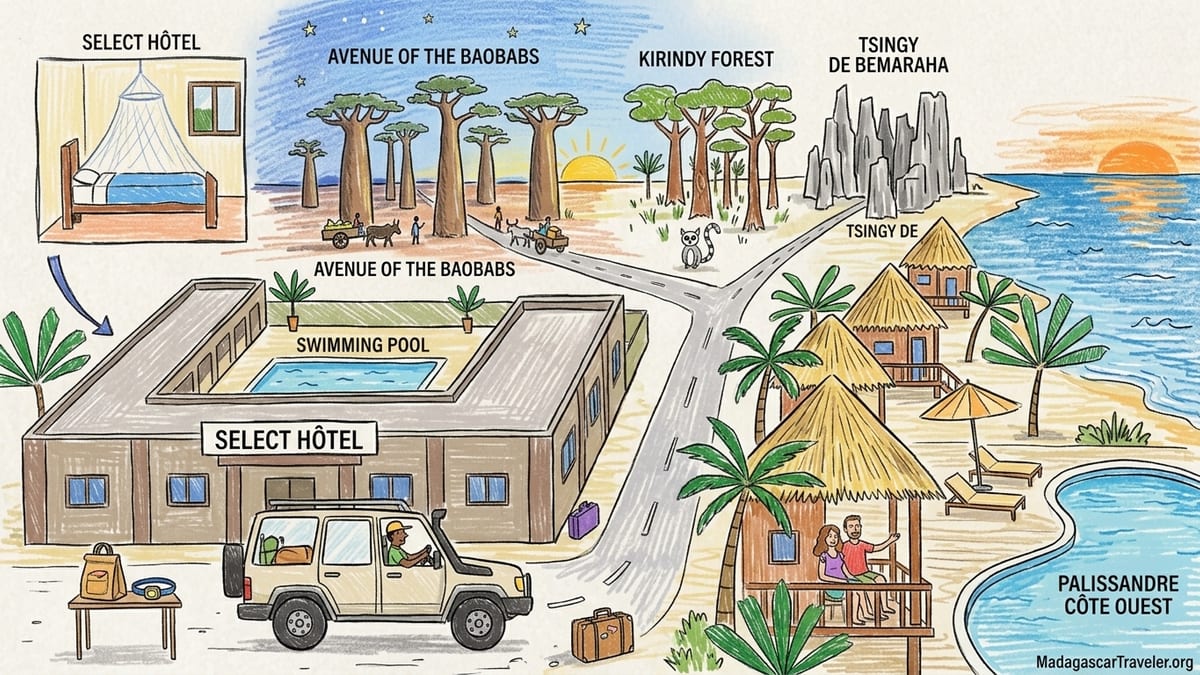
How I Chose and Tested Hotels in Morondava
I booked Morondava with very specific needs: an early exit to Kirindy Forest, a pre-dawn run to the Avenue of the Baobabs, and at least one day where I could simply sit by the sea and recover between long drives. That meant I needed a central stop that functioned smoothly for logistics, plus a coastal place that felt like a genuine break rather than a prettier version of the same dust and noise. I deliberately focused on properties that were consistently used by tour operators and independent travelers, then pressure-tested them against what actually happens on the ground.
To ground my choices, I cross-checked my own priorities against hundreds of recent traveler reviews and operator documents for Morondava. Select Hôtel, Hotel Trecicogne, Kimony Resort and Palissandre Côte Ouest repeatedly came up in connection with Avenue of the Baobabs, Kirindy and Tsingy excursions, often in detailed first-hand trip reports that mentioned real-world issues such as weak water pressure, patchy air conditioning and power cuts. I kept a close eye on mentions of mattress quality, breakfast timing, air flow and the ease of organizing drivers and early starts.
It is important to be transparent. I did not personally sleep in every one of the properties referenced here, and Madagascar infrastructure changes quickly. What follows is a blend of one hotel I did stay in, others I inspected and researched in depth while in Morondava, and several alternatives clearly labelled as research-based only. Where I describe a place as “personally tested,” that refers strictly to an overnight stay on my own itinerary. Everything else is based on on-site visits, conversations with staff and drivers, and recent reports from other travelers.
Rather than rank hotels as if there is a single “best,” this guide looks at what actually worked for different travel needs: arriving dusty and late from Tsingy, coordinating early departures, traveling with kids, wanting something romantic on the beach or simply trying to stretch your budget without sacrificing basic comfort. The goal is not to crown a winner, but to help you understand which hotel characteristics matter most for a Morondava trip and how to read between the lines of glossy booking photos.
My Central Base: Personally Tested Stay at Select Hôtel
Select Hôtel on the main road in Morondava became my functional base, the place I could trust to work when logistics were tight. The room I stayed in was large by Malagasy standards, with enough floor space to open two suitcases at once and still walk around the bed. The mattress was on the firm side but supportive, closer to a mid-range European hotel than a typical roadside guesthouse, and the bed frame did not creak every time I turned over, which mattered on a short night before an early start. Linen was basic cotton, not luxury, but felt clean, and extra pillows were available on request.
My room had both air conditioning and a ceiling fan. During the afternoon heat the air conditioning cooled the space reliably and reasonably quickly. At night I often switched it off and kept only the fan running for quieter airflow. The windows were glazed and closed well, which helped with both noise and mosquitoes, and there was a proper mosquito net over the bed with a full overlap below the mattress. I still used repellent around my ankles and wrists, but compared with other West Coast stays this setup felt reassuringly solid. In the bathroom, water pressure in the shower was moderate but steady, and I had hot water each time I tried, including very early in the morning. There was a short lag for the water to warm up, which is common in Madagascar, so factoring in extra minutes before a dawn departure is sensible.
Breakfast at Select Hôtel started early enough to be practical. On the day I left for the Avenue of the Baobabs before sunrise, staff were willing to put together a simple packed breakfast with bread, a croissant, a piece of cake and a cheese portion. It was very carb-heavy and not particularly exciting, but it meant I could eat something in the car without delaying my departure. On a more relaxed morning the sit-down breakfast included bread, pastries, eggs cooked to order and coffee from the bar. The on-site restaurant surprised me with its range, offering Malagasy dishes, French-accented plates and straightforward grilled fish, which meant I did not have to go searching around town after a long drive. Portions were generous enough that I sometimes skipped lunch the next day.
The hotel has a real swimming pool in a sheltered courtyard, which looked like a decorative extra in photos but turned out to be one of the greatest comforts after the Tsingy–Morondava road. The pool is not resort-sized, yet it was deep and long enough for a few strokes and, more importantly, it was clean when I visited. Loungers provided a place to dry off in the late-afternoon sun while my clothes and shoes shook off the dust. Wi-Fi coverage worked best in the restaurant and pool area and was weaker in my room, but I could usually send messages and back up a few photos if I was patient. Power did cut briefly one evening, which is normal in Morondava, but the hotel had a generator that kicked in after a short gap, and the fan and lights came back reasonably quickly.
For logistics, Select Hôtel functioned exactly as I needed. There is on-site parking, so my driver could pull in off the main road and park securely, and the reception team were used to arranging early checkouts and coordinating with guides. The location is not by the beach, which some travelers see as a drawback, but being on the main road simplified early exits toward the Baobab Avenue and Kirindy because we did not have to add extra time winding through the sandy coastal streets. The booking photos had not fully prepared me for how “businesslike” the hotel feels compared with beach properties, nor for how comforting that solid, almost utilitarian setup would be when everything else in the day involved heat, dust and delays.
Best Coastal Stay for Recovery Days: Research-Based Look at Palissandre Côte Ouest
For a coastal recovery stay, many Madagascar specialists steer travelers toward Palissandre Côte Ouest on the Nosy Kely peninsula, a beach strip about 30 minutes’ drive from the Avenue of the Baobabs and the airport. Even though my own overnight was inland at Select Hôtel, I spent time in Nosy Kely and dug deeply into reports and operator itineraries that place guests at Palissandre after Tsingy and baobab circuits. What emerges is a picture of a genuinely higher-comfort beach hotel that is still tied into the classic West Coast routes.
Rooms at Palissandre Côte Ouest are arranged in bungalows facing the sea, usually with private terraces looking over the sand and channel. Travelers consistently mention large beds with quality mattresses, proper blackout curtains and steady air conditioning. That combination matters on the coast, where afternoons can be both hot and bright. Photos show traditional wooden details and thatched roofs, but behind that rustic aesthetic there are tiled floors and furnished bathrooms with hot water, so you are not trading comfort for atmosphere. Mosquito protection combines nets around the beds with screens on doors and windows, and the coastal breeze can help with airflow once the sun drops.
The resort-style pool on the beachfront is one of the big advantages of Palissandre Côte Ouest if you are coming off bumpy inland roads. Instead of walking straight from dust into the sea, you have the choice of swimming in clear, chlorinated water and then rinsing off in your room’s shower. Many guests describe long idle afternoons moving between the pool, the shaded bar and the beach, which is exactly the kind of pause many itineraries need between trekking in Tsingy and the more urban chaos of Antananarivo. The on-site restaurant serves a mix of seafood and international dishes, and buffet breakfasts typically include eggs, fruit, pastries and Malagasy staples, which is more variety than you will find in most simple town hotels.
There are trade-offs. Because Palissandre Côte Ouest sits out on the beach strip rather than in town, trips to the market or to the main taxi-brousse station require a car, and early-morning departures to the baobabs or Kirindy involve driving back along the peninsula rather than simply following the main road out. For travelers with a dedicated driver this is a minor addition of time; for those relying on local taxis it can become a logistical detail to plan around. Prices are significantly higher than in town, reflecting both the beachfront location and the resort-style pool and spa services. This is not the place to trim your Madagascar budget, but if you are going to splurge anywhere on the West Coast, this is where the extra cost most obviously buys long-term comfort rather than just prettier photos.
Because my insight here is research-based rather than from a personal overnight, I am cautious about firm judgments. However, the consistency of reports from tour operators and independent travelers, and the way Palissandre Côte Ouest is repeatedly used as the finale of West Coast itineraries, suggests that its combination of room comfort, pool, food and direct beach access makes it the most complete coastal choice in Morondava for anyone who values recovery time between demanding excursions.
Best Value Town Stay: Research-Based Insights on Hotel Trecicogne
If you want to feel the ocean without paying resort prices, Hotel Trecicogne in town occupies a useful middle ground. It sits close to the seafront, in a relatively quiet pocket that still allows you to walk to the water and nearby restaurants. On my own walk through the area the neighborhood felt lived-in but not chaotic, with children playing and zebu carts passing slowly. That atmosphere matches traveler comments that describe the location as calm while still being near the ocean, a rare balance in smaller Malagasy cities.
Guest reports about rooms at Trecicogne paint a picture of solid, no-frills comfort. Rooms are typically smaller than at Select Hôtel, with simpler furniture and bathrooms, but travelers regularly describe them as clean and functional. Mattresses tend to be firmer and occasionally basic, which is worth considering if you have back issues, but many visitors manage multiple nights without complaint. Some rooms have fans rather than air conditioning, which can be sufficient with the sea breeze in the cooler months but may feel warm in peak summer. Mosquito nets are usually provided, although as in many budget and mid-range hotels in Madagascar, how snugly they tuck under the mattress can vary from room to room.
Breakfasts at Trecicogne are generally simple: bread or baguette, jam, butter and coffee or tea, sometimes with fruit or an egg if you ask. Travelers planning early excursions often negotiate an early coffee or a basic takeaway snack, but it is not as structured a process as at more business-oriented hotels. The on-site restaurant focuses on straightforward Malagasy and French options, with seafood when available. Prices per night at Trecicogne tend to be noticeably lower than at Palissandre Côte Ouest or other coastal resorts, and often a bit lower than Select Hôtel as well, which makes it attractive for travelers trying to stretch their stay over several weeks.
On the practical side, some travelers mention that Wi-Fi can be intermittent, especially in rooms farther from reception, and that power fluctuations are felt more strongly than in hotels with larger generators. If you need to back up photos or handle work emails, planning to do so in reception or the restaurant when the network is strongest is wise. Parking exists but is more constrained than at modern road-facing hotels; if you are traveling with a driver, confirming space for the vehicle and for a basic driver room is worth doing in advance. As with all research-based sections in this guide, these observations come from recent reviews and operator notes rather than my own overnight stay, so treat them as a guide to questions you should ask rather than as definitive verdicts.
Best for Early Baobab and Kirindy Departures: Personally Tested Priorities
The single hardest part of planning my Morondava hotel was not deciding between town and beach, but making sure the property actually supported early departures. The classic experiences here require being on the road before the sun is up or still out after dark: a dawn visit to the Avenue of the Baobabs, afternoon-to-night excursions in Kirindy Forest and long transfers to or from Bekopaka for the Tsingy de Bemaraha. From that perspective, Select Hôtel worked extremely well during my stay, and the features that mattered go far beyond having a comfortable bed.
First, breakfast logistics. When I asked about leaving before sunrise, staff immediately offered a packed breakfast without trying to push my departure later. The contents were basic, mostly white bread, pastries and a processed cheese portion, but because it was ready at the agreed time I could simply collect it and go. If you choose a different hotel, this is the standard you want to check for in advance: will they genuinely have something ready at 4:30 or 5:00 a.m., or is breakfast only theoretical before 6:30? If you are heading to Kirindy for a dawn or night walk, having calories you can eat in the car is more important than variety.
Second, power and hot water. Before my first early morning I tested the shower late at night and again just before dawn. In both cases Select Hôtel delivered hot water, with a short wait but no sudden cut. I also paid attention to what happened in the evening when a brief town-wide cut hit. The hotel’s generator kicked in quickly enough that I did not have to repack by headlamp, and the fan returned, which kept the room cool for rest before another early rise. For early excursions, these details are critical. In a place with more fragile infrastructure, a hotel that has a working generator and enough water pressure at odd hours may be worth more than a slightly prettier room.
Third, coordination with drivers and guides. At Select Hôtel, reception staff were used to seeing 4x4s come and go at unusual hours and already had contact details for several local drivers and operators. That meant when my driver mentioned minor delays on the road back to Morondava, the hotel was relaxed about a late arrival and still ready with dinner. In the morning, the security guard opened the gate on time and had the parking area cleared so the car could exit quickly. By contrast, some coastal hotels that prioritize leisurely days can be slower to adapt their rhythm to pre-dawn activity. If your main focus in Morondava is early baobab light or Kirindy wildlife, choose a hotel that understands this rhythm instinctively, even if its decor is less appealing than beach resorts.
Finally, location relative to the road north. Being on or near the main road that leads toward the Avenue of the Baobabs and Kirindy saved us 15 to 20 minutes compared with starting from some beachside addresses, especially when factoring in the time needed to navigate sandy side streets and occasional traffic jams with zebu carts. Over several early starts this time adds up. On a short trip where you might only have one dawn at the baobabs, that small buffer can be the difference between arriving in predawn calm and pulling up as tourist minibuses start to crowd the trees.
Best for Families and Groups: Research-Based Comparisons
Families and small groups heading to Morondava often face two competing needs. They want space for children to move and play safely after long drives, and they need basic logistics such as driver accommodation and early breakfasts to run smoothly. I did not travel with children, so my insight here is based on walking through family-friendly properties and on the patterns that emerge from families’ own reports.
Kimony Resort, located in a baobab-dotted landscape several kilometers outside town and a couple of kilometers from Kimony Beach, is one frequently mentioned option for families. Bungalows are spread out in a large garden where lemurs sometimes appear, and there is a sizeable swimming pool that gives children a place to burn off energy without going to the sea each time. Some families love the nature-focused feel, clean air and quiet nights. However, travelers also report that maintenance can vary, with occasional comments about weak water pressure, air conditioning that struggles and some facilities that feel older than the photos suggest. For families, this trade-off between space and reliability is important to weigh: you may gain a big pool and a garden at the cost of slightly rougher edges in the rooms.
Palissandre Côte Ouest also works for families who can afford its higher rates. Its bungalow layout and beachfront pool create a contained environment where parents can watch children swim or play in the sand while still relaxing themselves. Several family-oriented Madagascar tour itineraries place guests at Palissandre, which indicates a level of confidence in both safety and comfort. Larger rooms and the availability of extra beds mean siblings can share, reducing the need for multiple bungalows. For multi-generational trips where grandparents may appreciate air conditioning and comfortable mattresses as much as children want a pool, this kind of setup can justify the price.
Inside town, Select Hôtel is less of a classic family resort but still an option for groups, especially those traveling with older children or on educational tours. The pool, while not huge, gives hot and dusty teenagers somewhere to cool off, and the larger rooms can sometimes be arranged with twin beds. Importantly, town hotels are more likely to have simple rooms or beds for drivers at low or no extra charge, which matters on family trips where you may be traveling with a dedicated vehicle for several days. If you are booking with children, ask specifically about room configurations, pool depth and whether mosquito nets cover multiple beds or only a double, so you can pack extra netting if needed.
Whichever property you choose, the key for families in Morondava is to think through daily rhythms. Children will likely be tired and dusty after even short excursions, so prioritizing consistent hot water, easy access to food at flexible times and some kind of safe play area often matters more than elaborate decor or spa menus. Reading between the lines of recent family reviews and asking targeted questions by email before arrival can help you avoid surprises.
Best Romantic and Higher-End Option: Research-Based View
For couples looking for a romantic stay or anyone wanting a higher-end base, the West Coast around Morondava does not offer ultra-luxury in the way that some Indian Ocean islands do, but it does have a few properties that feel distinctly more polished. Palissandre Côte Ouest again sits at the top of this category, combining direct beach access, sunset views and more refined dining with the practicalities of a West Coast base.
In a romantic context, details that are pleasant extras for other travelers become central. Reports describe couples arriving after long domestic travel days and being greeted with cool drinks, scented towels and a smooth check-in process. Rooms tend to have king or queen beds with better-quality mattresses and sheets than town hotels, and private terraces with sea views invite long, slow evenings rather than collapsing immediately to sleep. The beachfront bar and restaurant give couples the option of lingering over dinner with the sound of the sea, which is significantly easier than arranging taxis back and forth from town restaurants after dark.
Higher-end options also tend to manage power and water more discreetly. While outages still occur, properties at this level usually have larger or better-maintained generators and water systems, which means fewer sudden blackouts or cold showers. For a honeymoon or anniversary trip, this reduced friction can be worth a great deal, even if the room itself is not dramatically more ornate than a solid mid-range option. What booking photos often fail to convey is the difference between a place where the staff quietly handle these issues before you notice, and one where you need to ask multiple times for basic fixes.
Cost is the main constraint. Nightly rates at high-end properties around Morondava can be several times those of simple town hotels, and restaurant prices follow the same pattern. Couples should decide where the romantic feel matters most in their itinerary. One sensible approach is to use a reliable, good-value town hotel like Select Hôtel for the purely functional nights linked to early departures, then book Palissandre Côte Ouest or a similar beachfront hotel for the final one or two nights as a decompression stop before flying out. This combination lets you benefit from both efficiency and romance without carrying full resort costs across your entire stay.
The Takeaway
Staying in Morondava is less about finding a universally “best” hotel and more about matching very specific comforts to your own route. My stay at Select Hôtel showed how valuable a large, clean room, reliable air conditioning, a functioning mosquito net and early breakfast can be when all you want is to sleep, shower and get back on the road. For that kind of night, central location and solid logistics beat any amount of beach scenery or decorative woodwork.
At the coastal and higher-end level, properties like Palissandre Côte Ouest and, for some families, Kimony Resort trade proximity to the main road for space, pools and sea views. These are not always the simplest bases for pre-dawn departures, but they shine as recovery stops after Tsingy or as romantic finales where hot water, sunset cocktails and a real swimming pool become the main events. Town options such as Hotel Trecicogne create a compromise between cost and access to the ocean, and can work well for travelers who are price-sensitive but still want some sea air and walking access to the waterfront.
The booking photos that dominate search results focus on pools, palm trees and sunsets, but they rarely show the things that matter most in Morondava after hours on laterite tracks: the thickness of the mattress, the way the mosquito net meets the mattress, whether water still runs hot before dawn, how quickly the generator kicks in and whether the kitchen can assemble a basic breakfast at 5:00 a.m. Asking hotels direct questions about these points and reading traveler reviews with them in mind will tell you far more than any picture of a palm-framed pool.
If you remember anything from this guide, let it be this: for Morondava, pick your hotel according to your timetable and tolerance, not just your budget. For early baobab and Kirindy starts, prioritize a central hotel that has a generator, proven hot water at odd hours and a track record of working with drivers. For rest and romance, shift to the beach and pay extra for comfort once the dust is behind you. You will enjoy Morondava more, not because you found the mythical perfect hotel, but because you chose a place that quietly supported the kind of trip you actually came for.
FAQ
Q1. Is it better to stay in town or on the beach in Morondava?
Staying in town simplifies early departures to the Avenue of the Baobabs and Kirindy because you are closer to the main road and services. Beach hotels on Nosy Kely or near Kimony Beach offer sea views and pools that are much better for rest days and sunsets, but usually add driving time and cost. Many travelers split their stay between a functional town base and a coastal hotel for recovery.
Q2. How important is air conditioning in Morondava hotels?
Temperatures on the west coast can be hot, particularly from October to December, and humidity rises near the sea. Air conditioning is not strictly essential for everyone, but it makes a big difference after dusty days on the road or in the hotter months. At a minimum, choose rooms with strong fans and the ability to keep windows or shutters open with mosquito protection. If you sleep poorly in heat, prioritize hotels with consistently reviewed air conditioning even if they cost more.
Q3. Do Morondava hotels usually have hot water early in the morning?
Some hotels, such as the more established town properties, manage to provide hot water even before dawn, while others rely on systems that can cool overnight or fluctuate with power cuts. It is wise to test the shower at the time you expect to use it or to ask reception specifically about hot water for early departures. If a hot shower before sunrise is essential, focus on hotels with recent traveler comments about reliable hot water and working generators.
Q4. How early can I get breakfast if I am visiting the Avenue of the Baobabs at sunrise?
In many Morondava hotels, standard breakfast service does not start early enough for sunrise departures, but staff can often prepare a simple packed breakfast if requested the day before. This usually means bread or pastries and a hot drink rather than a full buffet. When booking, ask whether the hotel is used by tour groups for baobab and Kirindy excursions and confirm what time they can actually have food ready.
Q5. Is Wi-Fi reliable in Morondava hotels?
Wi-Fi exists in most mid-range and higher-end hotels in Morondava, but it can be slow and uneven, particularly in rooms far from reception or during peak use. If you need to upload photos, book onward travel or work, plan to do it in the restaurant or lobby where the signal is strongest, and allow extra time. For critical tasks, consider arranging mobile data through a local SIM as a backup.
Q6. Do hotels in Morondava provide accommodation or parking for drivers?
Many town hotels that regularly host tourists have basic rooms or arrangements for drivers, sometimes included in the room rate or offered at a reduced price. Parking at these properties is usually on-site or in a gated courtyard. Beach and out-of-town hotels may have more limited driver facilities or charge more. If you are traveling with a dedicated vehicle, ask in advance about secure parking and whether a driver room is available.
Q7. Are mosquitoes and malaria a serious concern in Morondava hotels?
Morondava is in an area where malaria is present, so mosquito protection is important, particularly from dusk to dawn. Many hotels provide bed nets, but their condition and fit can vary. It is sensible to check the net when you arrive, use insect repellent on exposed skin and keep windows or doors closed or screened in the evening. Speak with a travel health professional before your trip about appropriate prophylaxis and vaccinations.
Q8. How far are Morondava hotels from the Avenue of the Baobabs and Kirindy Forest?
From central Morondava, the Avenue of the Baobabs is roughly an hour’s drive, depending on road conditions, while Kirindy Forest is farther along the same route and can take several hours each way by 4x4. Beach hotels on Nosy Kely or near Kimony Beach add extra time at the start and end of these drives. When planning your schedule, factor in at least an hour to reach the baobabs before sunrise and longer if you are heading to Kirindy for wildlife viewing.
Q9. Can I easily walk to restaurants and markets from my hotel?
Town hotels within Morondava often sit within walking distance of small restaurants, markets and basic shops, though you should remain aware of your surroundings, especially after dark. Beach hotels and resorts usually have their own restaurants, and walking off-property at night can be limited by lighting and distance. If you enjoy exploring local eateries, a central hotel may suit you better, while coastal stays favor staying on-site for dinner.
Q10. How should I balance budget and comfort when choosing a hotel in Morondava?
Because road travel in western Madagascar is tiring, skimping too much on comfort can affect how much you enjoy the main sights. A practical approach is to book a reliable mid-range town hotel with good beds, fans or air conditioning and early breakfast support for the nights tied to early departures, then allocate part of your budget for one or two nights at a higher-end beach property for rest. This way you pay for comfort exactly when it brings the greatest benefit.