


Hiring a guide, driver or 4x4 tour in Morondava can make the difference between a rushed box‑ticking stop at the Baobab Avenue and a smooth Menabe journey that hits Kirindy wildlife, sunset light and remote tracks without stress. On the other hand, it is very easy to overpay for full‑day excursions that do not add much beyond basic transport. This commercial‑investigation report looks at concrete, recent examples of Morondava‑based services that travelers have actually used, how they booked them, what they paid and, crucially, what value they really received in return.
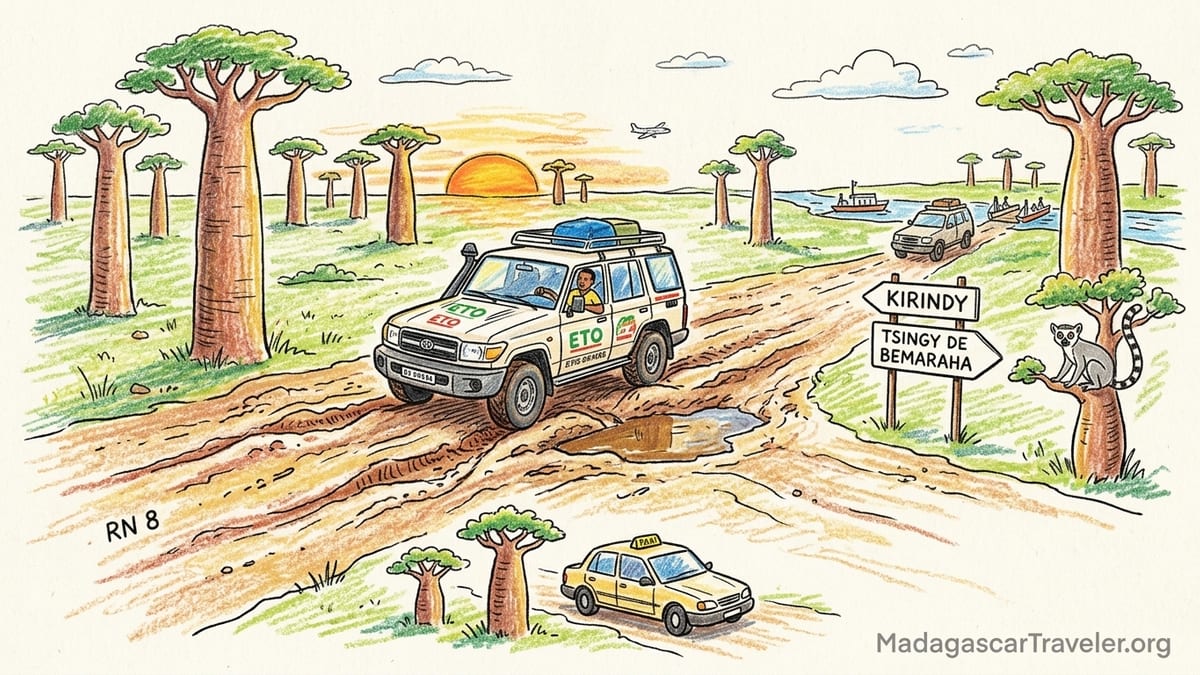
The Current Morondava 4x4 Landscape
Morondava sits at the heart of Madagascar’s Menabe region, and it is the jump‑off point for the Avenue of the Baobabs, Kirindy Forest and the longer, rougher track to Belo sur Tsiribihina and the Tsingy de Bemaraha. Roads quickly turn from tarmac to laterite and deep ruts once you leave town, which makes four‑wheel drive with a competent local driver far more than a luxury. Most visitors who reach Morondava either pre‑arrange a car and driver from Antananarivo, or, increasingly, pick up a local 4x4 through their hotel or a licensed operator once in town.
Recent offers from licensed Morondava operators help illustrate the going rates. Eto Morondava, which advertises its license number locally, currently lists a full‑day “Réserve de Kirindy et ses baobabs” excursion from around 150 euros for one person, with a sliding scale up to roughly 210 euros for four people. The package departs at 07:30 from the traveler’s hotel and includes a 4x4 vehicle and driver, fuel, park entry and guiding at Kirindy, parking, communal taxes, mineral water and visits to both the Avenue of the Baobabs and the Baobab Amoureux. Lunch and tips are explicitly excluded, which is typical of Morondava‑based day trips.
Alongside such licensed outfits, there is a parallel market of independent drivers who advertise through word of mouth, guesthouses or travel forums. One recent traveler arranging a West Madagascar loop including Morondava reported paying about 250,000 ariary per day for a 4x4 with driver, plus fuel on top, while another group organizing a dedicated Morondava to Tsingy run spoke of 350,000 ariary per day inclusive of car, driver and fuel plus extra for ferry crossings. These real‑world figures frame the choice between all‑inclusive excursions and more flexible, pay‑as‑you‑go vehicle hire.
In practice, the services fall into three broad categories. First are short sunset or sunrise runs from Morondava to the Avenue of the Baobabs in a regular car or 4x4, often booked via a hotel reception for roughly 90,000 to 180,000 ariary for the vehicle, with local access fees of a few thousand ariary on top. Second are full‑day Kirindy plus Baobabs circuits in proper 4x4s with guiding included. Third are multi‑day driver‑and‑vehicle hires toward Belo sur Tsiribihina, Bekopaka and the Tsingy, where a robust 4x4 and an overnight driver arrangement become essential rather than optional.
Case Study: Full‑Day Kirindy + Baobabs 4x4 Excursions
The classic product most first‑time visitors consider is the full‑day 4x4 trip that combines Kirindy Forest and the Avenue of the Baobabs. Eto Morondava’s Kirindy and Baobab tour is a good example of how these are structured. The booking is typically made directly with the operator online ahead of time or in person at their office or through a partner hotel once in Morondava. Departure is from the traveler’s hotel in town at around 07:30, with a maximum of four passengers in the 4x4.
The advertised price structure begins at about 150 euros for solo travelers and increases modestly with each added passenger, to around 170 euros for two, 190 euros for three and 210 euros for four people. The vehicle is a dedicated 4x4 with a local driver, and inclusions are clearly laid out: transport, driver, fuel, Kirindy park entry and local guiding, parking, mineral water, communal taxes and the standard stops at Baobab Alley and the so‑called Baobab Amoureux tree. Lunch is not included, although the driver will normally arrange a simple roadside or lodge meal stop at the traveler’s expense.
Flexibility on this sort of day tour is moderate rather than total. Drivers understand that photography is a major reason people visit Kirindy and the Baobabs, and they will usually adjust stop durations if the group spends longer on a lemur sighting or requests additional photo stops among roadside baobabs. However, the broad shape of the itinerary is fixed: a mid‑morning arrival at Kirindy for a daytime forest walk, a return drive through baobab country in the afternoon and a timed sunset session at the Avenue before heading back to Morondava in the dark.
Where these tours genuinely add value is in logistics and wasted time avoidance. The track from Morondava to Kirindy can deteriorate badly after rain, with flooded potholes and sticky mud that would be intimidating even for self‑drivers. A local 4x4 driver is not just steering; they are reading the road conditions, talking to other drivers about recent washouts and choosing the least risky ruts to avoid getting bogged. At Kirindy itself, the included local guide is essential for wildlife spotting. Many of Kirindy’s key species, from the fossa to tiny nocturnal lemurs and birds, are extremely hard for an untrained visitor to find on their own. A guide who knows current animal territories can turn a hot, puzzling walk into a rewarding series of encounters.
Private Drivers and Independent 4x4 Hire
Travelers with more time in Menabe or a desire to push beyond the standard day excursion often turn to independent 4x4 hire with a private driver. Unlike the fixed‑itinerary day tours, these arrangements are usually negotiated directly with drivers or small agencies based in Morondava or Antananarivo. The services are then used to connect Morondava, Kirindy, Belo sur Tsiribihina and sometimes onward to Bekopaka and the Tsingy de Bemaraha.
Recent traveler reports suggest that a fair ballpark for a private 4x4 with driver has hovered around 250,000 to 350,000 ariary per day, depending on vehicle size, route difficulty and whether fuel is bundled. One small local rental agency owner recently advertising on a travel forum from Morondava mentioned handling airport transfers and guided tours in a comfortable 4x4, reinforcing that this price range is realistic for locally based operators in 2025 and 2026, though all travelers should reconfirm current rates when they book. Some drivers quote “all‑in” daily rates including fuel, while others bill fuel separately according to kilometers driven and pump prices.
The difference in value compared with packaged tours depends on how intensively you use the vehicle. A multi‑day trip from Morondava north up the RN 8 track toward Belo sur Tsiribihina and Bekopaka for the Tsingy, with stops in Kirindy and possibly Marofandilia, can quickly add three to five driving days. One traveler sharing a Morondava‑Tsingy itinerary reported paying around 350,000 ariary per day inclusive of car, driver and fuel, plus roughly 180,000 ariary for key ferry crossings and river logistics, for a four‑day round trip.
With this type of private hire, inclusions are largely limited to vehicle, driver and in some cases fuel. Park entrance fees, local site guides at Kirindy or the Tsingy, accommodation and meals are paid directly by the traveler. Water is sometimes provided in a basic way, but is not guaranteed and should not be assumed. The real benefit is flexibility: private drivers will normally adapt departure times, photo stops and short detours to villages or viewpoints to suit your interests, within the constraints of road conditions and safety.
There is also a safety and continuity advantage. In remote Menabe, vehicle breakdowns are common, and drivers who make the west‑coast run regularly know mechanics in Belo sur Tsiribihina or Bekopaka and carry basic spare parts. While a larger tour operator can sometimes dispatch a replacement vehicle, independent drivers build their reputation on keeping a trip moving despite punctures, broken suspensions or ferry delays. For travelers planning to zigzag between river descents, Kirindy night walks and Tsingy hikes, this continuity can be more valuable than a few saved euros on day‑trip pricing.
Hotel‑Arranged Taxis and Short Morondava Excursions
At the other end of the spectrum are short, targeted excursions that generally do not require a full‑fledged tour operator. The most common are sunset or sunrise trips from Morondava town to the Avenue of the Baobabs and back, either in a saloon car during dry conditions or in a basic 4x4. Many hotels and beachfront bungalows in the Nosy Kely area maintain a short list of trusted drivers who can be called at a few hours’ notice.
Recent guidebooks and travel planning resources report typical prices in the range of 90,000 to 180,000 ariary for a taxi or car and driver from Morondava to the Avenue and back, depending on bargaining and whether you ask for extra stops among roadside baobabs. Small local fees at the Avenue itself, covering access and parking, usually fall somewhere between roughly 5,000 and 20,000 ariary and are paid by the traveler in cash. Here, there is little need for a fully licensed tour operator product. The service you are paying for is safe, punctual transport along a known route and a driver who understands how to time arrival for the best pre‑sunset or post‑sunrise light.
Hotel‑arranged cars make most sense when you have already visited Kirindy independently or simply do not want a long day on the tracks. A traveler might, for example, arrive on a midday flight to Morondava, check into a Nosy Kely bungalow and ask the reception to arrange a car to the Avenue for sunset. In dry season this is straightforward, and the driver can usually wait during the hour or two you spend walking between baobabs. Travelers who want to return for sunrise the next morning often simply re‑book the same driver for a pre‑dawn pickup.
Other local outings, such as short town tours, craft market visits or an afternoon stroll along the mangrove channels, are also well served by ad hoc taxis rather than formal guides. Drivers know the small detours and will normally wait while you explore. The key is to agree in advance on whether you are paying a flat excursion price for the car, or an hourly rate, and to confirm if the total price is per vehicle or per person. In Morondava, almost all such arrangements are per vehicle, which works in your favor if you are traveling as a couple or small group.
When an Overnight Driver Becomes Essential
Beyond Kirindy and the Avenue of the Baobabs, distances and road conditions in Menabe quickly cross the line where an overnight driver and 4x4 are necessities rather than conveniences. The RN 8 track north from Morondava to Belo sur Tsiribihina and finally Bekopaka, gateway to the Tsingy de Bemaraha National Park, is unpaved, heavily rutted in places and interrupted by basic river ferries. Travel‑time estimates from experienced tour planners make it clear that even in the dry season you should expect a full day to reach Belo sur Tsiribihina and another long day to reach Bekopaka.
For this reason, multi‑day arrangements with a dedicated driver and vehicle are standard for anyone attempting the Tsingy loop or more exploratory Menabe routes. Several tour itineraries that connect Antananarivo, Morondava, Kirindy, Tsingy and the Tsiribihina River descent are built around at least three to five days of 4x4 travel between Morondava, Belo sur Tsiribihina and Bekopaka. Overnight stops in Belo or Marofandilia are used both for rest and as buffers against ferry queues, breakdowns and sudden rain that can transform the track.
In this context, trying to economize with one‑off taxis or piecemeal day trips is likely to backfire. A driver who is contracted for the full loop has clear responsibility for the entire routing. They help you coordinate Tsiribihina descents with boat operators, adjust departure times to match ferry opening hours and keep a close watch on park office schedules at Bekopaka and Kirindy. Many also serve as ad hoc translators with village residents, ferry operators and park staff, a role that becomes important when changes to water levels or track closures must be negotiated on the fly.
Costs inevitably rise with this level of commitment. A fair total budget for a private 4x4 and driver on a four‑day Morondava to Tsingy round trip often reaches into the low hundreds of euros once daily vehicle rates, fuel, ferry fees and the driver’s accommodation and meals are counted. Some organized options bundle these into an all‑inclusive Tsingy extension, while do‑it‑yourself travelers must remember to agree explicitly on who pays for the driver’s lodging and food in Belo and Bekopaka before setting off.
What Guides and Drivers Actually Add Beyond Transport
Whether booked as part of a polished excursion product or as an informal arrangement, the best Morondava‑area guides and drivers add several layers of value beyond merely having a set of wheels. The first and most obvious is navigation of rough, unmarked and sometimes changing tracks. Particularly after heavy rain, the back road sections between the Baobab Alley, Kirindy and Marofandilia become a series of muddy decision points. An experienced driver knows which ruts to straddle, when to wait for another vehicle to test a water‑filled hole and how to interpret the state of a community ferry or bridge.
Timing is another subtle but important contribution. For photographers, the Avenue of the Baobabs is all about light. Drivers who make this run several times a week know how long it takes to reach the Avenue from different parts of Morondava, and they can advise whether it is realistic to squeeze a late‑afternoon Kirindy visit and a sunset at the Avenue into the same day in a particular season. They also keep one eye on clouds building out over the Mozambique Channel. When it is clear that a dramatic red sunset is unlikely, some will propose lengthening the golden‑hour stop among lesser‑known roadside baobabs instead.
At Kirindy, guiding is tied directly to wildlife sightings. Local guides who walk the forest daily are familiar with current fossa territories, lemur sleeping trees and bird nesting sites. A traveler who joins a guided day or night walk shortly after arrival stands a high chance of seeing several lemur species and at least hearing fossa activity. Self‑guided walks, which are theoretically possible if you know the trail network, tend to produce far fewer sightings and can even put visitors in the wrong place during sensitive breeding or denning periods.
Finally, there is a layer of problem‑solving and bureaucracy handling that matters more in western Madagascar than in many better‑resourced destinations. Drivers often pay small local bridge or parking fees on behalf of travelers to speed things up, then settle up the total at the end of the day. They keep in touch with park offices regarding closures or strikes, and they are the ones who argue with a ferry operator about queue order while travelers rest in the shade. During multi‑day runs, they can coordinate with accommodations in Belo or Bekopaka about late arrivals, so a bungalow is still held if the track deteriorates. None of this is glamorous, but it significantly reduces wasted time and frayed nerves.
What You Can Comfortably Do Without an Expensive Tour
Not every Morondava experience justifies a high‑priced, pre‑packaged excursion. For independent travelers willing to ask basic questions and carry some cash, several highlights can be enjoyed using simple hotel‑booked cars and on‑site local guides rather than a full‑service operator. The most important of these is the Avenue of the Baobabs at sunset or sunrise. The route from Morondava is straightforward, and when conditions are dry a basic car or pick‑up is usually sufficient. Hotel staff can call a trusted driver, agree a per‑vehicle price in the common 90,000 to 180,000 ariary range and arrange for the car to wait while you photograph and explore.
Similarly, a traveler already moving between Morondava and Kirindy for other reasons can often organize guiding on the spot at the Kirindy park office rather than pre‑paying a full “Kirindy package” from town. Park entrance and guiding fees quoted in recent planning resources are usually under the equivalent of 40 US dollars per person for a combination of day and night walks, and the official guides are allocated as visitors arrive. When you already have a vehicle and driver, there is little added value in paying a Morondava operator to re‑bundle these services unless you need language support or guaranteed advance timing.
Within Morondava itself, basic introductions to the town, the seafront and nearby fishing villages can be handled by local taxis or even on foot. Curious travelers will pick up stories and explanations simply by talking with hotel staff, market vendors and drivers. In these cases, a formal “city tour” is usually unnecessary. The one area where a local guide can still add cultural depth is visits to remote Sakalava communities or sacred baobabs off the normal tourist circuits, but these are best arranged through someone with proven community connections rather than an anonymous tout.
Finally, travelers on very tight budgets should remember that not every day in Morondava must feature a paid excursion. It is entirely reasonable to alternate a more expensive full‑day trip to Kirindy and the Baobabs with a slower beach day in Nosy Kely, or with a simple sunset walk along the estuary without a vehicle at all. Spreading costs this way keeps the overall budget manageable while still leaving room to pay properly for the specific services, like Kirindy wildlife guiding and multi‑day 4x4 hires, that genuinely affect your experience.
The Takeaway
When you strip away glossy brochure language, Morondava’s guide, driver and 4x4 market comes down to a few clear decisions. The first is whether you want the convenience of an all‑inclusive day tour, such as Eto Morondava’s roughly 150‑euro‑and‑up Kirindy and Baobabs package that folds vehicle, fuel, Kirindy entry, local guiding and mineral water into one price, or the flexibility of a private 4x4 and driver hired by the day with park fees and meals paid as you go. The second is how far into Menabe you plan to push. For a simple Baobab Avenue sunset, a hotel‑arranged taxi and on‑the‑spot access fees are entirely adequate. For Kirindy and especially for the long and unpredictable run to Belo sur Tsiribihina and the Tsingy, an experienced driver with a robust 4x4 quickly becomes non‑negotiable.
Real‑world examples from recent travelers and licensed operators suggest that a sensible budget for a serious Morondava visit includes at least one well‑planned paid day in Kirindy with a local guide, a couple of modestly priced taxi trips to the Avenue of the Baobabs for sunrise or sunset, and, for those heading north toward Belo and Bekopaka, several days of private 4x4 hire in the 250,000 to 350,000 ariary per day range plus ferries and the driver’s expenses. Paying a premium above these ballparks is rarely necessary unless you are joining a highly specialized photo safari or want the reassurance of a fully escorted package from Antananarivo.
Perhaps the most important conclusion is that value in Morondava is not measured only in kilometers covered. A driver who times your arrival at the Avenue perfectly, knows which Kirindy guide has been tracking a resident fossa, and can navigate a flooded stretch of RN 8 without drama may justify their fee many times over. Conversely, an expensive full‑day tour that adds little beyond what a hotel‑called taxi and on‑site park guide would provide is money that could be better spent on extra nights in Menabe or a future return. With realistic expectations, careful questions about what is included and an understanding of where professional expertise matters most, travelers can spend wisely on the Morondava services that are truly worth paying for.
FAQ
Q1. Do I really need a 4x4 to visit the Avenue of the Baobabs from Morondava?
In the dry season, many visitors reach the Avenue in a regular car arranged through their hotel, and a full 4x4 is not always essential. However, after heavy rain or if you plan to continue beyond the Avenue toward Kirindy or Belo sur Tsiribihina, a proper 4x4 with good clearance is strongly recommended for safety and comfort.
Q2. How much should I expect to pay for a full‑day Kirindy plus Baobabs tour?
Recent pricing from a licensed Morondava operator shows full‑day Kirindy plus Baobabs excursions starting around 150 euros for one person, rising to roughly 210 euros for four. This includes 4x4 transport with driver, fuel, Kirindy entry and guiding, basic water and local taxes, but usually excludes lunch and tips. Travelers should always reconfirm current rates before booking, as prices can change with fuel and exchange rates.
Q3. Is it cheaper to hire a private driver and arrange Kirindy on my own?
For couples or small groups staying several days, hiring a private 4x4 and driver in the 250,000 to 350,000 ariary per day range and paying Kirindy fees separately can work out more economical and flexible than repeating high‑priced day tours. You will need to budget separately for park entry, local guides, accommodation and the driver’s expenses, but you gain the ability to shape your itinerary day by day.
Q4. How are Morondava drivers and guides usually booked?
Travelers typically use three channels: advance booking with licensed local operators, arrangements through hotel or guesthouse receptions and direct contact with independent drivers recommended on travel forums or by word of mouth. For simple Baobab Avenue sunsets, hotel‑arranged taxis are common. For multi‑day Menabe routes, it is safer to secure an experienced driver through a reputable operator or well‑reviewed local agency.
Q5. What exactly is included when I hire a car and driver by the day?
A daily car‑and‑driver rate in Morondava almost always covers the vehicle, the driver’s time and basic maintenance. Some quotes include fuel, while others charge fuel separately based on distance driven. Park entries, local site guides, ferry fees, your meals and usually the driver’s accommodation and food on overnight trips are extra. Always ask in advance if the price is “vehicle and driver only” or “all‑inclusive with fuel.”
Q6. When does an overnight driver become essential rather than optional?
Any routing that goes beyond Kirindy toward Belo sur Tsiribihina, Bekopaka or the Tsingy de Bemaraha effectively requires an overnight driver and a dedicated 4x4. The unpaved RN 8, river ferries and long driving days mean you need someone who knows the track, can handle delays and will stay with you for the whole loop. Trying to piece this together with one‑off taxis is risky and usually ends up more stressful and expensive.
Q7. Can I visit Kirindy without joining a pre‑packaged tour?
Yes. If you already have a car and driver, you can pay Kirindy park entrance fees and hire an official local guide directly at the reserve. Many independent travelers do this, combining a self‑arranged vehicle hire with on‑the‑spot guiding. The key is to leave Morondava early enough to arrive for the main daytime wildlife activity and, if desired, to stay overnight for night walks.
Q8. What added value does a guide at Kirindy provide?
Local guides at Kirindy walk the trails daily and know where key species have been seen recently. They help you spot lemurs, birds and fossas that most visitors would miss alone, explain forest ecology and ensure you follow current rules about trail access and animal disturbance. For many travelers, the difference in sightings with a guide compared to self‑guiding justifies the guiding fee several times over.
Q9. Are shared 4x4 trips available from Morondava to the Tsingy?
Shared arrangements do exist but are informal and depend on timing. Travelers sometimes use online forums or Morondava guesthouse noticeboards to find others to split the cost of a 4x4 to Bekopaka. However, there is no fixed daily departure system, so if your schedule is tight it is safer to budget for a private vehicle and then reduce your costs if a sharing opportunity appears.
Q10. Which Morondava experiences are worth paying more for, and which are not?
Experiences that strongly benefit from professional logistics and local knowledge, such as Kirindy wildlife walks and multi‑day 4x4 loops to the Tsingy, are where it makes sense to pay for reputable guides and drivers. Simple activities like a Baobab Avenue sunset, a town stroll or a beach day in Nosy Kely usually do not require expensive tours and can be managed with modestly priced taxis, on‑site guides and your own planning.