

Antananarivo, or simply "Tana" to locals, can feel overwhelming at first glance: steep hills packed with houses, chaotic traffic and a mix of royal history, street markets and everyday Malagasy life. A guided tour is one of the most efficient ways to get your bearings, visit the Rova and Upper Town, meet lemurs at Lemurs’ Park, and reach the UNESCO listed hill of Ambohimanga without stressing over logistics. With around four dozen different tours on major marketplaces at any given time, it helps to know which style fits your time, budget and travel style.
Understanding Antananarivo’s Main Tour Types
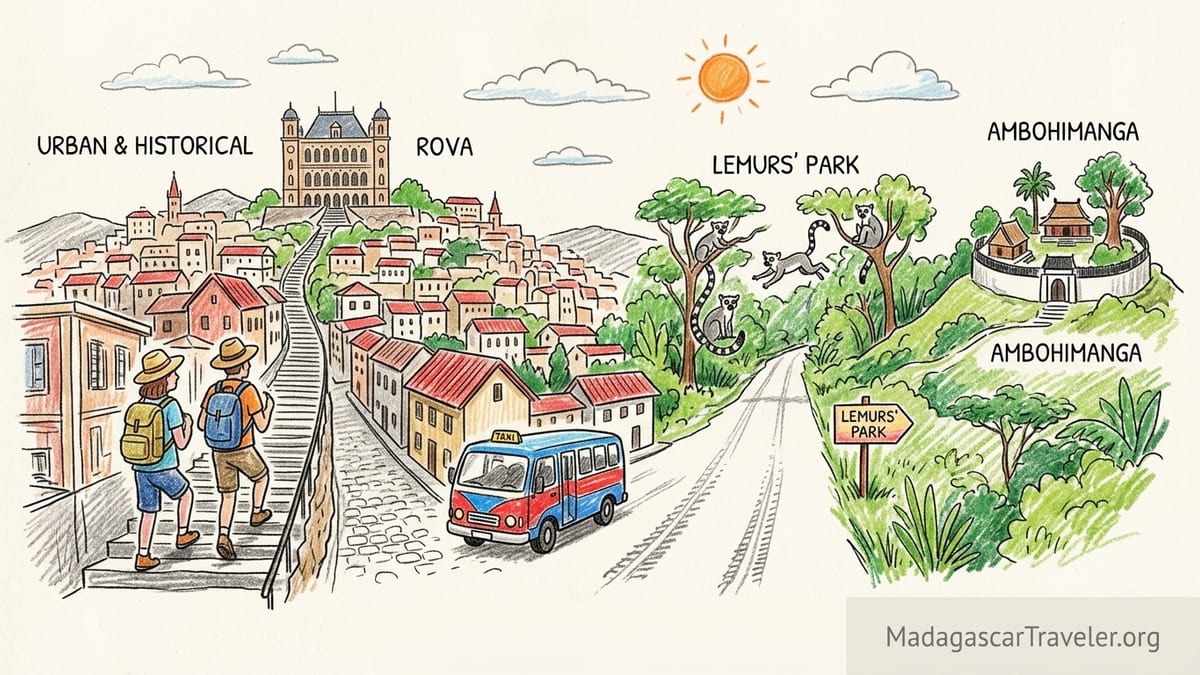
Most Antananarivo tours cluster around a few classic experiences: walking circuits through the Upper Town and Rova area, chauffeured city sightseeing with hotel pickup, half day or full day trips to Lemurs’ Park, cultural excursions to Ambohimanga and increasingly, food focused tours through central neighborhoods like Isoraka and Analakely. Online marketplaces typically list around 40 to 50 separate activities, but many are variations on these core themes, often combining the Rova with Lemurs’ Park, or pairing Ambohimanga with handicraft markets in one full day.
Walking tours concentrate on the historic core above the city, where the Queen’s Palace, churches and viewpoints sit on steep cobbled lanes. These are usually private or very small group and last 2 to 3 hours, often timed for late afternoon light when the sun drops over the rice paddies. Chauffeured tours, on the other hand, can cover more ground in a single day, linking the Upper Town with markets, Lake Anosy, the Presidential Palace area, and sometimes a short drive out to Ambohimanga or Lemurs’ Park.
Outside the city center, Lemurs’ Park lies roughly 22 to 25 kilometers southwest along the RN1, while Ambohimanga sits on a separate hill about 20 to 25 kilometers northeast of the capital. Because they are on different roads and traffic can be heavy, many operators sell separate half day trips: one toward Lemurs’ Park, another toward Ambohimanga. A few ambitious full day private tours combine the Rova or Upper Town with Lemurs’ Park, offering a city plus nature sampler for visitors who only have one day in Tana.
Food and culture tours are a newer category but increasingly popular. These tend to be evening walking experiences in central districts, sampling street snacks like mofo gasy (rice flour pancakes) and koba (peanut and rice cake), visiting local bars or tea shops, and sometimes adding a home cooked Malagasy meal with a local family. They are well suited to travelers who have already done the classic sightseeing tours and want a more lived in view of the city.
Walking Tours of Upper Town and the Rova
Upper Town walking tours offer the most atmospheric way to understand Antananarivo. A typical private route starts near the lower city and climbs through stairways and alleys to the Rova of Antananarivo, also known as the Queen’s Palace, on the ridge of Analamanga. Along the way, guides point out wooden aristocratic houses, small churches, and panoramic terraces where you can see the city spreading across the hills and rice fields below. Expect a moderate workout: there are many steps, and comfortable footwear is essential.
One common format is a 2.5 hour private walk in the late afternoon, priced from around 20 to 35 US dollars per person depending on group size and inclusions. These tours are usually offered in English and French, with some agencies also able to organize Spanish or German speaking guides on request. Entrance to the Rova itself, when included, is often paid on the spot and may be quoted in Malagasy ariary, so it is worth carrying local currency. Because restoration work and opening hours can change, a guide is helpful for navigating what is open on a given day.
The main advantage of a walking tour is how closely it connects you to the rhythm of Tana. You pause at small shops, watch children playing in stairways, and stop at lookouts that a car would simply drive past. Photographers especially appreciate the freedom to linger at viewpoints like Ambohimitsimbina, where the light over the red brick houses can be beautiful near sunset. For independent travelers who feel uneasy exploring steep backstreets alone, a local guide adds both context and a sense of security.
On the downside, walking tours cover a relatively small geographic area. You will see the historic heart and nearby neighborhoods, but you will not reach Lemurs’ Park or Ambohimanga on foot in any practical sense. If your time in Antananarivo is just one day, some travelers prefer a chauffeured city tour that includes brief walking segments in Upper Town, trading depth for a broader overview.
Private City Sightseeing and Chauffeured Full Day Tours
Chauffeured city tours are the workhorse option for visitors who want to see as much as possible in a limited time. A typical private full day city tour runs 7 to 9 hours and includes hotel pickup and drop off in central districts or near Ivato Airport. It usually combines the Upper Town and Rova with photo stops at Lake Anosy, visits to the Independence Avenue area, markets such as Analakely or the artisanal Digue market, and in some cases a detour to Ambohimanga or Lemurs’ Park if you are willing to spend more time in the car.
Prices for a full day private sightseeing tour within the city generally start around 60 to 100 US dollars for one or two people, rising if you add entry fees or extend the route beyond the city limits. The fee typically covers a vehicle with driver guide, fuel and guiding, while you pay entrance tickets separately. For example, you might pay a modest local entrance fee at the Rova, plus optional camera fees, and similar small charges at other monuments. In practice, the total for entrance fees on a city only day tends to be low compared with the tour price itself.
These tours are especially valuable in Antananarivo’s notorious traffic. Locals often warn that cross town journeys that look short on a map can easily stretch to an hour or more in the wrong part of the day. Having a dedicated driver who knows shortcuts and where to park saves time and reduces stress, particularly if you are not used to the driving style or want to avoid negotiating with taxis in Malagasy or French. Families, older travelers, or anyone arriving jet lagged often find this the most comfortable way to see the city.
Small group versions of these tours do exist, particularly on global booking platforms, but Antananarivo still leans heavily toward private arrangements. When shared tours are offered, they may limit groups to 6 to 10 participants, which keeps things flexible but can reduce the possibility of tailoring the itinerary. Most operators can run the tour in French and English, with some also advertising Italian, Spanish or German guides at higher rates.
Lemurs’ Park and Rova Combination Tours
For travelers interested in wildlife but without time to venture deep into Madagascar’s rainforests, Lemurs’ Park is often the easiest introduction. Located roughly an hour’s drive southwest of Antananarivo along the RN1, this small private reserve protects several hectares of semi natural habitat where multiple lemur species live in relative freedom. Guided visits are mandatory and usually last around ninety minutes, during which a local guide points out lemurs, chameleons and local plants, and explains the park’s conservation work.
Tour operators package Lemurs’ Park as either a half day outing or part of a full day “city and lemurs” itinerary. A half day private tour often includes hotel pickup, round trip transport and the park visit, leaving either morning or afternoon free for other activities. As a full day, agencies frequently pair Lemurs’ Park with a visit to the Upper Town and Rova. A common pattern is to leave the city mid morning, visit the park around lunchtime, then return for a walking segment in the historic center before sunset.
Entrance fees for Lemurs’ Park are paid locally in ariary and include a guide within the reserve. Exact prices change over time, so most agencies describe them as “entrance not included” and recommend carrying enough local cash for tickets, drinks and optional lunch at the onsite restaurant. Compared with the cost of a private vehicle and driver from the city, park admission is usually a smaller part of the overall budget, though it can still be significant for long stays or families with several children.
When choosing between dedicated Lemurs’ Park tours and those that combine it with the Rova, think about your energy levels and interest in history. The combined day is efficient but full, with hours spent in the car between Tana, the park and the Upper Town. If you are arriving the previous night on a long haul flight, or traveling with younger children, a simple half day to Lemurs’ Park with the rest of the day free may feel more relaxed. On the other hand, visitors on a tight schedule often appreciate the chance to see lemurs and the main royal site in a single day.
Ambohimanga Excursions from Antananarivo
Ambohimanga, a royal hilltop complex about 20 to 25 kilometers from Antananarivo, is one of Madagascar’s most important historic and spiritual sites. Recognized as a UNESCO World Heritage Site, it contains royal residences, sacred burial areas and forested slopes long associated with the Merina monarchy. For many Malagasy people, it remains a pilgrimage site as much as a tourist attraction, and visits can include encounters with local families coming to pray or make offerings.
Most Ambohimanga excursions run as private half day or full day tours by car. A typical half day trip picks you up from your hotel in the morning, drives through the northeastern outskirts of the city and up to the hill, then includes a guided visit inside the complex itself. You return to Antananarivo by early afternoon, leaving time for a city visit or airport transfer. Some tour operators extend this to a full day, pairing the royal hill with a stop at a handicraft market or with a city sightseeing circuit on the way back.
Pricing for a private Ambohimanga excursion is often comparable to a city tour, ranging from roughly 60 to 120 US dollars for a car and driver guide, depending on duration and inclusions. Entrance fees to the site are extra and relatively modest, particularly by international standards. In many cases you will also hire a local site guide at the entrance, a common practice at major Malagasy cultural sites. Guides frequently speak French and have at least basic English; tour agencies can usually arrange fully English speaking guides if requested in advance.
From a practical standpoint, Ambohimanga works particularly well for travelers with at least two days in Antananarivo. One day can focus on the city and Rova, perhaps with a short food or culture tour in the evening, while a second day is reserved for the royal hill. Trying to squeeze Ambohimanga plus Lemurs’ Park plus the full city into a single day is theoretically possible on a private tour, but traffic and road conditions make it ambitious. Allow room for delays rather than planning a tight airport connection after your excursion.
Food and Culture Tours in Antananarivo
While royal palaces and lemur reserves tend to dominate first time itineraries, Antananarivo’s food and street life are increasingly a reason to stay in the city longer. Food and culture tours typically start in the late afternoon or early evening, when vendors fire up grills and local restaurants fill with after work crowds. Routes often weave through central neighborhoods, stopping at street stalls for skewers or fried snacks, visiting markets for spices and fresh produce, and ending in a simple Malagasy restaurant or family home for dinner.
These experiences usually operate as small group or private walking tours, with prices from roughly 25 to 60 US dollars per person depending on whether dinner is included. Many are run by younger local guides who speak strong English and are keen to share everyday routines rather than textbook history. You might learn how to say basic phrases in Malagasy, how to navigate bus routes, or which street foods are considered safe and which are better avoided. Alcohol is commonly available but not always central; tea, fresh juice and local soft drinks feature heavily.
Culture oriented tours sometimes add non food elements, such as visits to artisan workshops, music bars or community projects. For instance, a guide might take you to a neighbourhood craft cooperative to see embroidered tablecloths and woodcarvings, then continue on foot to a viewpoint over the city for sunset before dinner. These combinations are particularly appealing if you want to support local initiatives and bring context to the souvenirs you will see later in airport shops or handicraft markets.
Compared with daytime sightseeing, food and culture tours place more emphasis on interaction and less on formal monuments. They work best for travelers who enjoy spontaneity and conversation. If you are concerned about walking at night, look for tours that include hotel pickup and drop off by taxi or private car, or ask your guide to arrange a trusted driver for the return journey. As with all city walks in Tana, it is wise to leave valuables at your accommodation and carry only what you need in a discreet bag.
Comparing Walking vs Chauffeured, Private vs Small Group
Choosing between walking and chauffeured tours in Antananarivo comes down to how you balance immersion, comfort and time. Walking tours in Upper Town and the central districts are the most immersive, putting you directly in the flow of daily life but limiting how far you can go. They suit reasonably fit travelers who want to focus on one area in depth. Chauffeured tours trade some of that intimacy for reach and comfort, allowing you to link the Rova, markets, lakeside viewpoints and even out of town sites like Lemurs’ Park or Ambohimanga in one day.
Weather and air quality also play roles. During the dry season, particularly in the cooler months from roughly May to August, walking tours are pleasant, with crisp air and clear views over the city. In the rainy months, or on particularly dusty days, a car with air conditioning may simply feel better. Older visitors or families with young children often appreciate the ability to rest between stops, while still being able to step out for short walks at key sites.
On the private versus small group spectrum, Antananarivo remains skewed toward private services. Private tours give you control over pace, photo stops and focus. If you find one market fascinating, you can linger; if you prefer to skip a sight, the guide can rearrange on the spot. This flexibility can be valuable in a city where traffic sometimes forces route changes. Small group tours are lighter on the wallet and can be sociable, but will rarely adjust as easily to personal interests, and departure days may not align with short stays.
Language options depend strongly on whether you book private or group. Private guides in Antananarivo commonly speak French and English, and some agencies list Spanish, Italian or German on request. On group departures, English and French predominate. If you have specific language needs, booking a private tour and confirming the guide’s language in advance is the safest route. Regardless of format, tipping is appreciated but not obligatory; many travelers choose to leave an additional amount in local currency at the end of a successful day.
Practicalities: Hotel Pickup, Duration and Entrance Fees
Most Antananarivo tours that involve a vehicle include hotel pickup in central areas, such as Isoraka, Analakely or near the main business districts. Airport pickup is sometimes possible but usually costs more, and traffic between Ivato Airport and the city center can easily take an hour or longer depending on the time of day. Pure walking tours may specify a meeting point near Upper Town instead of hotel pickup; in that case, a short taxi ride or arranged car transfer gets you to the start.
Durations vary widely. Short Upper Town walking tours last around 2 to 3 hours, food or evening culture tours often run 3 to 4 hours, and classic city sightseeing itineraries are billed as half day (about 4 hours) or full day (7 to 9 hours). Ambohimanga and Lemurs’ Park excursions tend to require at least a half day each once you factor in driving and site visits. Visitors planning a single jam packed day often choose either a city plus Lemurs’ Park combination or a city plus Ambohimanga combination, rather than attempting all three.
Entrance fees are generally not included in quoted tour prices and are payable in ariary on arrival at each site. This applies to the Rova or Queen’s Palace complex, Lemurs’ Park, Ambohimanga and some museums. While exact amounts change periodically, they are usually modest by international standards, though they can add up across a full day of sightseeing. Guides or drivers will usually alert you before reaching each site and may help with payment if you are unfamiliar with the currency. Some tours also mention optional camera or photo fees at historic sites.
When comparing tours online, look carefully at what is included beyond transport and guiding. Bottled water is commonly provided on full day trips but not universal. Lunch is usually excluded unless clearly described as included in a food or culture tour. Travel insurance is almost never part of a day tour package and should be arranged separately. Finally, always allow a time buffer between the scheduled end of your tour and any onward flights, as afternoon traffic in Tana can be unpredictable.
The Takeaway
Antananarivo rewards travelers who slow down enough to look past the traffic and see its layers of history and daily life. Whether you explore on foot through the Upper Town, ride in a private car between palaces and markets, or spend a relaxed morning watching sifakas leap through the trees at Lemurs’ Park, guided tours can turn what might otherwise feel chaotic into something coherent and memorable. With dozens of options on offer, from simple walking routes to full day circuits combining the Rova, Lemurs’ Park and Ambohimanga, there is a format to match most interests and budgets.
If you have just one day, a private city tour with short walks in the Upper Town, or a combined Rova and Lemurs’ Park itinerary, offers a strong introduction. With two or more days, consider dedicating one day to the city and another to Ambohimanga, perhaps with an evening food tour to experience local flavors. Regardless of how you structure your time, prioritize clear communication with your guide, build in room for traffic delays, and carry enough local currency for entrance fees and small purchases.
Ultimately, the best Antananarivo tour is the one that fits both your schedule and your style of travel. Some visitors leave raving about a simple two hour walk with a local storyteller, while others cherish a full day loop that took them from royal tombs to lemur filled forest. Choose the balance of walking and driving, private and group experiences that feels right for you, and Tana will reward that choice with a deeper, more textured understanding of Madagascar’s capital.
FAQ
Q1. Is a guided tour in Antananarivo really necessary, or can I explore on my own?
Independent exploration is possible in central areas, but guided tours help with navigation, language barriers, traffic logistics and understanding the historical context of places like the Rova and Ambohimanga.
Q2. How much time should I plan for a visit to Lemurs’ Park from Antananarivo?
Allow at least a half day, typically 4 to 5 hours door to door, to account for traffic, the drive along the RN1, a guided visit inside the park and a relaxed return to the city.
Q3. Can I realistically visit Lemurs’ Park, the Rova and Ambohimanga all in one day?
It is technically possible on a private tour but not recommended, as road conditions and traffic often make the day rushed; most travelers focus on one out of town site plus city highlights.
Q4. Are Antananarivo walking tours suitable for children and older travelers?
Upper Town walks involve many stairs and slopes, so they suit reasonably fit participants; families and older travelers often prefer chauffeured tours with short walks at key viewpoints instead.
Q5. What languages are commonly available for tours in Antananarivo?
French and English are the most widely available, while some agencies can also provide Spanish, Italian or German speaking guides on request, especially for private tours.
Q6. How much do entrance fees add to the cost of an Antananarivo tour?
Entrance fees at sites such as the Rova, Lemurs’ Park and Ambohimanga are usually modest but not included, so it is sensible to budget extra local currency for tickets and small camera fees.
Q7. Is it safe to do evening food or culture tours in Antananarivo?
Evening tours with reputable guides are generally considered safe in central areas, provided you follow local advice, avoid displaying valuables and arrange trusted transport back to your hotel.
Q8. Should I book Antananarivo tours in advance or wait until I arrive?
Booking at least a few days ahead is wise during peak months, especially for English language guides, although some hotels and local agencies can organize private city or Ambohimanga tours on short notice.
Q9. What is the best way to handle tipping for guides and drivers?
Tipping is not mandatory but appreciated; many visitors choose to give a modest cash tip in ariary at the end of a tour if they were satisfied with the guiding and driving.
Q10. How should I choose between private and small group tours in Antananarivo?
Private tours cost more but offer flexibility in pace and itinerary, while small group options are cheaper and more social; your choice depends on budget, time and how personalized you want the experience to be.