


Antsiranana, still widely known as Diego Suarez, is northern Madagascar’s natural hub: a deep-water bay ringed by beaches and limestone headlands, with rainforest peaks, coral lagoons and otherworldly rock formations within day-trip range. The challenge for most visitors is not what to see, but how to sequence it all sensibly with the time they have. This guide builds an itinerary around realistic driving times, local weather and excursion logistics, so you can match Diego Suarez, the Three Bays, Emerald Sea, Amber Mountain, Red Tsingy and even Ankarana to a two, three or four-night stay.
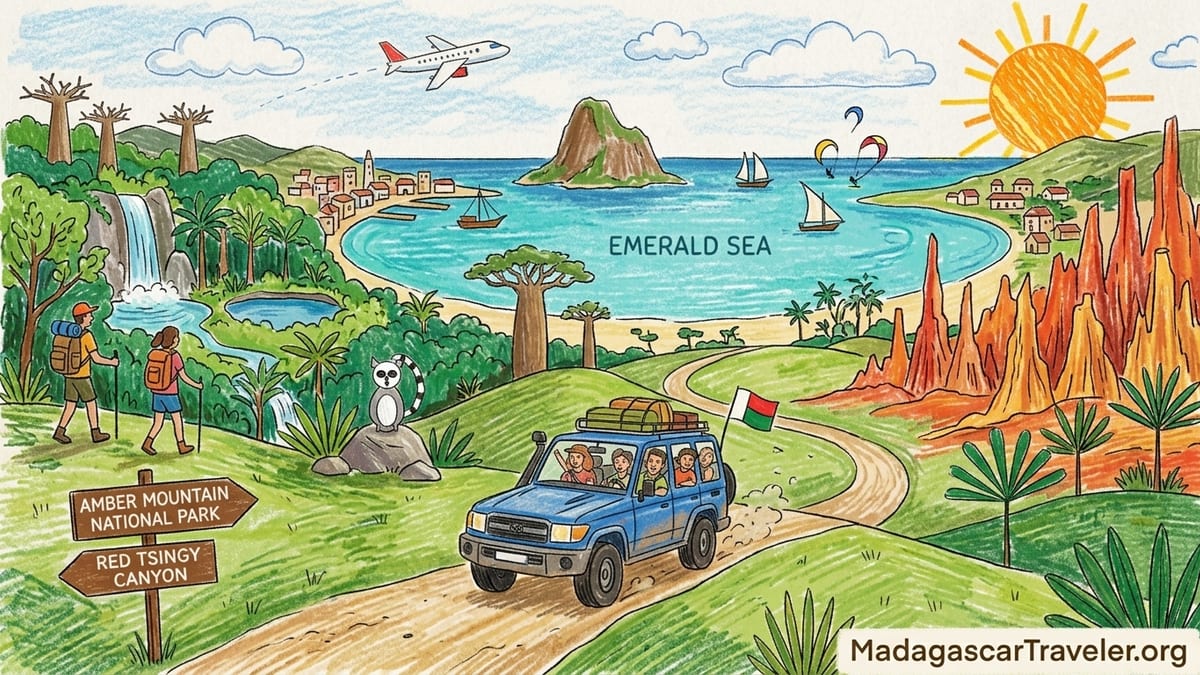
How long to stay in Antsiranana and when to visit
Antsiranana sits at the northern tip of Madagascar, at the end of the RN6 highway, and works best as a base for at least two and ideally four nights. This is enough to explore its bay, beaches and nearby national parks without spending every day in a vehicle. Most international visitors reach Antsiranana by domestic flight from Antananarivo; overland journeys from the capital or Nosy Be are possible but can take 10 hours or more in current road conditions, so plan to arrive with at least one full day still ahead of you rather than late at night.
The climate is tropical with a hot, wet season roughly November to March and a drier, cooler season April to October. The dry months suit hiking in Amber Mountain and road trips toward Red Tsingy and Ankarana, when tracks are less muddy and river levels lower. The trade winds that make the Emerald Sea famous for kitesurfing tend to blow most consistently from about May to November, which creates superb sailing and board conditions but can mean choppy and wet rides for day-trippers in small open boats.
Given these patterns, visitors focused on boat excursions and beaches often prefer the shoulder months of April, May, September and October, when seas can be calmer and trails relatively dry. If you travel in peak wet season, budget more leeway in your schedule, as heavy rain can delay flights, make the sandy approach to Red Tsingy slow-going and turn the track to some Emerald Sea embarkation points into deep ruts. When in doubt, ask your hotel or driver for a frank update on current road conditions before you lock in your sequence of excursions.
Prices in the Antsiranana region remain lower than in many African coastal destinations, but logistics add up quickly. As a rough benchmark in 2026, expect a full-day private 4x4 with driver to cost in the region of what you would pay for a long taxi day in Western Europe, plus separate park fees and local guiding. Joining a small group or booking through your accommodation can spread costs, but most visitors still find northern Madagascar a destination where realistic budgeting matters.
One full day: city, bay viewpoints and Three Bays
With only one full day in Antsiranana, prioritize the places that lie close together along the bay and coastal road. Start early in Diego Suarez itself with a walk along the seafront boulevard, where rusting port cranes frame views across one of the world’s largest natural harbours. The central market streets behind the quay provide a quick immersion into northern Malagasy life, from baskets of vanilla and cloves to mobile phone kiosks and small eateries serving rice, fish curries and zebu skewers.
By late morning, head east toward the village of Ramena, about 20 kilometres away along a paved road that shadows the bay. Many visitors hire a car with driver for the day, but if you are comfortable negotiating in French or Malagasy, you can also arrange a local taxi to take you as far as the beaches and wait. About halfway along, ask your driver to stop at a viewpoint overlooking the Sugarloaf, a rounded islet standing guard in the narrow entrance to the bay and one of the classic silhouettes of Diego Suarez.
From Ramena, it is an easy progression to the Three Bays: Sakalava, Pigeons and Dunes. A common pattern is to walk or drive one way and return the other, linking each crescent of white sand along low coastal tracks. The beaches face slightly different directions, which makes them a natural option in mixed weather: if strong wind chops up Sakalava, Pigeons Bay can be more sheltered a few minutes’ drive away. Pack water, sun protection and simple picnic supplies from town; beach shacks open and close with the seasons and may only stock basic soft drinks and grilled fish.
Accommodation-wise, if you have just one night in the area, staying in town keeps transfers short and allows you to stroll to restaurants in the evening. Simple hotels near the waterfront and mid-range options slightly uphill from the centre both work well, especially those that can organize a reliable driver on call. For visitors who prefer to wake to the sound of the waves, small lodges in Ramena or at Sakalava Bay are worth considering, though they add 30–40 minutes of driving back into town for flights, banking or markets.
Two to three days: adding Emerald Sea or Amber Mountain
With a second or third day, you can add a full-day boat trip to the Emerald Sea or a day in Amber Mountain National Park. Which you choose first depends on the weather. Boat excursions to the Emerald Sea are highly wind and swell dependent: guides will often confirm the day’s plan early in the morning after checking conditions. If you arrive to calm seas, it is wise to book the Emerald Sea right away and leave hiking for the following day, as wind can build through a week. Conversely, if the forecast promises strong trade winds but clear skies, hiking in the forest may be more comfortable first.
The Emerald Sea is a shallow coral lagoon beyond the mouth of Antsiranana Bay, accessible by motorised pirogue or small wooden boat from Ramena. A typical day trip starts around 8:00 from your hotel, with a transfer to Ramena, crossing the channel past Suarez Island and anchoring off sandbanks for snorkelling and swimming. Many outings include a simple grilled-fish lunch on a beach, with sun shelters rigged from canvas and driftwood. The lagoon’s name is no exaggeration: in clear light the water shifts from turquoise to bright green over sand and coral patches, but in heavier seas, waves can break over the bow and make the return ride wet and tiring, so motion-sensitive travellers should come prepared.
Amber Mountain, by contrast, is a cool, upland national park rising south of Antsiranana, reachable in roughly one and a half to two hours by road. The last stretch climbs toward the village of Joffreville, where many lodges and guesthouses cluster for quick park access. Here, the microclimate changes abruptly: tall rainforest, crater lakes and waterfalls offer a welcome temperature drop after the coast. Trails range from short circuits to half-day hikes, and local guides can usually be hired on arrival at the park office for modest fees. With two or three days in the region, one popular sequence is city and Three Bays on arrival, Emerald Sea on the first full day, then Amber Mountain on the final day before departure.
If you know in advance that you want both the Emerald Sea and Amber Mountain, choose accommodation accordingly. Some travellers base themselves in Diego Suarez for all nights and accept the daily transfers. Others split their stay, spending one or two nights near the bay or Ramena for easy access to boat trips, then moving inland to a lodge in Joffreville for one night closer to the park. The split-base strategy can reduce early-morning driving and makes it easier to start hikes before the day warms up, but it does mean repacking and coordinating transfers with two sets of hotel staff.
Four nights and beyond: Red Tsingy and when to add Ankarana
Once you have four nights or more, the classic next step is to loop south along the RN6 toward the Red Tsingy and, if time permits, Ankarana Special Reserve. The Red Tsingy formations lie roughly 60 kilometres from Diego Suarez, part gravel and part sandy track from the main highway. In dry conditions, visitors in a 4x4 usually combine a morning at Red Tsingy with onward travel to a lodge near Ankarana, arriving by mid-afternoon. In wet months, the same stretch can take considerably longer and drivers may advise a simple out-and-back excursion instead of pressing on.
The Red Tsingy is a canyon of fragile red laterite spires sculpted by erosion, very different from the grey limestone pinnacles that made Ankarana and western Tsingy de Bemaraha famous. Footpaths and viewpoints loop around the amphitheatre, and because the formations are delicate, walking is typically on designated routes rather than among the spires themselves. Sun and heat are intense in the middle of the day, so an early start from Diego Suarez pays off, both for cooler temperatures and for softer light on the rock formations. Many travellers describe this as one of the most photogenic sites in northern Madagascar, especially after rain has cleared dust from the air.
An extra night in your schedule is what allows the Red Tsingy outing to evolve into a fuller northern circuit including Ankarana. With only three nights in total, squeezing in Ankarana from Antsiranana involves long driving days that leave little time on the trails. With four or five nights, you can spend one night near the Red Tsingy or continue directly to Ankarana, waking the next morning on the doorstep of limestone canyons, caves and forests where crowned lemurs and chameleons are frequently seen. It is also logistically simpler: you head south once, visiting Red Tsingy on the way, and continue onward later to Ankify and Nosy Be or backtrack to Antsiranana by road.
Lodging near Ankarana ranges from simple bungalows with mosquito nets and bucket showers to more comfortable lodges with en suite bathrooms, small pools and on-site restaurants. Wherever you stay, you will usually hire Ankarana guides at the park office rather than through your hotel, though many properties work with the same local guides day after day. Walking routes vary from easy half-day circuits along forest trails to longer treks across sharp tsingy ridges, and some include optional cave sections requiring a torch and a steady footing. Having the extra night outside Antsiranana means you can choose your route according to how you feel that day, not how far you still have to drive afterward.
Which excursions combine logically in one stay
From a trip-planning perspective, the most logical way to cluster excursions is by direction and mode of transport. The city, Ramena, Three Bays and Emerald Sea form a tight northern-coastal cluster that can be tackled from a base in Diego Suarez or Ramena with relatively short transfers. Within that group, city sightseeing pairs naturally with a half-day bay viewpoint drive or a late-afternoon swim at Ramena if your arrival flight gets in by midday. A full-day Emerald Sea trip, however, usually stands alone, as the outing itself fills the daylight hours.
Amber Mountain belongs to a separate inland cluster. Many visitors find that combining it with another half-day stop, such as a short bay viewpoint or a quick market run, makes for a very full but still manageable day. If you spend a night in Joffreville, you can even split Amber Mountain across two half-days, one focusing on waterfalls and crater lakes, the other on wildlife. This flexibility helps if afternoon showers roll in; you hike the drier morning hours and retreat to your lodge if cloud builds over the peaks later.
Red Tsingy and Ankarana, finally, sit in a southern corridor along the RN6 and combine most logically with each other, not with coastal excursions from Diego Suarez. The most efficient sequence is usually Diego Suarez to Red Tsingy to Ankarana, then onward travel. Some travellers try to visit Red Tsingy as a day trip from Diego Suarez and still reach Ankarana before dark, but this can be optimistic in 2026 road conditions and leaves little margin for photo stops, snacks or unexpected delays. When planning, think in terms of clusters rather than ticking off individual names on a list.
If you are limited to two nights in Antsiranana and do not plan to continue south, prioritise the coastal and Amber Mountain clusters. If you have four nights with onward travel, invest in the southern loop. In both cases, communicate your must-see priorities clearly to your hotel or local operator; they can often suggest the best order of days based on current roadworks, damaged bridges or recent heavy rain that might affect specific tracks.
Drivers, road conditions and whether to pre-book
Northern Madagascar is not a region where you rely on ride-hailing apps or metered taxis. In Antsiranana itself, tuk-tuks and local taxis cover short hops across town and out to the airport, but you will need a pre-arranged car and driver for almost all excursions beyond the city limits. The main RN6 highway is a mix of paved sections, potholes and occasional diversions, and side roads to Red Tsingy, some bays and parts of the Emerald Sea embarkation area are unpaved. For these, a 4x4 with decent ground clearance is strongly recommended, even in dry season.
For short coastal trips to Ramena and the Three Bays, a standard vehicle can suffice when the weather is good, and many hotels have trusted drivers they call on a trip-by-trip basis. For Amber Mountain, Red Tsingy and Ankarana, pre-booking a 4x4 with driver for the day or for the whole northern segment of your journey is usually the simplest and safest option. Several local agencies based in Diego Suarez and Antananarivo specialise in exactly this service and can arrange vehicles, English- or French-speaking drivers and park visits in a package. Booking at least a few weeks ahead is sensible in the peak dry season, when domestic flights and good vehicles can be fully committed.
If you are a highly experienced driver, it is technically possible to self-drive from Antsiranana, but visitors who try this without local knowledge often underestimate the fatigue of long days on patchy roads, the value of having a driver who knows informal detours and the stress of arranging secure overnight parking in small villages. A local driver also helps translate at police checkpoints and in rural communities where little English is spoken. In practical terms, most independent travellers opt to keep their autonomy by planning the route and daily schedule themselves, while outsourcing the actual driving.
Payment practices vary: some agencies work on a per-day car and driver rate plus your fuel costs, others quote an all-inclusive price that factors in fuel, driver meals and accommodation on multi-day circuits. Ask for clarity in writing and carry sufficient local currency for park entrance fees and guide payments, which are typically paid in cash on arrival at Amber Mountain and Ankarana. Generous but not extravagant tips for drivers and guides are appreciated, especially on multi-day journeys where they are on duty from early morning until after dark.
Where to stay: city, bay or in the hills
Choosing a base in the Antsiranana region shapes how much time you spend in a vehicle each day. Staying in Diego Suarez itself puts you close to the airport, markets and seafront restaurants, and makes it easy to adjust departure times based on last-minute changes. Mid-range hotels near the waterfront often have bay-view rooms, small pools and on-site restaurants, while more basic guesthouses in the grid of streets behind the port trade facilities for local atmosphere and lower prices. For travellers relying on hotel-arranged excursions, these city properties work particularly well.
Ramena, roughly 45 minutes from the city, offers a softer, beach-village feel. Several small hotels and bungalow complexes back directly onto the sand, with palm trees shading simple terraces and fishing pirogues pulled up in front. Staying here is especially convenient if you plan more than one day focused on the sea, such as an Emerald Sea trip plus relaxed time at the Three Bays. Kitesurfing-oriented lodges at Sakalava Bay and nearby spots cater to guests who want to step straight from their room onto the lagoon, and some run their own boats and board rentals.
For Amber Mountain, the logical base is in or near Joffreville, a small town nestled below the park boundary. Lodges here range from rustic-chic eco properties with wooden bungalows and communal dinners to simpler local guesthouses. The key advantage is proximity: you can be at the park entrance within minutes, which increases your chances of spotting lemurs and birdlife active in the cooler early hours. Nights are cooler at this altitude than in Diego Suarez, so pack an extra layer and, in some cases, expect hot-water bottles rather than air conditioning.
If your itinerary extends to Ankarana and the Red Tsingy corridor, factor in at least one night near the park, often in simple lodges along the RN6. Some travellers choose to break the journey between Amber Mountain and Ankarana with a rural overnight stay closer to Red Tsingy itself, particularly when travelling in rainy months when driving times are less predictable. Regardless of where you stay, confirm in advance that your accommodation can provide or arrange reliable early breakfasts and packed lunches on hiking days; shops around the parks are basic and may not open early.
The Takeaway
Planning Antsiranana as a flexible hub rather than a rigid checklist destination makes a significant difference to how much you enjoy northern Madagascar. With one or two nights, focus on the city, bay viewpoints, Ramena and the Three Bays, adding the Emerald Sea if conditions are calm. With three days, bring Amber Mountain into the mix for rainforest trails and waterfalls. When you can spare a fourth or fifth night and are prepared for longer drives, fold in Red Tsingy and, ideally, Ankarana for the region’s most striking limestone landscapes.
Along the way, be realistic about road conditions, respect the weather that shapes both sea and forest, and invest in a capable local driver rather than trying to do everything yourself behind the wheel. Choose accommodation that matches your priorities, whether that is walking distance to Diego Suarez’s seafront restaurants, easy dawn access to Amber Mountain’s trailheads or a direct step from your veranda onto the sand at Ramena. Northern Madagascar rewards those who give it enough time and plan around its rhythms, rather than forcing a mainland-style schedule onto its volcanic peaks, coral lagoons and eroded red canyons.
FAQ
Q1. How many days do I really need in Antsiranana to see the highlights?
Most travellers should plan at least three full days: one for the city and Three Bays, one for the Emerald Sea if conditions allow, and one for Amber Mountain. If you want to include Red Tsingy and Ankarana without rushing, four or five nights is more comfortable.
Q2. Can I visit the Emerald Sea and Amber Mountain in the same day?
In practice it is very difficult and not recommended. Emerald Sea excursions typically run from morning until late afternoon, and Amber Mountain is roughly a two-hour drive in the opposite direction. Combining them would mean hours in transit and little quality time at either site.
Q3. Do I need to pre-book a driver, or can I arrange everything on arrival?
For city sightseeing and short trips to Ramena, arranging drivers on arrival through your hotel is often fine. For Amber Mountain, Red Tsingy and Ankarana, especially in the busy dry season, it is wise to pre-book a 4x4 with driver so that you are not left negotiating for scarce vehicles at the last minute.
Q4. Is it safe to swim at the Three Bays and Emerald Sea?
Swimming at the Three Bays is generally calm on normal days, although currents and waves can build when the wind is strong. At the Emerald Sea, sandy shallows are ideal for wading and snorkelling, but always follow your boat crew’s guidance about where and when to enter the water, and be prepared for choppy crossings in trade-wind months.
Q5. When is the best time of year to visit Antsiranana for this itinerary?
The cooler, drier season from about April to October is the most comfortable for hiking and road trips, and is also when the Emerald Sea’s trade winds are at their best for sailing and kitesurfing. The wet months from November to March bring heavier rain, rougher tracks and more humidity, so allow extra flexibility if travelling then.
Q6. Do I need a guide inside Amber Mountain and Ankarana?
In Amber Mountain, trails are relatively clear and some experienced hikers explore short routes without a guide, but hiring a local guide is inexpensive and greatly increases your chances of spotting wildlife. In Ankarana, guides are effectively essential, both for navigating the maze of tsingy formations and caves and for safety on longer routes.
Q7. Can I visit Red Tsingy as a day trip from Diego Suarez without staying overnight?
Yes, many visitors make Red Tsingy a full-day excursion from Diego Suarez, especially in dry conditions when the tracks are in better shape. However, if you also plan to continue south to Ankarana, it is more efficient to visit Red Tsingy on the way and spend at least one night near the park.
Q8. What sort of accommodation should I expect around Amber Mountain and Ankarana?
Near Amber Mountain, expect small lodges and guesthouses ranging from rustic eco properties to comfortable but low-key hotels, often with set-menu dinners. Around Ankarana, accommodation is generally simpler, with a few mid-range lodges offering en suite rooms and basic amenities, and more modest bungalows with mosquito nets and shared facilities.
Q9. Is self-driving a good idea for this part of Madagascar?
Self-driving is possible for experienced travellers, but road conditions, long distances and limited roadside assistance make it challenging. Most visitors find that hiring a local driver with a 4x4 is better value and far less stressful, especially on the sandy or muddy approaches to Red Tsingy and some sections of the RN6.
Q10. How far in advance should I book flights and excursions for Antsiranana?
Domestic flights to Antsiranana can be limited in frequency, so booking several months ahead is sensible in peak season. For key excursions like the Emerald Sea, Amber Mountain day trips and circuits including Red Tsingy and Ankarana, arranging plans a few weeks in advance through a trusted operator or your hotel helps secure vehicles and guides on your preferred dates.