


Nosy Be in northwest Madagascar is often described as an island of beaches, sunsets and ylang-ylang perfume. For first-time visitors, what many people do not realize is that the postcard scenes they see online are usually from smaller islands around Nosy Be, reached on day trips by boat. This guide explains how the main island really works as a base, what to expect in each key area, and how to plan a realistic stay that mixes Nosy Be itself with the best nearby islands.
Understanding Nosy Be and Its Surrounding Islands
Nosy Be sits off Madagascar’s northwest coast in the Mozambique Channel, with a ring of smaller islands such as Nosy Komba, Nosy Tanikely, Nosy Sakatia and Nosy Iranja scattered around it. The main island has a paved road network on the west side, volcanic hills like Mont Passot, ylang-ylang plantations and a handful of main beaches including Andilana and Ambatoloaka/Madirokely. It is also home to the airport at Fascene and the port at Hell-Ville, where most visitors arrive.
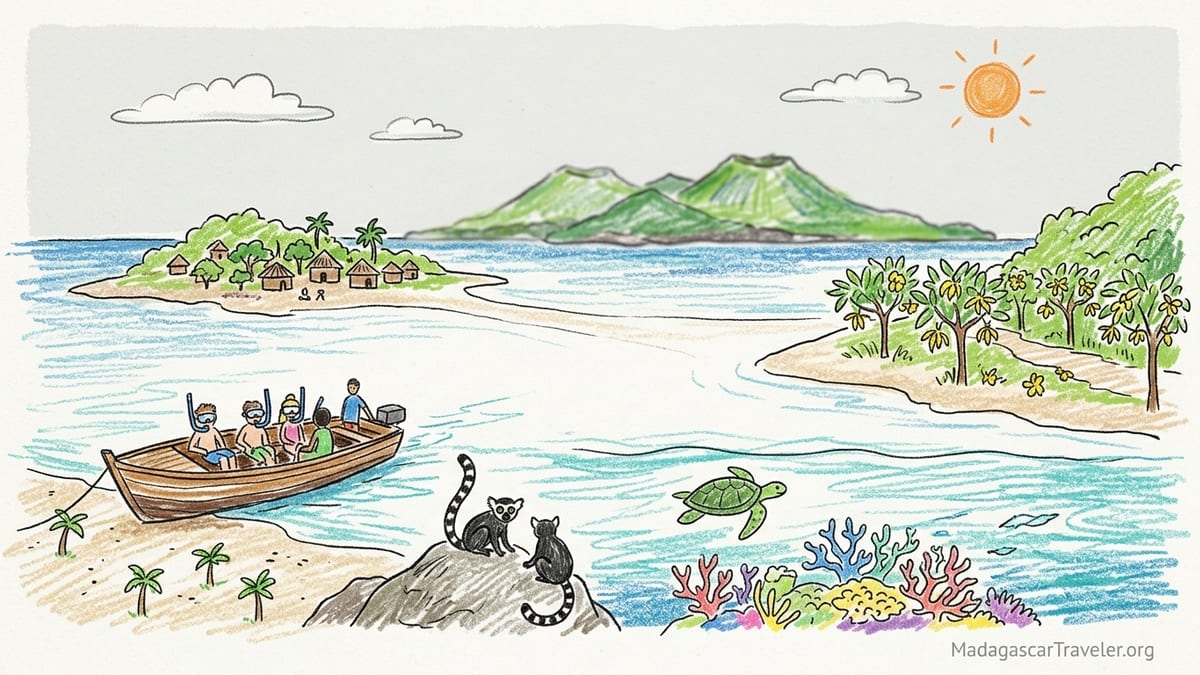
Most of Nosy Be’s headline experiences actually take place off the main island on boat excursions. Classic brochure images of a sandbar linking two islands are from Nosy Iranja. Snorkeling over bright coral with turtles is usually at the Nosy Tanikely marine reserve. Close-up encounters with semi-habituated black lemurs are on Nosy Komba, and relaxed turtle swims in seagrass meadows tend to be on Nosy Sakatia. On Nosy Be itself, the experiences are quieter: beaches, sunsets, short hikes, plantations and the Lokobe forest.
As a first-time visitor it helps to think of Nosy Be as your hub. You will sleep in a hotel or guesthouse on the main island, often around Ambatoloaka/Madirokely or Andilana, then join day trips by motorized pirogue or speedboat to the surrounding islands. Typical excursions leave from Ambatoloaka beach around 8:30 in the morning and return by mid-afternoon, so you still have time for a swim or sunset cocktail back at your base.
The distances are short but the sea dictates timings. Nosy Komba and Nosy Tanikely are usually 30 to 60 minutes by speedboat from Ambatoloaka depending on conditions. Nosy Sakatia is closer, often 15 to 20 minutes. Nosy Iranja is much farther, often around 1.5 to 2 hours one way. Weather, tides and swell in the Mozambique Channel can all affect whether an excursion is comfortable or cancelled, which is one reason it is wise to allow at least a few extra days in your itinerary.
Ambatoloaka and Madirokely: Lively Beach Hub
Ambatoloaka and neighboring Madirokely form Nosy Be’s busiest beach strip, roughly 10 kilometers from Hell-Ville. Ambatoloaka is effectively the tourism hub, where restaurants, bars, guesthouses and small dive shops line the waterfront. In the evening, the main lane becomes pedestrian and you walk between grilled-fish stalls, rum bars and simple creperies. Madirokely, a short walk south, has a broader sand bay, a more laid-back atmosphere and mid-range hotels set just back from the beach.
This is the main departure point for boat excursions to Nosy Komba, Nosy Tanikely, Nosy Sakatia and Nosy Iranja. On a typical morning you might walk the sand at Ambatoloaka and see skippers calling out destinations. A straightforward shared trip to Nosy Komba and Nosy Tanikely with lunch on the beach might cost somewhere in the region of the equivalent of 35 to 60 US dollars per person, depending on group size and inclusions. Private boats are more expensive but can be arranged easily through hotels or local agencies.
For first-time visitors who want a mix of activity and nightlife, staying in Ambatoloaka or Madirokely makes sense. You can dive in the morning, have a late lunch of grilled zebu skewers or fresh tuna at a beachside restaurant, then join locals at a music bar after dark. The flip side is that it can be noisy late into the night, especially on weekends or during events such as the Donia music festival, which usually takes place in the dry season.
When budgeting, keep in mind that while meals in simple Malagasy eateries can be inexpensive, beachfront tourist menus are closer to international resort pricing. A seafood plate in a popular Ambatoloaka restaurant could cost the equivalent of 8 to 15 US dollars, while a draft beer is often around 1 to 2 dollars. Many places accept card payments but outages are not rare, so it is wise to carry enough Ariary in cash for a couple of days of meals and taxis.
Andilana: Classic Beach and Quiet Resorts
Andilana sits at the northern tip of Nosy Be and is widely regarded as the island’s best main beach. A wide crescent of pale sand curves between rocky headlands, with relatively calm turquoise water during the dry season. Resort hotels occupy much of the prime frontage, but there are still public access points where day visitors can walk or swim. Compared with Ambatoloaka, Andilana feels more self-contained and resort-focused, with fewer independent restaurants and bars.
Reaching Andilana from Ambatoloaka or Hell-Ville is straightforward by the paved coastal road known locally as the Route de l’Ouest and RN30a. Taxi cars and yellow tuk-tuk style vehicles run the route frequently. A daytime taxi between Ambatoloaka and Andilana might cost roughly the equivalent of 3 to 6 US dollars, depending on negotiation, vehicle type and where exactly you start and finish. Drivers will usually wait for you for an agreed fee if you only want a day visit.
Andilana’s strengths are its swimming conditions and sunsets rather than access to excursions. Boat trips are more limited from here, and many guests still travel down to Ambatoloaka for organized tours. A realistic approach is to stay part of your trip in Ambatoloaka for activities, then spend two or three nights in Andilana for quieter beach time. Families with young children often appreciate Andilana’s shallow, gently shelving water and the ability to spend full days on the sand without needing transport.
If you base yourself in Andilana, plan ahead for cash and basic shopping. The nearest ATMs and larger supermarkets are in Hell-Ville, around an hour away by road depending on traffic and stops. Hotels often sell bottled water, sunscreen and mosquito repellent, but prices are marked up and choice is limited compared to Hell-Ville’s supermarkets and pharmacies.
Hell-Ville, Lokobe and Mont Passot: Town, Forest and Views
Hell-Ville, officially known as Andoany, is the administrative capital of Nosy Be and the main port facing the Malagasy mainland. Many visitors pass through without staying the night, but the town is worth at least a half day. You can stroll from the harbor past colonial-era buildings to the covered market, where stalls pile up vanilla beans, cloves, peppers and baskets of ylang-ylang flowers. ATMs from major banks are here, along with small supermarkets that stock basics such as long-life milk, snacks, sunscreen and mosquito coils.
On the southeastern side of Nosy Be, Lokobe National Park protects one of the island’s last pockets of primary rainforest. Trips typically start with a short drive to a departure village, followed by a dugout canoe ride and then a guided walk on muddy forest paths. With a local guide you may spot nocturnal lemurs sleeping in tree hollows, day geckos, chameleons and endemic birds. This is not a zoo-style experience: wildlife sightings depend on patience and the guide’s knowledge. Tour operators usually recommend closed walking shoes, light long trousers and insect repellent.
In the interior, Mont Passot rises above a necklace of crater lakes. It is one of the best places on Nosy Be itself for sunset views. A typical itinerary will combine a short walk to a viewpoint with time at small cafes serving coffee, fresh coconut or local rum cocktails while the sky turns pink over the lakes and the Mozambique Channel. The access road is now mostly paved, though rain can leave some stretches potholed. Many visitors join a half-day private tour in a 4x4 that stops at ylang-ylang plantations and a sacred banyan tree before reaching the summit area.
None of these experiences involve long hikes, but temperatures and humidity can make even short walks feel demanding. In practice, a first-time visitor might devote one full day to Lokobe and half a day to Mont Passot and nearby plantations, leaving the rest of the trip for beaches and island excursions. Visiting Hell-Ville works well on arrival or departure days, especially if you need to visit an ATM or buy items like SIM cards, snorkel masks or snacks for upcoming boat trips.
Beaches, Snorkeling and Diving: Where the Best Experiences Really Are
Nosy Be’s main island beaches offer pleasant swimming, especially at Andilana and Madirokely, but the most impressive marine life and picture-perfect lagoon scenes are almost always on the surrounding islands. The corals right off Ambatoloaka are heavily impacted and you will see more seagrass and sand than reef. By contrast, the Nosy Tanikely marine reserve has clear water and healthier coral patches, with frequent sightings of green turtles, rays and schools of tropical fish in shallow depths suitable for novice snorkelers.
Dive centers based in Ambatoloaka and Madirokely organize daily trips to offshore sites, often combining two dives at reefs or drop-offs between Nosy Be and the neighboring islands. Depending on the operator, a two-tank dive with rental gear might cost a few tens of dollars equivalent, broadly in line with Indian Ocean destinations but usually cheaper than Mauritius or the Seychelles. Many centers also offer introductory dives for beginners who have never used scuba before, usually after a short pool or beach practice.
For relaxed snorkeling with a high chance of turtles in seagrass, Nosy Sakatia is a favorite. Day trips usually include a short hike through a fishing village and a simple lunch of grilled fish with rice and coconut sauce on the beach. More energetic travelers might opt for Nosy Iranja, famous for its sandbar, which shines bright white at low tide. Weather conditions matter greatly here; crossings can be rough in wind or swell, and reputable operators may cancel or postpone rather than risk an uncomfortable day.
Whale and whale shark encounters are another highlight for visitors at the right time of year. Humpback whales are often spotted offshore between roughly July and September, while whale sharks are most frequently seen between around October and December. Specialized operators run trips that focus on finding and safely swimming alongside these animals in small groups, usually with briefing sessions on behavior and conservation. These are full-day outings and are typically among the more expensive excursions on offer.
Ylang-Ylang Plantations and the “Perfume Island”
Nosy Be is nicknamed the “Perfume Island” because of its ylang-ylang plantations and other fragrant crops. Along the roads heading north from Hell-Ville and towards the airport, you will pass small distilleries and groves of low ylang-ylang trees. Local guides or drivers can usually arrange impromptu stops where you see metal stills, piles of yellow flowers and the process of slowly distilling essential oil used in international perfumery.
Plantation visits are rarely stand-alone excursions. More often they form part of a half-day or full-day island tour by car that might also include the sacred tree outside Hell-Ville, viewpoints over the crater lakes and a swim at Andilana before returning to your hotel. Prices vary with group size and vehicle type, but a full-day circuit in a private 4x4 with driver and guide might be priced at the equivalent of 60 to 120 US dollars for the vehicle, shared between passengers.
These tours provide context that is easy to miss if you stay only on the beach. You see how ylang-ylang, vanilla, coffee and sugarcane shape the local economy, and how rural villages are connected by the loop of paved and dirt roads around the island. Many tours include short walks through fields, so light footwear and a hat are useful. If you are interested in photography, the mix of stills, smoke, flowers and drying spices offers some of the most atmospheric scenes on Nosy Be itself.
It is worth remembering that plantations are working sites, not theme parks. Conditions can be hot and smoky inside distillation sheds, and facilities are basic. Most visitors are welcomed warmly, but tipping your guide and buying a small bottle of essential oil or locally produced vanilla is a simple way to contribute directly to the community.
Practicalities: Airport, Taxis, Money and Weather
Most international visitors arrive at Fascene Airport on Nosy Be, which has direct or seasonal flights from Antananarivo and several regional hubs. The airport lies on the northeast of the island, roughly 12 kilometers from Hell-Ville. On arrival you will find yellow tuk-tuk style taxis and regular cars waiting outside. A private taxi to Ambatoloaka or Madirokely might cost the equivalent of 10 to 20 US dollars after bargaining, while shared transfers organized through hotels are often priced higher but may be more straightforward if you arrive late in the evening.
Within the island, short daytime taxi rides in the main tourist belt between Hell-Ville, Ambatoloaka and Madirokely are usually inexpensive by international standards, often a few dollars or less, but you should always agree the fare in Ariary before getting in. At night, or for longer runs to Andilana or the airport, prices rise and it can be worth asking your hotel to call a trusted driver. On some routes, especially around Ambatoloaka, three-wheeled tuk-tuks are more common than cars and can navigate narrow streets more easily.
The best time to visit Nosy Be is generally the dry season from around April to November, when days are mostly sunny, humidity is lower and seas are calmer. This period aligns with the southern winter, so temperatures are warm but not extreme, often in the mid to high 20s Celsius during the day. The wet season from roughly December to March brings heavier rains, higher humidity and a greater risk of cyclones in the wider region. Some smaller guesthouses close briefly for maintenance during the rainiest months, and boat excursions can be more frequently cancelled.
ATMs are concentrated in Hell-Ville and, increasingly, around the main resort zones, but they can run out of cash or have network issues. Card payments are accepted at many mid-range and high-end hotels, plus some dive centers and restaurants, yet should not be relied on exclusively. As a first-time visitor, it is sensible to withdraw or exchange enough Ariary to cover at least a couple of days of expenses. Daily costs vary widely depending on your style of travel, but boat excursions, diving and transfers will likely make up a significant share of your budget.
How Long to Stay and How to Structure Your Trip
Because so many of Nosy Be’s highlights are boat-based excursions to surrounding islands, a rushed two-night stay is rarely satisfying. A realistic minimum for a first visit is around four full days on the island. That allows one beach day on Nosy Be itself, one day at Lokobe and Mont Passot combined, and at least one full day for a Nosy Komba and Nosy Tanikely boat trip. Even with four days, you will still be making choices and may not reach Nosy Iranja or Nosy Sakatia.
A more comfortable timeframe is roughly six to seven nights. With a week you can split your stay between Ambatoloaka/Madirokely for activities and Andilana for quieter downtime. For example, you might spend the first three nights in Ambatoloaka, using two days for boat excursions and one for Lokobe, then move to Andilana for three or four nights of relaxed beach time with only a sunset trip to Mont Passot as a scheduled outing. This approach builds in some flexibility if weather affects the sea conditions.
Travelers combining Nosy Be with other parts of northern Madagascar, such as Ankarana’s tsingy formations or Amber Mountain National Park, often allocate at least 10 to 14 days in total. In these itineraries Nosy Be serves as both an arrival point and a final place to unwind after inland hikes. Speedboat transfers connect Nosy Be to the mainland port of Ankify, where road journeys continue to Ambanja and further north or south. These overland segments can be tiring, and Nosy Be’s beaches make a natural break.
Whichever duration you choose, build in some unstructured time. It is easy to over-schedule with whale shark trips, multiple dive days and several island excursions. Leaving at least one or two entirely free days gives you space to wander the beach at sunrise, linger longer over lunch at a beach hut, or simply sit on your veranda listening to ylang-ylang trees rustling in the evening breeze.
The Takeaway
Nosy Be rewards travelers who understand it as a base rather than a single all-in-one attraction. The main island offers solid beaches, colorful markets, gentle hikes and the sensory experience of ylang-ylang plantations and crater lakes. The true showstoppers, however, are reached by boat: turtle-filled reefs at Nosy Tanikely, lemurs in the forests of Nosy Komba, sandbars at Nosy Iranja and seagrass meadows at Nosy Sakatia.
For a first-time visitor, choosing where to stay between Ambatoloaka, Madirokely, Andilana and quieter corners shapes your experience more than any single sight. Add in Lokobe’s forest, Mont Passot’s sunsets, seasonal whale and whale shark encounters, and you have an island cluster that can easily fill a week or more. Come with a flexible plan, a realistic sense of travel times and costs, and an appreciation that sea conditions rule the daily schedule, and Nosy Be will likely match the perfume of its nickname with memories just as lasting.
FAQ
Q1. Is Nosy Be safe for first-time visitors?
Nosy Be is generally considered safe for travelers who take normal precautions, such as avoiding isolated beaches at night, using registered taxis, keeping valuables discreet and following local advice from hotels or guides.
Q2. Do I need a guide for Lokobe and the surrounding islands?
For Lokobe National Park you effectively need a local guide, both for access and to spot wildlife. For islands like Nosy Komba, Nosy Tanikely and Nosy Sakatia most visitors join organized boat trips that include a guide, which simplifies logistics and timing with tides.
Q3. Can I snorkel directly from the beach on Nosy Be?
You can snorkel from beaches like Madirokely or Andilana, but coral is limited and visibility can be variable. For the best snorkeling with turtles and colorful reef fish, plan boat trips to Nosy Tanikely or Nosy Sakatia, where conditions are usually much better.
Q4. How much should I budget for boat excursions?
Prices vary by operator and season, but simple shared day trips that include lunch often cost the equivalent of a few dozen US dollars per person, while private boats or specialized whale and whale shark outings cost more. It is wise to set aside a significant portion of your budget for excursions, as they are central to the Nosy Be experience.
Q5. What is the best time of year to visit Nosy Be?
The dry season from around April to November offers the sunniest weather and calmest seas, making it ideal for beaches, diving and island-hopping. Humpback whales are usually seen mid-year, while whale sharks are more common from roughly October to December.
Q6. How do I get from Fascene Airport to my hotel?
On arrival at Fascene Airport you can take a taxi or pre-arranged hotel transfer. Agree the fare in Ariary before leaving the parking area. Many first-time visitors ask their hotel to organize a driver, especially for late arrivals or long journeys to Andilana.
Q7. Is it worth staying in Hell-Ville?
Hell-Ville is useful for ATMs, markets and supermarkets, and some travelers enjoy a night or two to experience local life. However, most first-time visitors prefer to sleep in beach areas such as Ambatoloaka, Madirokely or Andilana and visit Hell-Ville on a half-day trip.
Q8. Can I visit Nosy Be on a short trip of two or three days?
You can, but it will feel rushed. With only two or three days you might manage one boat excursion and a brief look at the main island. To appreciate both Nosy Be and the surrounding islands, plan at least four full days, and ideally six or seven nights.
Q9. Do I need to bring my own snorkel or diving gear?
Dive centers and many excursion operators provide snorkels, masks and fins, and divers can usually rent full equipment. That said, bringing your own mask and snorkel ensures a good fit and is useful if you want to swim directly from the beach at your hotel.
Q10. How important is cash, and are cards widely accepted?
Cash in Ariary remains essential, especially for taxis, small restaurants, market purchases and tips. Cards are increasingly accepted at mid-range and high-end hotels, some dive shops and a few restaurants, but network issues are common, so you should not rely solely on card payments.