


For many travelers to Madagascar, Antananarivo is both a necessary gateway and an unexpectedly fascinating stop. The challenge is not whether to stay, but where. Hotel searches split the capital into a handful of distinct zones, each with its own traffic patterns, restaurant scene and overall feel: Haute Ville and Antaninarenina on the historic hilltop, lively Isoraka just below, the modern business strip of Ankorondrano and nearby Ivandry, the central low‑lying market area of Analakely, and Ivato around the international airport. Choosing among them can easily add or remove hours of sitting in traffic from your itinerary.
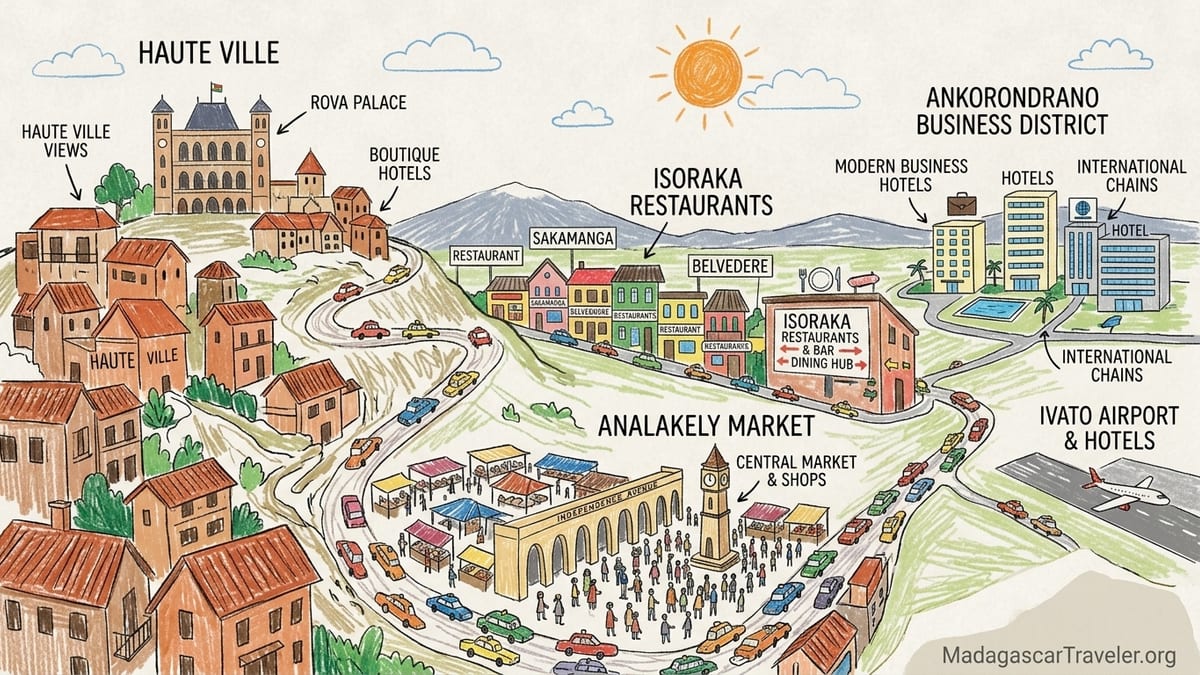
Understanding Antananarivo’s Hotel Zones
Antananarivo is built over a series of hills and valleys, which is why accommodation clusters into a few recognizable pockets rather than one continuous downtown. The traditional heart is Haute Ville, the Upper Town that grew around the royal Rova on Analamanga hill. Below that, Antaninarenina and Isoraka form a ridge of townhouses, restaurants and mid‑range hotels. Drop further down and you hit Analakely, the commercial valley with Independence Avenue, the main market and the historic train station. To the north, the Ankorondrano and Ivandry corridor has grown into the city’s modern business district, where many international hotel chains have opened. Out by the runway, Ivato caters to travelers with late‑night arrivals, early departures and short layovers.
These areas are not far apart on the map. In light traffic, the drive from Haute Ville down to Analakely might be 10 to 15 minutes, and from central districts out to Ivato Airport around 45 minutes. In practice, congestion on Antananarivo’s narrow streets can double those times, especially around rush hours and in the market valleys. That is why choosing where to sleep based on your flight schedule, sightseeing plans and appetite for walking can be more important than saving a few euros on a room.
Think of Antananarivo’s hotel geography as a trade‑off between character and convenience. Haute Ville and Isoraka give you historic architecture, viewpoints and restaurants, but require a slog to the airport. Ankorondrano and Ivandry put you closer to business facilities and wide roads, though sights are a taxi ride away. Analakely offers gritty central access, markets and local energy, but it is the least relaxing place to sleep. Ivato flips the equation: very handy for the runway, but removed from the city’s cultural life.
Haute Ville & Antaninarenina: History, Views and Classic Hotels
Perched on the highest ridge, Haute Ville is where Antananarivo began and where its skyline is at its most photogenic. Here you find the restored shell of the Rova of Antananarivo and the Andohalo and Faravohitra viewpoints, which look out over a sea of terracotta roofs and rice paddies on the plains beyond. Narrow streets wind between 19th‑century townhouses and churches, and at night the air is cooler and quieter than in the valleys below. A guesthouse like Relais de la Haute Ville occupies a traditional house on the royal hill, while slightly downhill in Antaninarenina, Le Louvre Hôtel & Spa blends a historic building designed by Gustave Eiffel’s office with modern comforts such as an indoor pool and spa.
For visitors who care most about scenery and a sense of place, this is arguably the best base. You can walk down towards Independence Avenue, detouring at the Photography Museum or a café terrace that looks across to Lake Anosy. Expect to pay roughly mid‑range European city prices at the better‑known properties: standard rooms at Le Louvre often sit in the mid double‑digit euro range per night, with breakfast extra, while smaller guesthouses can undercut that significantly. Street food is limited on the hill itself, but taxis up and down are reasonably priced, and there are a few bistros and patisseries in Antaninarenina for coffee or a light dinner.
Traffic is both an advantage and a drawback here. Because you are on a hilltop cul‑de‑sac rather than a through route, there is less night‑time noise from cars and minibuses. On the other hand, reaching the airport means threading back through bottlenecks in the lower town. From Haute Ville to Ivato, many hotels recommend allowing at least 90 minutes in peak periods, even though the journey might take under an hour in the middle of the day. For that reason, some travelers treat Haute Ville as their main base for earlier days in the trip, then switch closer to the airport on their final night.
Isoraka: Restaurant Hub and Sociable Evening Atmosphere
Isoraka climbs the western slope directly below Haute Ville and is famous among both residents and visitors for its concentration of restaurants, bars and small hotels. It is the part of town where many people go out to eat, which makes it attractive if you want to be able to walk to dinner instead of calling a taxi every time. A classic example is Hôtel Sakamanga, a colorful maze of rooms, patios and a small pool, anchored by a popular restaurant and bar that serves everything from Malagasy dishes to steaks and vegetarian plates. Nearby, Belvedere Hotel sits a little higher with broad city views from its terrace restaurant, while mid‑range options like Hotel Brajas or Sole Hotel offer straightforward comfort around a similar price band.
For food‑oriented travelers, Isoraka is the obvious pick. Within a few blocks you can have a Malagasy lunch of romazava stew, an Indian curry, an upmarket French‑Malagasy tasting menu or wood‑fired pizza. Dinner in a good bistro might cost less than in major European capitals, with mains often in the equivalent of 8 to 15 euros and tasting menus somewhat more, though prices fluctuate with exchange rates and inflation. Because there is more foot traffic in the evenings, you will see a mix of visitors, expatriates and locals socializing here compared with the quieter residential feel of Haute Ville.
In terms of walkability and safety, Isoraka and Antaninarenina are generally considered among the better areas for strolling during the day, though many residents still advise using taxis after dark rather than walking long distances. Streets are steep and pavements can be cracked, so sturdy footwear matters. Getting to and from the airport is similar to Haute Ville: in light traffic, allow 45 minutes to an hour, but build in extra time during rush hours or in the rainy season. For a first night in Madagascar when you want to decompress over a proper dinner, Isoraka works particularly well, as long as your arrival time does not fall too late at night.
Ankorondrano & Ivandry: Business District and Modern Comfort
North of the old center, along Route des Hydrocarbures, Ankorondrano and nearby Ivandry feel like a different city. This is where you find newer office buildings, shopping centers and several of Antananarivo’s most modern hotels. Radisson Blu Hotel Antananarivo Waterfront, overlooking an artificial lake development, is a prime example, offering contemporary rooms, an outdoor pool, conference facilities and a fitness center. Nearby, Tamboho Suites and Tamboho Hotel at the Tana Waterfront, as well as the Ibis Antananarivo Ankorondrano, cater heavily to business travelers with meeting rooms, reliable Wi‑Fi and secure parking.
For visitors who prioritize international standards and predictability over heritage charm, this corridor is appealing. Rooms here generally cost more than mid‑range guesthouses in Isoraka or Haute Ville, but you gain in amenities, such as on‑site gyms, business centers and larger breakfast spreads. The surrounding streets are less crowded and chaotic than Analakely, with wider roads and planned developments, although they are not designed for leisurely walking in the same way as the historic neighborhoods. Many guests move between hotel, office, mall and restaurant by short taxi rides rather than on foot.
From a logistics standpoint, Ankorondrano and Ivandry sit on one of the main routes between downtown and Ivato Airport, which can slightly reduce travel time to the runway compared with staying on the hilltops. In good conditions the trip to the airport might fall around 30 to 40 minutes, though you should still allow more. For travelers on multi‑day business trips, or those who plan an early departure south along National Road 7, this location can strike a balance: close enough to the city to taxi in for sightseeing, yet better positioned for road and airport access than the older quarters.
Analakely: Central, Lively and Intense
In the bottom of the main valley, Analakely is Antananarivo’s commercial core. Independence Avenue runs through it from the Soarano train station to the city hall, lined with arcaded buildings, banks and clothing shops. Just off the main drag spreads Analakely Market, a dense web of stalls selling fresh produce, street snacks like mofo gasy rice pancakes, cheap electronics and everything in between. Hotels here tend to be functional rather than atmospheric, such as Tana Hotel on Avenue de l’Indépendance or older properties above shopfronts.
If your priority is being in the middle of everything and you do not mind noise, this can be a convenient base. From Analakely you can walk uphill to Isoraka and Antaninarenina or take short taxi rides to the Rova and other sights. Local eateries, pastry counters and basic restaurants abound, and prices skew lower than in the hilltop dining rooms. However, the area is busy, polluted and prone to traffic jams, especially during commuting hours and pre‑holiday shopping periods. Many residents and guides also warn that pickpocketing is more common in these crowded streets, so it is important to keep valuables out of sight and avoid wandering with cameras and phones in hand.
Because of that chaotic feel, Analakely can be tiring as an overnight base, particularly for first‑time visitors to Madagascar who are still adjusting to the city’s energy. It often works better as somewhere to visit during the day to soak up market life and then retreat from. For a last‑night stay when you are already familiar with the city and want easy access to shops and banks, a central hotel here may still make sense, but many short‑term visitors opt instead for Isoraka or Haute Ville to sleep more peacefully.
Ivato: Airport Convenience for First or Last Nights
Ivato sits around 15 to 20 kilometers from central Antananarivo, beside the international airport that handles most long‑haul and domestic flights. Although the distance is not huge, the road passes through busy suburban strips and bottlenecks, which is why travelers are often told to allow roughly 45 minutes to an hour each way, sometimes more in the late afternoon and early evening. For someone arriving on a late‑night flight or departing very early in the morning, staying near the airport can remove a significant layer of stress.
The area around the terminal has grown into its own small hotel zone, with options ranging from simple guesthouses to modern properties. Places like Fly Inn or Hotel Ivato frequently attract overnight passengers, partly because many offer pre‑arranged airport transfers and flexible check‑in times. Restaurants in this zone tend toward hotel dining rooms and a few independent eateries, so you will not find the same variety as in Isoraka, but you gain the comfort of being a five to ten minute drive from check‑in counters rather than facing the city’s traffic maze before sunrise.
As a base for sightseeing, however, Ivato is not ideal. Reaching the Rova, Independence Avenue or Antananarivo’s main museums means repeating the airport commute in reverse, which can eat up half a day once you factor in traffic and waiting for taxis. That is why many itineraries treat Ivato as a practical bookend: arrive late at night, sleep near the airport, then move into town the next morning; or enjoy the city center for most of your stay, then shift back out to an airport hotel for the last night before an early flight. For domestic connections with tight layovers or potentially unreliable schedules, staying close to the runway can also provide a buffer against delays.
Traffic, Walkability and Matching Neighborhoods to Your Itinerary
Traffic shapes almost every decision in Antananarivo, and it is worth planning where you sleep around how often you want to be in a car. The same journey can take 30 minutes or 90 depending on the time of day, weather and ad hoc blockages. Morning and late afternoon rush hours are particularly slow on the major arteries leading into Analakely and across the city’s few bridges. Streets in the historic center are narrow and steep, so two vehicles stuck nose‑to‑nose can hold up a whole block. In contrast, the newer roads in Ankorondrano and around Ivato tend to be wider, though still busy.
In terms of walkability, Haute Ville, Antaninarenina and Isoraka are the most enjoyable districts to explore on foot for many visitors. Distances are short and there is something to look at on almost every corner, from historic facades to small neighborhood shops. The downside is that climbs can be punishing, especially under the midday sun, and pavements may be uneven. Analakely is flat and central but overwhelming; it works best for targeted walks to and from specific markets or banks rather than aimless wandering. Ankorondrano and Ivandry have some sidewalks along their main avenues, yet the environment is more utilitarian, built for cars and offices rather than pedestrians. Ivato’s surroundings are semi‑rural and spread out, so most guests rely on hotel shuttles or taxis.
For first‑night versus last‑night stays, a simple rule of thumb helps. If you land in daylight hours and are not too exhausted, heading straight into Isoraka or Haute Ville gives you an immediate sense of being in Madagascar’s capital, with dinner options on your doorstep and easy taxi access to viewpoints the next morning. If you arrive after dark, or if your onward domestic flight leaves early the next day, an Ivato hotel can be the safer and calmer option, letting you adjust to the country without facing its capital’s rush‑hour traffic immediately. For departures, many travelers now budget one night near the airport at the end, particularly if their international flight leaves before mid‑morning.
Which Area Is Best for You
Choosing a base in Antananarivo is less about finding the single “best” neighborhood and more about matching the city’s distinct hotel zones to the shape of your trip. If you are curious about Madagascar’s history and want to wake up with sweeping views, Haute Ville and Antaninarenina make sense. Boutique guesthouses carved out of historic homes offer character, and you can walk or taxi to the Rova, museums and lakefront viewpoints in minutes. The price you pay is longer, sometimes unpredictable drives to and from Ivato Airport.
If food and a relaxed evening atmosphere are your priorities, Isoraka stands out. Staying at a place like Hôtel Sakamanga or Belvedere puts a wide range of restaurants within an easy walk and still keeps you close to central sights. You can dip into Analakely for markets in the day, then climb back up the hill to a quieter, more convivial scene at night. For business trips, conference visits or travelers who simply want large modern rooms and facilities, Ankorondrano and Ivandry are logical: Radisson Blu Antananarivo Waterfront, Tamboho and Ibis Ankorondrano bring international chain reliability, though you will spend a little more and see a bit less of old Tana on your doorstep.
Analakely suits more experienced or budget‑focused travelers who do not mind noise and crowds in exchange for rock‑bottom street food prices and direct access to buses, markets and services. For almost everyone else, it is a place to visit rather than to sleep. Finally, Ivato is the pure convenience choice, ideal for that jet‑lagged first night or nervous last night when making a flight matters more than city views. By consciously deciding whether each night of your itinerary is about exploration, business, markets or logistics, you can stitch these areas together into a stay in Antananarivo that feels intentional rather than improvised.
The Takeaway
Antananarivo’s hotel districts mirror the city itself: layered, sometimes challenging, but full of character if you choose your vantage point carefully. Haute Ville and Antaninarenina reward travelers who stay long enough to enjoy hilltop breezes, old townhouses and royal history. Isoraka adds lively restaurants and sociable courtyards, making it an easy favorite for many first‑time visitors. Ankorondrano and Ivandry answer the needs of business travelers and those who want modern comforts and slightly better road access, while Analakely shows the bustling everyday city in all its noise and color.
Ivato, finally, is less a destination than a pressure valve. It allows you to step outside the traffic equation when flight schedules leave no room for delays. By weighing up traffic, walkability, restaurant access, airport proximity and what you want from your first and last nights in Madagascar, you can turn Antananarivo from a mere transit point into a memorable part of your journey, without being caught off guard by its logistics.
FAQ
Q1. Which area of Antananarivo is best for a first‑time visitor?
For most first‑time visitors, Isoraka or Haute Ville work best, combining atmosphere, access to main sights and a good choice of restaurants within short taxi or walking distance.
Q2. How long does it take to get from the city center to Ivato Airport?
In light traffic the drive can be around 45 minutes, but at busy times many travelers sensibly allow up to 60 to 90 minutes each way to avoid missing flights.
Q3. Is it safe to walk around Isoraka and Haute Ville at night?
These areas are among the more comfortable for walking, but most residents still recommend using taxis after dark, keeping valuables discreet and sticking to well‑lit main streets.
Q4. Are there modern international‑standard hotels in Antananarivo?
Yes. Radisson Blu Antananarivo Waterfront, Tamboho Hotel, Ibis Antananarivo Ankorondrano and similar properties in Ankorondrano and Ivandry offer modern rooms and business facilities.
Q5. Should I stay in Analakely to be central?
Analakely is very central and practical for markets and banks, but it is noisy, crowded and more prone to petty theft, so many visitors prefer to sleep in Isoraka or Haute Ville instead.
Q6. When does it make sense to stay near Ivato Airport?
Staying in Ivato is a good idea for very late arrivals, very early departures or tight domestic connections when you want to avoid unpredictable city traffic before a flight.
Q7. Is Antananarivo walkable between the main hotel areas?
Distances between Haute Ville, Isoraka and Analakely are relatively short, but the hills are steep and pavements uneven, so be prepared for climbs and use taxis when tired or after dark.
Q8. Where should business travelers stay?
Business travelers often choose Ankorondrano or Ivandry, where modern hotels cluster near offices and shopping centers and have better access to main roads to the airport.
Q9. Is it worth changing hotels for the last night before flying out?
Many itineraries include a last night in Ivato or Ankorondrano specifically to shorten the journey to the airport and reduce the risk of missing an early‑morning international flight.
Q10. Can I use one neighborhood as a base for all sightseeing?
Yes. With enough time in your schedule, you can base yourself in Isoraka or Haute Ville and reach most sights by short taxi rides, accepting that occasional traffic delays are part of the experience.